In the early morning of January 24, a fire engulfed the apartment of 32-year-old N.T.L. in a condominium in Long Truong Ward of HCMC. When neighbors broke down the door to rescue the victims, they discovered Mrs. L. and her two daughters unconscious due to smoke inhalation.
Nguyen Huy V., a resident who participated in the rescue, recounted that the situation was extremely tense. The group split up: one team focused on calling firefighters and extinguishing the blaze, while another called the 115 Emergency Center and administered first aid.
Fortunately, some residents were medical professionals, so they immediately performed artificial respiration and chest compressions while waiting for the ambulance from Le Van Thinh Hospital. The professional emergency crew arrived and continued advanced cardiopulmonary resuscitation (CPR) measures successfully before transferring the victims to the hospital.
“If the residents hadn’t had the professional skills for chest compressions and artificial respiration, I dare not imagine what the consequences would have been,” Mr. V. recalled.
Recently, the HCMC 115 Emergency Center received an emergency call from a badminton court in Binh Dong Ward. A 52-year-old man, while playing, suddenly felt tired, vomited, became drowsy, collapsed, and fell unconscious. Identifying this as a case of cardiac and respiratory arrest, the 115 Center operator immediately guided the caller to stay calm and perform chest compressions on the victim while waiting for the emergency team.
After about 7 minutes, the team arrived at the scene and performed advanced CPR, including four defibrillation shocks. As a result, the patient’s pulse returned. He was transferred to Cho Ray Hospital for specialized treatment with a diagnosis of acute myocardial infarction. Overcoming the critical condition, the man was discharged in a stable and alert state.
“This is one of the cases of complete recovery after circulatory arrest thanks to the timely activation of the emergency chain, from the calmness of the initial public support and guidance from the 115 Switchboard to the professional intervention of the emergency team and the hospital. Proper first aid in the first few minutes can determine the survival of the victim,” shared Level-II Specialist Nguyen Duy Long, Director of the HCMC 115 Emergency Center.
According to Assoc Prof Nguyen Hoang Hai, MD PhD, Director of Gia Dinh People’s Hospital, sudden death due to out-of-hospital cardiac arrest is one of the leading causes of death worldwide. In the US, there are 300,000–400,000 cases of sudden cardiac arrest annually, but the survival rate is only about 10 percent.
The main reasons are late detection, a lack of bystanders with initial first aid skills, and a lack of on-site handling equipment. In community cardiac arrest emergencies, an Automated External Defibrillator (AED) is a “weapon” that can increase survival rates to 50-70 percent if used within the first 3-5 minutes. If the professional emergency system cannot access the site immediately, this “golden time” is the patient’s opportunity.
“Parallel to equipping Automated External Defibrillators (AEDs) for crowded areas like the metro line, we also organize cardiac arrest emergency training for staff here, ensuring passengers are medically safe.”
Assoc Prof Nguyen Hoang Hai, MD PhD
Currently, stations on Metro Line No.1 (Ben Thanh – Suoi Tien) in HCMC have been equipped with 6 AEDs to respond to medical emergencies. The devices feature Vietnamese instructions via images and audio, allowing even those without medical expertise to use them easily.
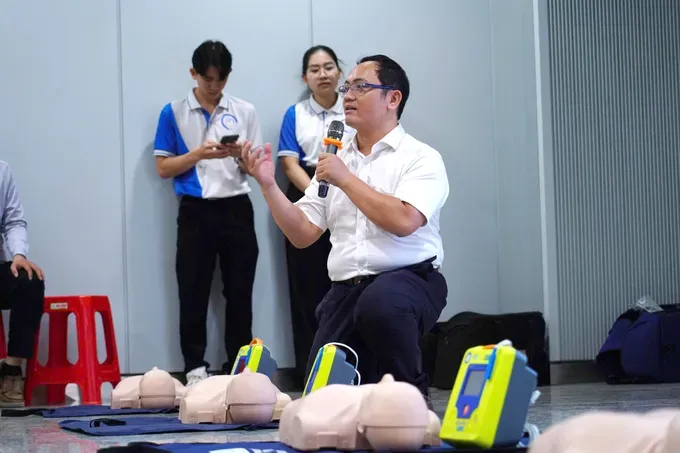
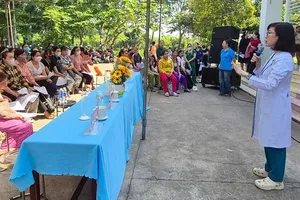
To replicate first aid skills within the community, the HCMC 115 Emergency Center frequently organizes training classes to improve citizens’ initial response capabilities to medical emergencies. According to Level-II Specialist Nguyen Duy Long, emergency experts provide specific guidance on first aid skills for common life situations such as cardiac arrest, respiratory arrest, choking on foreign objects, trauma, and bleeding.
Trainees practice directly on models and in hypothetical scenarios, receiving guidance on every step and on-the-spot technical correction. Direct practice helps citizens reduce anxiety and stay calm to act correctly in real situations. “Every citizen equipped with first aid skills adds an important ‘link’ to the emergency chain, giving patients one more chance at life before professional medical forces arrive at the scene,” Level-II Specialist Nguyen Duy Long emphasized.




)