1,700 points seen as nearest support
Vietnam's stock market reversed lower last week after two consecutive weeks of gains, as selling pressure intensified near the key 1,800-point resistance level.
The VN-Index fell 38.98 points, or 2.2 percent, to 1,729.08, while the HNX-Index lost 13.45 points, or 4.58 percent, to close at 279.99.
An analyst at VPBank Securities (VPBS) said the market's final session of the week delivered a notably bearish signal, with the VN-Index forming a long red candle, breaking below its 20-day moving average (MA20), and losing 36.55 points on heavy trading volume.
Part of the selling pressure stemmed from shares bought during the previous market bottom around 1,650 points becoming available for trading, the analyst said.
On the weekly chart, however, trading volume did not surge excessively. This suggests the VN-Index could retest the 1,680-1,700 range this week, an area that also marks the lower boundary of the broader trading range.
Vietcombank Securities (VCBS) similarly noted that the VN-Index ended last week with a steep red candle and fell below the MA20, indicating mounting selling pressure and weakening demand.
Technical indicators signal further downside risks, with the MACD and RSI turning lower and the ADX and -DI staying above 25, suggesting the downtrend may persist. The 1,700-point mark is the nearest key support.
On the hourly chart, technical indicators continued to deteriorate. Although the RSI had entered oversold territory, signs of a short-term technical rebound remained unclear because bottom-fishing demand was still weak.
The market is therefore likely to remain under corrective pressure in the next trading session, VCBS said.
Preserving buying power is key
Amid heightened volatility, analysts recommended that investors focus on risk management and closely monitor market movements so they can adjust their strategies promptly.
Investors should also review their portfolios and restructure positions, particularly stocks that have reached predetermined stop-loss levels. Preserving cash reserves and maintaining discipline will put investors in a stronger position to capitalize on any market rebound.
A Vietcap analyst said two consecutive long red candles at the end of last week signaled that sellers remained firmly in control.
Over the next one to three sessions, the VN-Index could retest 1,750 points. If demand at that level proves insufficient, the index could extend its decline, the analyst said.
Another key event for investors this week will come on August 21, when global index provider FTSE Russell is expected to announce the results of its September 2026 semi-annual review of the FTSE Global Equity Index Series (FTSE GEIS), including the list of companies eligible for inclusion in relevant indexes.
FTSE Russell has previously confirmed that Vietnam will be upgraded from Frontier Market status to Secondary Emerging Market status, with the reclassification expected to take effect on September 21, 2026.
The upgrade could provide a source of optimism for the domestic market, the Vietcap analyst said. If the VN-Index holds above 1,750 points, it could move sideways while investors assess the next direction.
Conversely, a break below that threshold would increase the probability of further declines.
A recovery could emerge if market conditions stabilize, large-cap stocks such as VIC and VHM avoid another deep sell-off, and market breadth improves. However, the VN-Index would need to break above the 1,800-point area to confirm a new uptrend.
Vietcap recommended that investors reduce their margin exposure to safer levels and refrain from rushing into bottom-fishing trades while selling pressure remains strong, limiting the risk of attempting to catch a falling knife.
In terms of sector allocation, analysts at Rong Viet Securities (VDSC) continued to rank banking among their preferred sectors. However, they favored a stock-selection approach rather than increasing exposure to the banking sector as a whole.
Rubber, construction, and construction materials were also viewed favorably for potential overweight positions, as valuations have become more attractive following the recent correction and first-half 2026 earnings showed encouraging growth.
Commodities, industrial services, and steel remain on investors' watchlists. Although these sectors received relatively high ratings, they would require either more attractive valuations or additional near-term catalysts to strengthen their appeal.
VDSC advised maintaining only limited exposure to residential real estate and adopting a cautious stance. Within food and beverage and retail, only selected stocks with favorable prospects were recommended.
Based on its analysis, VDSC highlighted DGW, PHR and CTI as stocks for investors to consider in the coming period.
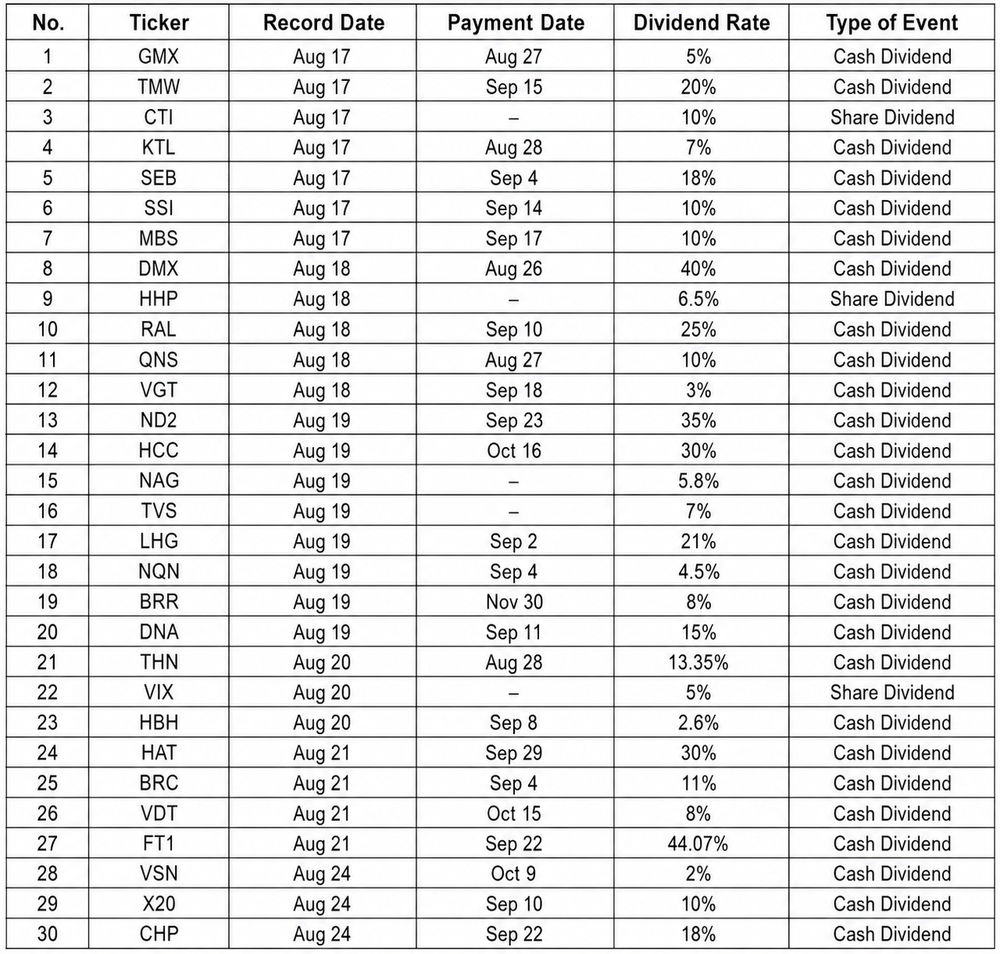
30 companies set dividend record dates
From August 17 to 21, 30 listed companies are expected to set record dates for dividend payments, including SSI, MWG, VIX, and MBS.