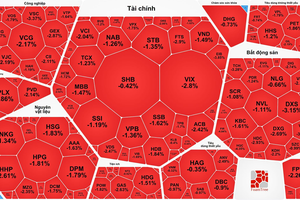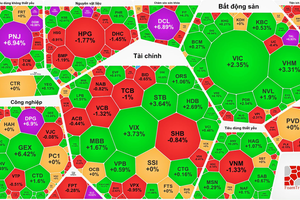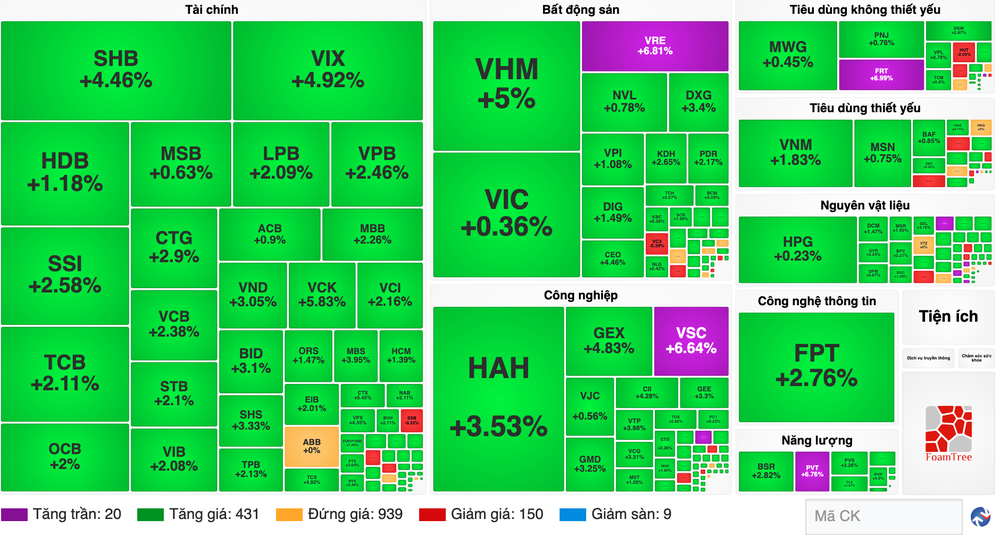
By the end of the morning session, the VN-Index had gained 30.8 points, or 1.43 percent, to 1,735.48 points. Advancers outnumbered decliners 246 to 60, while 38 stocks were unchanged.
On the Hanoi Stock Exchange, the HNX-Index climbed 2.3 points, or 0.85 percent, to 273.98 points, with 70 stocks advancing, 40 declining, and 52 standing still.
Combined trading value on the HOSE and HNX exceeded VND10.2 trillion, with HOSE accounting for nearly VND9.8 trillion. Gains were broad-based, with several real estate, consumer, and oil-and-gas stocks hitting their daily upper limits, including VRE, FRT, VSC, and PVT.
Foreign investors also returned as net buyers on HOSE, purchasing a net VND279 billion and ending a seven-session selling streak.
Analysts attributed the market's resilience primarily to domestic economic fundamentals and strong local liquidity.
Ms. Le Thi Hang, Head of the Trading Division at VPBank Securities, told SGGP Newspaper that the Fed's decision to maintain its policy rate at 3.5-3.75 percent was broadly anticipated. However, cautious comments by Fed Chair Kevin Warsh pushed US Treasury yields and the US dollar higher, weighing on global equity markets.
Vietnamese equities remain supported by stable macroeconomic conditions, improving GDP growth, public investment, exports, and consumer spending, which are strengthening expectations for corporate earnings, Ms. Le Thi Hang said. Domestic liquidity remains the key driver, while the prospect of a market upgrade is attracting medium- and long-term capital.
She also noted that the VN-Index has fallen nearly 300 points from its May 2026 peak of 1,933, bringing many stocks into more attractive valuation territory. Vietnam's market valuations are also considered relatively low compared with regional peers when measured against earnings-growth prospects.
“Vietnam's market may maintain its positive trend in the short term, although sharper bouts of volatility are likely,” Ms. Le Thi Hang said.
Mr. Nguyen The Hoai, Director of the Dong Nai branch of Rong Viet Securities, identified three additional supports: stable interest rates and system liquidity maintained by the State Bank of Vietnam, easing exchange-rate pressure compared with earlier this year, and improved second-quarter earnings at many companies while share prices remain attractive.
However, Mr. Nguyen The Hoai cautioned that the market has yet to achieve a decisive breakout because liquidity remains limited. Buying demand has mainly emerged during market dips, suggesting investors remain reluctant to chase higher prices.
He expects the VN-Index to continue fluctuating around the 1,700-point level, within a range of roughly 30 points.