The seminar, titled Restructuring Capital Mobilization Channels, was jointly organized by the Ministry of Finance's Finance and Investment newspaper, the State Securities Commission (SSC), and industry partners.
Speaking at the event, SSC Vice Chairman Bui Hoang Hai said Vietnam will require an estimated VND38 quadrillion (US$1.45 trillion) in investment capital during 2026-2030 to sustain high and stable economic growth. The State budget is expected to cover only VND8.5 quadrillion, or about 20 percent of total demand, leaving the remainder to be financed by the private sector and international investors.
The Ministry of Finance aims to mobilize around VND5.4 quadrillion during the period, more than double the amount raised between 2020 and 2025. Achieving that target will require a comprehensive restructuring of capital mobilization channels, with the stock market expected to play a central role in providing medium- and long-term funding.

Ms. Dang Nguyet Minh, Research Director at Dragon Capital, said Vietnam continues to offer compelling fundamentals for global investors, including robust GDP growth, improving corporate earnings prospects, a more favorable business environment, and the potential for a market status upgrade. Despite these advantages, foreign portfolio investors have continued to record net outflows.
According to Ms. Dang Nguyet Minh, the market faces two structural bottlenecks.
The first is an imbalance in the composition of listed companies. Vietnam's equity market lacks the high-quality investment opportunities sought by long-term institutional investors. Financial and real estate firms now account for 68 percent of total market capitalization, up from 56 percent in 2020, while manufacturing has declined from 21 percent to 15 percent and services from 17 percent to 11 percent. High-growth sectors such as advanced technology and large-scale consumer businesses remain underrepresented, leaving the market less diversified than more mature markets such as Taiwan and South Korea.

The second challenge is the absence of a strong domestic long-term investor base. Retail investors still account for 85-90 percent of trading value, making the market more vulnerable to herd behavior and sharp price swings. Meanwhile, capital from pension funds, life insurers, and open-ended funds remains limited, leaving a significant gap in long-term domestic financing.
Mr. Nguyen Son, Chairman of the Vietnam Securities Depository and Clearing Corporation, said the Ministry of Finance is seeking public feedback on a draft decree governing public bond offerings by public-private partnership (PPP) project companies. The proposal is expected to create a more flexible legal framework for infrastructure financing while expanding investment opportunities in the capital market.
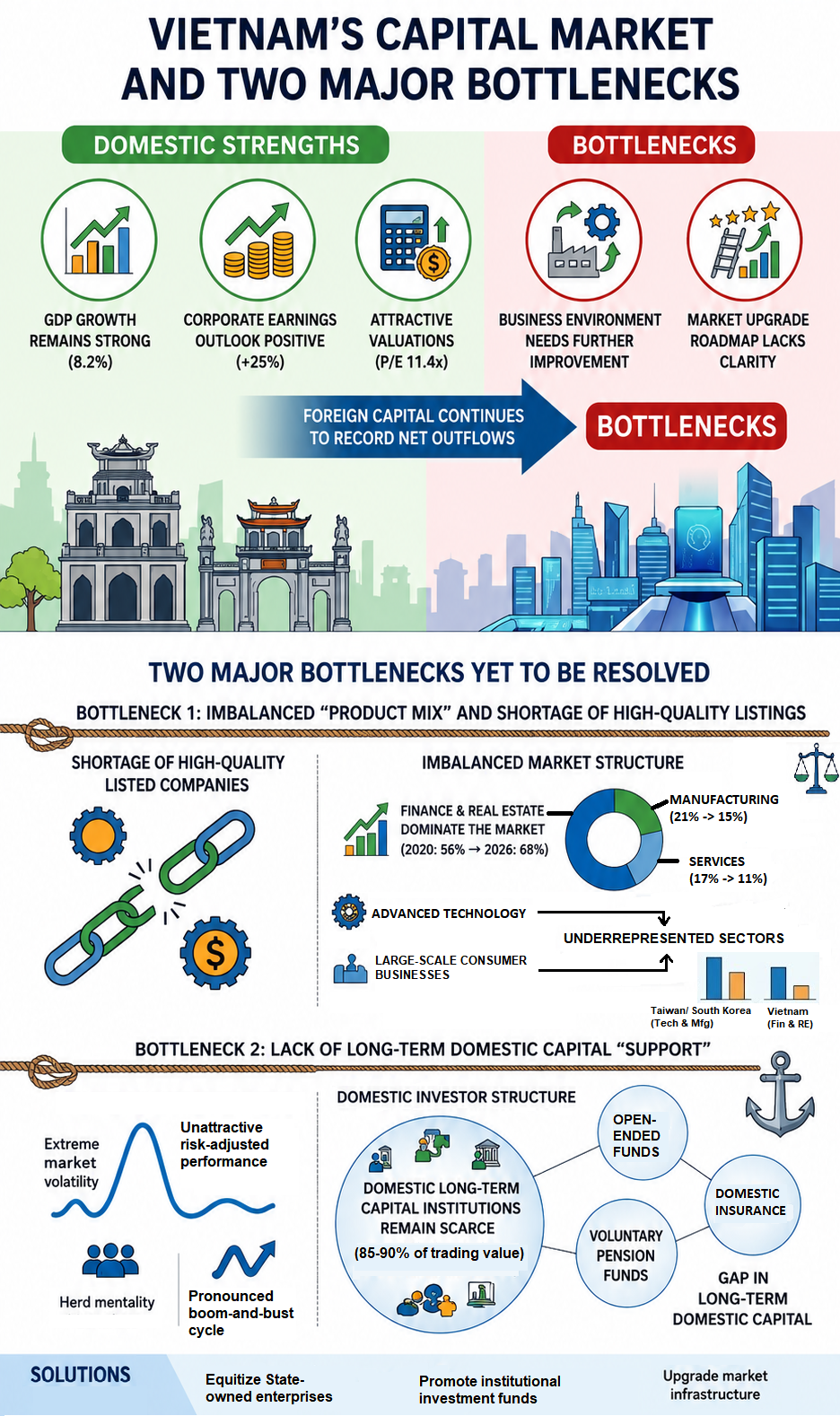
Experts agreed that strengthening Vietnam's capital market will require coordinated reforms, including increasing the supply of quality listed assets, expanding the domestic institutional investor base, and further improving market infrastructure and the regulatory framework.