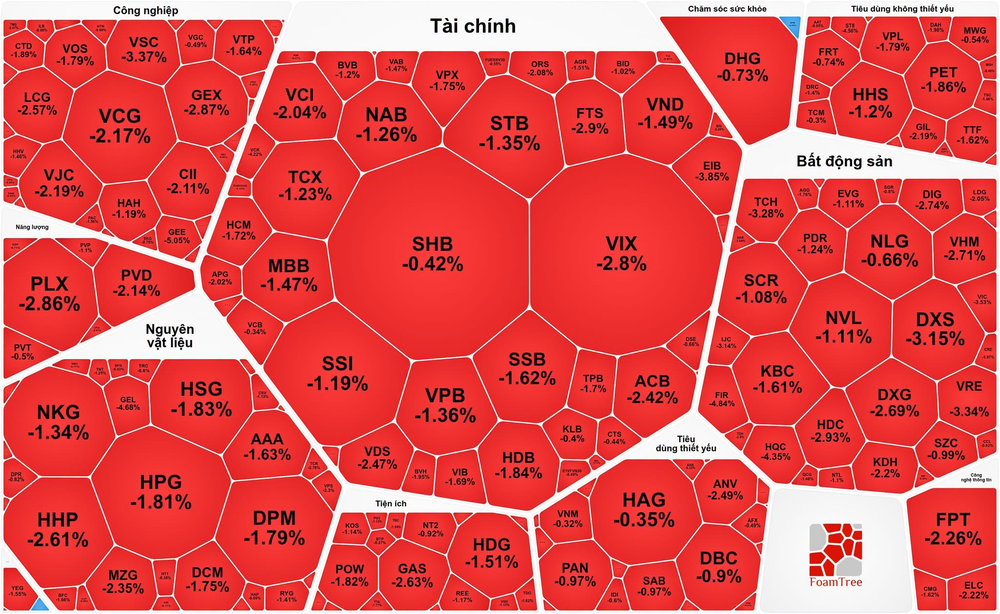
The domestic stock market tumbled on August 13 even as global equities broadly advanced, with decliners overwhelmingly outnumbering gainers.
Blue-chip stocks came under heavy selling pressure, weighing heavily on the index. GAS slid 2.6 percent, while HPG retreated 1.81 percent, VCK shed 4.22 percent, and FPT dropped 2.26 percent. Shares of the three Vingroup companies also declined sharply, with VIC down 3.53 percent, VHM 2.71 percent, and VRE 3.34 percent, together erasing more than 16 points from the VN-Index.
Financial stocks, including banks, securities firms, and insurers, also decreased broadly, with several losing more than 2 percent. EIB devalued by 3.85 percent, ACB by 2.42 percent, VCI by 2.04 percent, VIX by 2.8 percent, and ORS by 2.08 percent.
The VN-Index closed 27.55 points, or 1.54 percent, lower at 1,765.63, with 85 stocks advancing, 227 declining, and 60 standing still.
The HNX-Index also lost 5.11 points, or 1.77 percent, to close at 283.34, with 56 gainers, 83 decliners, and 45 unchanged.
Heavier selling lifted trading activity. Turnover on the Ho Chi Minh Stock Exchange (HOSE) reached nearly VND18.7 trillion, up VND4.7 trillion from the previous session. Combined turnover on HOSE and the Hanoi Stock Exchange (HNX) totaled nearly VND19.7 trillion.
Ms. Le Thi Hang, Head of Trading at VPBank Securities, attributed the sharp decline to growing correction pressure after the VN-Index's rapid advance over a short period.
She said the previous session's gains had been driven largely by large-cap stocks, while matched trading value on HOSE stood at just over VND14 trillion, well below the 20-session average. This suggested that liquidity had yet to broaden sufficiently, making the index's rally after breaking above key moving averages less convincing.
On Thursday, weakness in Vingroup stocks added significant pressure, while profit-taking intensified in stocks that had rebounded strongly from their lows. As the VN-Index neared 1,800 points, investor caution increased, triggering broader selling and a steep reversal.
Ms. Le Thi Hang said the decline should nevertheless be viewed in the context of the index's rapid rise from around 1,650 points to nearly 1,800 in a short period, making a sharp correction relatively unsurprising.
"Overall, the current correction is understandable after such a strong rally in a short period. Investors should closely monitor liquidity and the performance of leading stocks to assess whether the market can regain balance," she said.