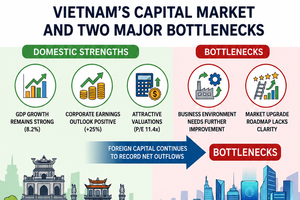
Analysts say, however, that Vietnam's upgrade to secondary emerging-market status is unlikely to trigger an immediate reversal in foreign capital flows.

VN-Index could retreat toward 1,780-1,790
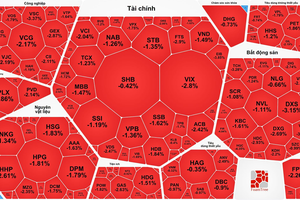
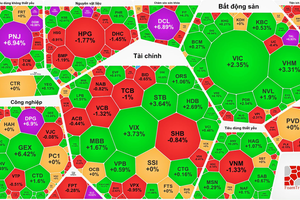
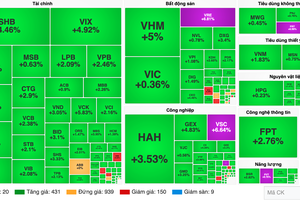
Vietnamese shares suffered a sharp pullback last week, with the benchmark VN-Index losing nearly 58 points, or 3.12 percent, to close at 1,795.21. The HNX-Index fell almost 10 points, or 3.49 percent, to 272.68.
Selling pressure intensified toward the end of the week, pushing the VN-Index below the psychologically important 1,800-point threshold. Securities firms warned that the risk of further short-term correction remains elevated.
Vietcap Securities said the VN-Index could continue retreating toward support at 1,780-1,790 points. Any technical rebound in the coming sessions is likely to face resistance around 1,810 points, it said.
Thien Viet Securities, or TVS, noted that the benchmark is approaching support around its 200-day moving average, corresponding to roughly 1,788-1,790 points. Continued weakness among large-cap stocks, particularly Vingroup-related shares and banks, could drag the market deeper toward 1,770-1,780.
TVS advised investors to maintain their existing equity exposure while closely monitoring price action around that zone. New positions should only be considered after the VN-Index has fully closed the nearby price gap and resumed its upward trend, it said. Should the index break below the projected support range, investors may need to reduce equity exposure to safer levels.
BIDV Securities, or BSC, offered a more cautious assessment, saying the combination of heavier trading volume and the loss of the 1,800-point level could send the VN-Index toward 1,765. The brokerage urged investors to remain conservative in their trading decisions.
Foreign capital unlikely to reverse immediately
FTSE Russell is scheduled to reclassify Vietnam as a secondary emerging market on Sep 21. Yet despite expectations that foreign investors would position ahead of the upgrade, overseas investors have been net sellers in six of the first seven trading sessions of September, recording net sales of more than VND1.5 trillion last week alone.
VDSC Research, the research arm of Rong Viet Securities, said this week marks a peak period for foreign-fund portfolio rebalancing.
The Sep 14-18 trading week is particularly important because the first FTSE GEIS capital allocation coincides with the scheduled rebalancing of the Fubon FTSE Vietnam ETF.
FTSE GEIS-linked funds are expected to deploy about US$211.9 million, while Fubon's rebalancing is estimated to involve around US$103.2 million in trades, equivalent to 28.9 percent of its portfolio.
Mr. Pham Luu Hung, Chief Economist at SSI Research, said foreign investors are still waiting for stronger catalysts before returning to Vietnam's stock market in greater force.
Foreign investors reduced the scale of their net selling in August, but they have yet to contribute significant additional liquidity to the market, he said.
Mr. Pham Luu Hung said that once Vietnam enters the emerging-market universe, capital inflows could come not only from passive funds and exchange-traded funds but also from actively managed investment funds.
SSI Research estimates that if Vietnam maintains a 0.49 percent weighting in the relevant FTSE benchmark, potential capital inflows could reach US$2.2 billion to US$2.3 billion, assuming the size of ETF assets remains unchanged.
Under a more optimistic scenario, Vietnam's weighting could rise to about 0.95 percent within a year. That could lift total inflows above US$4 billion and potentially to around US$4.5 billion.
The key caveat, however, is that passive capital will be deployed gradually rather than entering the market all at once.
MBS Research, the research arm of MB Securities, estimates that more than US$1.8 billion from passive ETFs could eventually be allocated to Vietnamese equities after the country's weighting in the FTSE Emerging All Cap Index rises from 0.329 percent to 0.49 percent.
The expected allocation will be divided into four phases: 10 percent in September 2026, 20 percent in March 2027, 35 percent in June 2027 and the remaining 35 percent in September 2027.
MBS cautioned that the market upgrade does not necessarily mean the VN-Index will rise immediately.
Historical performance in other markets upgraded by FTSE Russell, including Kuwait, Saudi Arabia, Qatar, and the United Arab Emirates, suggests equities may rally ahead of reclassification but can trade sideways or correct afterward. Over the following two to three years, however, market performance has generally improved, although gains have varied considerably across countries.
Mr. Pham Luu Hung said a single wave of post-upgrade inflows would be unlikely to sway the long-term investment decisions of major international funds.
Fund managers will also assess whether Vietnam continues to receive favorable reviews from global index providers and whether the market improves its capacity to absorb larger volumes of international capital.
The months after September will therefore be critical in determining whether the upgrade generates only a one-off burst of investment or marks the beginning of a more sustainable foreign-capital cycle.
Eight bank stocks could attract US$30.9 million
Banking shares are expected to be among the main beneficiaries of the initial FTSE-linked allocation.
In a market strategy report on stocks likely to attract foreign capital through the FTSE GEIS, MBS forecast that eight Vietnamese banks - VPB, VCB, STB, HDB, SHB, SSB, BID, and MSB - could receive a combined US$30.9 million during the first phase of ETF allocations.
VPB is expected to attract the largest inflow at about US$7.5 million, followed by VCB with US$6.3 million, STB with US$4.9 million, and HDB with US$4.3 million.
SHB is projected to receive US$2.2 million, while SSB and BID could each attract about US$2 million. MSB is expected to draw approximately US$1.7 million.
The eight bank stocks are among 27 Vietnamese equities selected by FTSE Russell for inclusion in the FTSE Global Equity Index Series during its September 2026 review.
MBS estimates that ETFs will allocate about US$180 million across the 27 stocks in the initial phase, with banking shares accounting for US$30.9 million of the total.