VN-Index faces key test at 1,680–1,700 points
Last week, the VN-Index fell more than 101 points, or 5.67 percent, from the previous week, dropping below the 1,700-point mark to close at 1,688.11 points. However, securities firms said it is still too early to conclude that the market's downtrend has ended.

In the short term, the 1,680-1,700-point range will serve as a key support zone. If the index fails to hold above this level, it could retreat to the 1,650-1,670-point range.
According to Viet Dragon Securities (VDSC), the 1,680-1,700-point range will play a critical role in the near term. If the VN-Index remains above this level and market liquidity improves across a broader range of sectors, the market will be more likely to establish a stable trading range.
Conversely, if external headwinds continue to intensify, the index could come under further downward pressure. VDSC said the market absorbed most outstanding margin debt during last week's sell-off, significantly reducing the likelihood of the VN-Index falling back to the 1,600-point level. A more likely scenario is that the market will enter a consolidation phase before establishing a new trend.
SSI Securities said selling pressure remains strong, making every rebound vulnerable. However, the 1,650-1,660-point support zone remains intact, while momentum indicators have begun to improve, reinforcing the importance of that support level. If it continues to hold, the VN-Index could extend its technical rebound toward 1,700-1,720 points.
Saigon-Hanoi Securities (SHS) also believes the VN-Index could stabilize and recover within the 1,650-1,670-point range.
Valuations reach historic lows, raising recovery hopes
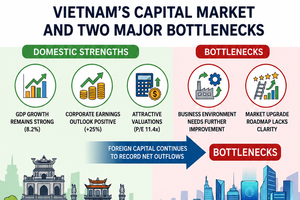
The country's stock market is experiencing one of its most volatile periods in years, with about 83 percent of listed stocks trading below their prices at the beginning of 2026. At the same time, valuations have fallen to their lowest levels in years, creating potential opportunities for medium- and long-term investors.
According to SHS, excluding Vingroup stocks, the market capitalization of the rest of the market has fallen back to the lows recorded in April 2025, when the market was hit by the previous tariff shock.
Notably, while many companies continue to post earnings growth, about 60 percent of listed stocks are trading below book value, with price-to-book (P/B) ratios below one. Many fundamentally strong companies are trading at price-to-earnings (P/E) ratios of just four to seven times, well below historical averages.
Ho Chi Minh City Securities Corporation (HSC) estimates that many leading stocks have returned to attractive price levels after the sharp decline. Banking stocks including VCB, CTG, EIB, and TPB have fallen to their lowest levels in about a year.
Among securities firms, SSI, VIX, and VCI have also retreated to multi-month lows. Meanwhile, KDH has returned to price levels last seen at the end of 2022, while NLG has fallen back to early 2023 levels.
PNJ and DGC have dropped to their lowest levels since 2021, mainly because of concerns over legal risks and corporate governance.
Even so, analysts said attractive valuations alone are not enough to draw investors back into the market while leverage-related pressure remains.
They said there is not yet sufficient evidence to confirm that forced selling from margin calls has eased significantly. However, the sharp decline in stock prices to attractive valuation levels is expected to provide a foundation for a market recovery.
Head Nguyen Thi My Lien of the Research Division at Phu Hung Securities (PHS) said the market is not lacking fundamental support but rather a sufficiently strong catalyst to revive capital inflows. With geopolitical risks and uncertainties surrounding tariff policies still present, investor caution continues to dominate market sentiment.
Although analysts remain optimistic about the medium- and long-term outlook, they believe the market is likely to enter a consolidation phase before a new trend emerges.
To manage risks, Director Le Dieu Linh of investment advisory at Viet Dragon Securities recommended that investors maintain reasonable leverage levels and focus on accumulating shares of fundamentally strong companies rather than increasing margin borrowing during technical rebounds.
24 listed companies set dividend record dates
Between July 27 and July 31, 24 listed companies will finalize shareholder lists for dividend and bonus distributions, with several offering high cash dividend payouts.
Noi Bai Cargo Service JSC (NCT) will pay a cash dividend of 80 percent, or VND8,000 per share, with a total estimated payout of about VND209 billion (US$7.96 million).
Sonadezi Long Binh JSC (SZB) will pay a cash dividend of 45 percent, or VND4,500 per share, totaling about VND135 billion.
Saigon Beer-Alcohol-Beverage Corp. (Sabeco, SAB) will distribute a cash dividend of 30 percent, or VND3,000 per share, with an estimated payout of about VND3.84 trillion.
Viglacera Corporation (VGC) will pay a cash dividend of 22 percent, or VND2,200 per share, with a projected total payout of about VND986.4 billion.