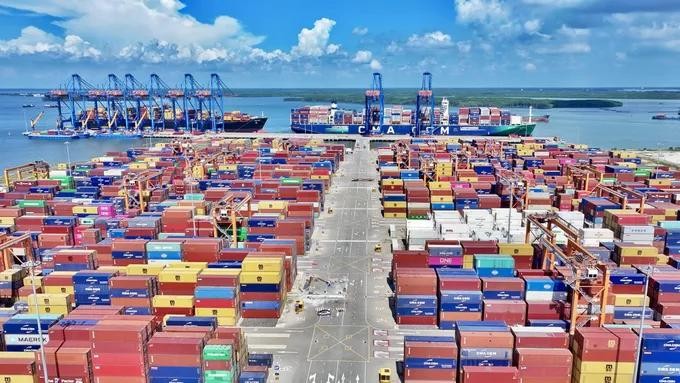
From green logistics and digital ports to maritime blockchain platforms and logistics finance, Vietnamese companies are rolling out a range of initiatives to strengthen competitiveness and build a modern maritime economy integrated into global supply chains.
Major export markets are continuously raising standards on carbon emissions, traceability, and sustainable development, requiring Vietnamese businesses to adapt to maintain their competitiveness.
One of the flagship projects is Vietnam's first electric barge service, jointly developed by Gemadept Corp. and CMA CGM, the French multinational shipping and logistics group, on the Cai Mep–Thi Vai route.
Pham Quoc Long, Deputy Chief Executive Officer of Gemadept, said the electric barge is expected to reduce carbon dioxide emissions by about 778 metric tons annually on each 180-kilometer round trip while transporting approximately 50,000 TEUs a year.
To support the electric barge's operations, Gemalink Port will invest in a solar power system capable of generating about 1 gigawatt-hour of renewable electricity annually. The system will supply charging stations while contributing to CMA CGM's goal of achieving net-zero emissions by 2050. The project is expected to begin operations in 2027.
Pham Hong Diep, Chairman and Chief Executive Officer of SHINEC, said green logistics extends beyond low-emission transportation and should be integrated across the entire supply chain through a circular economy model, from industrial parks and seaports to multimodal transportation systems.
He said the biggest obstacle to developing green logistics is investment capital and expressed hope that a logistics finance center within the Vietnam International Financial Center in Ho Chi Minh City would provide additional resources to support the green transition.
From the perspective of port operators, Ngo Thi Thanh Vy, Deputy Chief Executive Officer of QTM International Port, said the company incorporated environmental, social, and governance (ESG) standards into its development strategy from the outset. Research and deployment of green energy solutions and sustainable connectivity have been identified as key priorities for building a green port model that meets international market requirements and supports the sustainable development of the port and logistics sectors.
Digital maritime ecosystem development
Industry representatives said logistics management today involves more than data exchange, increasingly relying on artificial intelligence, big data, and automation to enable real-time operations.
Pham Anh Tuan, Chief Executive Officer of Portcoast, said developing a national digital port system is a strategic step toward strengthening Vietnam's maritime economy.
He said a digital port consists of two key components: digital infrastructure and digital operational management systems. Technologies including the Internet of Things, Scan-to-BIM, Building Information Modeling, and ArcGIS are being used to create digital twin models of ports.
The digital twin allows operators to simulate all port activities in real time, from vessel traffic and cargo handling to emergency situations, supporting planning and operational optimization. Portcoast has already deployed a digital twin for the Cai Mep–Thi Vai deep-water port system.
Chief Executive Officer of Portcoast Pham Anh Tuan added that many port operators are linking their operational management systems with the Port Community System to enable data sharing among logistics companies, shipping lines, and government agencies. Digital ports are expected to improve transparency, shorten administrative processing times, and enhance supply chain reliability.
The Ministry of Construction is proposing a range of incentives in the draft Vietnam Maritime and Inland Waterways Code. Investors developing green seaports, inland waterway ports, and vessels powered by clean fuels could receive exemptions or reductions in land lease fees, access to preferential credit, and other support policies.
The combination of supportive policies, digital transformation, and green logistics development is expected to provide a foundation for Vietnam's port system to become more modern, intelligent, and sustainable, strengthening the competitiveness of the logistics sector and positioning the maritime economy as a key driver of international economic integration.
Alongside the digitalization of ports, Ho Chi Minh City is developing a digital maritime finance ecosystem under the International Maritime Financial Center model.
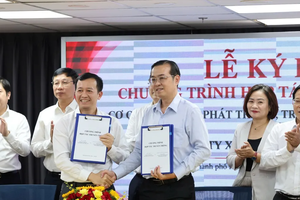
Recently, the Executive Agency of the Vietnam International Financial Center in Ho Chi Minh City and Gemadept signed a strategic memorandum of understanding and introduced a Maritime Community Information System and a blockchain-based maritime trading platform.
Deputy Chief Executive Officer of Gemadept Pham Quoc Long said one of the logistics sector's biggest bottlenecks is its continued reliance on paper documentation, which prolongs verification procedures, increases the risk of discrepancies, and raises costs. The blockchain platform is intended to digitize trade documents, apply smart contracts, and automate transactions.






)