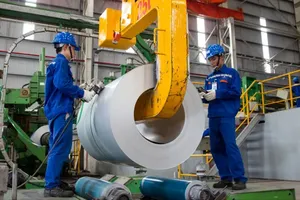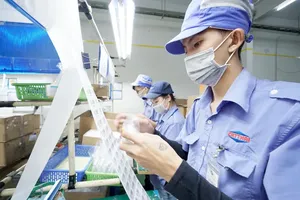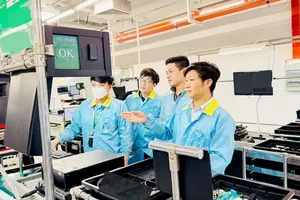
Artificial intelligence (AI) is transforming the way people work and raising new expectations for employees. To remain employable, workers must continuously upgrade their skills. Businesses, meanwhile, also need to take a proactive role in training and developing their workforce.
Workers upgrade their skills
According to a study by the International Labour Organization (ILO), about 11.5 million workers in Vietnam, which is equivalent to one-fifth of the country's workforce, could be affected by generative artificial intelligence (GenAI). Of those, around 1 million hold highly standardized jobs that could be fully replaced by AI. Geographically, workers in Hanoi, Ho Chi Minh City, and Da Nang account for more than one-third of all jobs nationwide that are vulnerable to AI-related disruption.
Those figures have placed growing pressure on workers to continuously improve their capabilities and develop new skills. In Ho Chi Minh City, many employees have taken the initiative to acquire digital skills and update their technological knowledge to meet increasingly demanding labor market requirements.
Nguyen Duc Tung, who works in the information systems department at Nidec Vietnam Company in the Ho Chi Minh City High-Tech Park, said he constantly reminds himself to "upgrade" his skills because AI and automation could replace repetitive tasks if he fails to adapt. In addition to attending short-term training courses, worker Tung has independently researched and proposed a number of initiatives to improve work processes. Among them is an equipment management system (AMS) that he developed, which reduced inventory time from three months to one month, cut the equivalent of eight worker-days of labor for each inventory cycle, and saved the company about 200 million dong in outsourced software development costs.
Concerned about AI's potential impact on her job, Nguyen Thanh Loan, an administrative employee at a company in Phu Nhuan Ward, Ho Chi Minh City, has spent more than a year enrolling in short-term courses to strengthen her technology skills.
"After taking several courses, I realized that AI should not be viewed as an 'enemy.' Instead, we need to become 'colleagues,'" Loan said.
Businesses adapt as well
Businesses are also taking proactive steps to adapt to digital transformation. Rather than waiting to recruit workers who already possess the required skills, many companies are expanding on-the-job training in digital skills and machine operation.
Juki Vietnam Company, based in Tan Thuan Ward, Ho Chi Minh City, has organized short-term training courses to help employees improve both their technical skills and technological expertise.
At Printing No. 7 Joint Stock Company in Tan Tao Ward, Ho Chi Minh City, the company is preparing to import a new-generation printing press from Japan. It has selected experienced and highly skilled employees to travel to Japan to learn how to operate and manage the equipment. The initiative is one of many ways the company invests in workforce development.
In addition to overseas training, the company organizes six to eight training courses each year, inviting instructors from reputable vocational schools. It also encourages experienced employees to mentor newer staff, including training machine operators to become lead operators. Office employees, in addition to production workers, receive training on using AI-powered office applications.
Alongside efforts by workers and businesses, the Ho Chi Minh City Employment Service Center has stepped up its analysis of labor market trends and the provision of information by industry and skill level to improve job matching. Going forward, the center will focus on strengthening labor supply-demand matching, helping workers better meet employers' recruitment requirements while supporting businesses in finding suitable talent.
According to Director Nguyen Van Hanh Thuc of the Ho Chi Minh City Employment Service Center under the Ho Chi Minh City Department of Home Affairs, about 23,700 people registered as job seekers in June 2026, while businesses were seeking to fill nearly 30,000 positions.
The June 2026 labor market showed positive signs of recovery, with hiring demand exceeding the available labor supply. However, labor supply and demand remain imbalanced because of differences in occupational structures and professional qualifications. As a result, workers need to continually update their skills and capabilities to meet evolving job requirements.
During the first six months of 2026, the Ho Chi Minh City Employment Service Center received 102,395 applications for unemployment benefits, an increase of 732 applications, or 0.72 percent, compared with the same period in 2025.