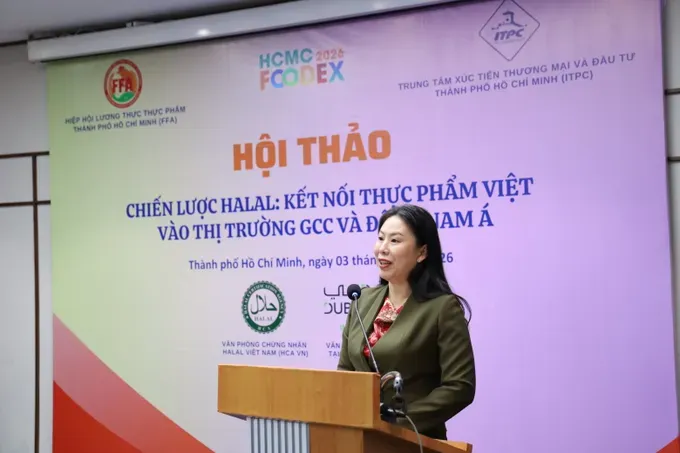
The Halal market is emerging as a new pillar of international trade. The global Halal market is currently valued at approximately US$5 trillion and continues to experience robust growth. However, according to Ms. Ho Thi Quyen, Deputy Director of the Ho Chi Minh City Investment and Trade Promotion Center (ITPC), only about 0.2 percent of Vietnamese enterprises have products certified as Halal, indicating substantial untapped potential for market expansion.
From a business perspective, Ms. Ly Kim Chi, Chairwoman of the Ho Chi Minh City Food and Foodstuff Association, emphasized that the Halal market imposes stringent requirements in terms of standards, quality, and transparency. To achieve deeper market penetration, enterprises need to make comprehensive investments across production processes, certification systems, brand development, and the enhancement of sustainable competitiveness.
The GCC area is identified as a key market with substantial import demand. Mr. Truong Xuan Trung, Head of the Vietnam Trade Office in the UAE, stated that the global Halal economy is currently valued at around US$5 trillion and is projected to reach US$10 trillion by 2028.
The Middle East alone accounts for approximately 62.5 percent of the total market size, with a consumer base of around 500 million people. Notably, the region depends heavily on imports, sourcing between 85 percent and 90 percent of its food and foodstuff needs from abroad.
To effectively seize these opportunities, experts advise enterprises to promptly complete Halal certification procedures, design market-appropriate packaging—especially bilingual English–Arabic labels—and intensify the use of e-commerce platforms, which currently account for more than 80 percent of Halal consumer goods transactions in the Middle East.
Within ASEAN, the Muslim population represents over 40 percent of the total population. Notably, several markets, such as Indonesia, have tightened regulatory frameworks, mandating Halal certification for imported food and beverage products. This requires Vietnamese enterprises to expedite compliance with relevant procedures to ensure smooth market access and circulation of goods.
According to Mr. Ta Xuan Hien, Vice Chairman of the Vietnam Business Council in the UAE, enterprises should regard the UAE as a strategic transshipment gateway. Accordingly, they are encouraged to develop market entry strategies through local import and distribution systems, rather than approaching end consumers directly.