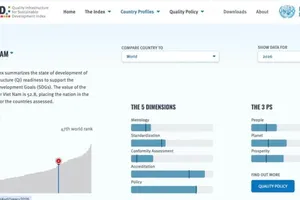
The “2026 Geography of Crypto Report,” published on September 30, 2026, by Chainalysis, a US-based blockchain analytics and digital asset data platform, revealed that from July 1, 2025, to June 30, 2026, Vietnam recorded a staggering US$122.2 billion in cryptocurrency activity value.
This impressive figure secures the nation’s position as the fourth largest within the CSAO region (Central and Southern Asia, Southeast Asia, and Oceania). However, the tangible exploitation results still aren’t fully commensurate with the sheer economic value derived from these vast resources.
Numerous tech platforms participating in pilot programs
While quite a few domestic crypto investors currently park their assets in digital wallets, refusing to convert them as they anxiously wait for Vietnamese exchanges to officially launch, Da Nang’s pilot program facilitating cryptocurrency exchanges across numerous locations, scheduled to run until August 26, 2028, is actively opening up entirely novel experiences.
The Basal Pay platform has been officially permitted to undergo rigorous testing at Da Nang International Airport, Hoi An Ancient Town, Ba Na Hills, the golf course network, and sprawling coastal tourist resorts. Additionally, two software parks, the Da Nang Innovation Startup Support Center, alongside several commercial and service zones are also allowed to facilitate transactions using crypto assets.
This marks the direct outcome of the Basal Pay application being granted a controlled testing license (sandbox) by Da Nang authorities back in August 2025.
To utilize Basal Pay, users simply deposit their crypto assets into the application’s wallet, verify their identity via eKYC, and subsequently scan a QR code at supported points of sale. The encrypted assets are then seamlessly converted into VND during the transaction via a VietQR code or a direct transfer through the NAPAS system.
After a solid year of operation, this application reportedly boasts 10,000 registered accounts, racking up over 15,000 individual transactions. The total transaction value across the three initial testing zones reached over $100,000.
According to the Da Nang Department of Science and Technology, Basal Pay stands as the very first model for exchanging encrypted assets into fiat currency ever licensed by the city. Following the trial period, 100 percent of the transactions generated on the platform successfully complied with stringent regulations regarding anti-money laundering, combating terrorist financing, and overall international standards.
Currently, several other platforms such as PayD, UmiPay, and X-Border have also been officially granted pilot licenses by Da Nang to seamlessly convert digital assets into fiat currency.
Promptly bringing exchanges into operation
Actively rolling out the Government’s Resolution No.05/2025/NQ-CP regarding the pilot launch of a cryptocurrency market in Vietnam, the Ministry of Finance has spearheaded efforts, coordinating closely with the Ministry of Public Security and the Vietnam State Bank to carefully select organizations capable of providing digital asset services.
Nationwide, there are 5 such organizations that have already registered and are currently finalizing their dossiers to legally offer cryptocurrency trading services across Vietnam.
These domestic exchanges are strictly mandated to satisfy a charter capital threshold of up to VND10 trillion ($389.3 million), while forging tight linkages with the banking system and securities firms to guarantee transparency, segregate client assets, and actively combat money laundering. However, as of the end of October 2026, there isn’t a single digital asset exchange officially operating yet.
For Secretary General Tran Xuan Tien of the HCMC Blockchain Association, the current landscape dictates a highly practical priority. The critical issue isn’t the global ranking regarding cryptocurrency adoption levels, but rather exactly how much tangible economic value Vietnam is actively generating from the burgeoning digital asset market.
Beyond mere exchanges, he stressed that Vietnam desperately needs a clear roadmap to actively develop digital asset applications that inject genuine value into the broader economy. Among these, the tokenization of real-world assets, mobilizing robust capital for enterprises, alongside deploying smooth cross-border value transfer solutions emerge as highly promising trajectories inherently demanding thorough research and controlled piloting.
“If we merely stop at having millions of people trading crypto assets across these platforms, Vietnam will stubbornly remain stuck playing the role of a consumer market,” Secretary General Tran Xuan Tien explained. “Therefore, we require dominant objectives acting as actual revenue streams for the economy, tangibly reflected through the sheer volume of international investment capital successfully attracted alongside the raw number of tech enterprises actively flourishing.”
Regarding the establishment of domestic cryptocurrency exchanges, Standing Deputy Head To Tran Hoa of the Crypto Asset Trading Market Management Board under the State Securities Commission of Vietnam (SSC), revealed that 5 enterprises have received preliminary approval in principle to prep for their exchange launches.
Nevertheless, the exact operational timeline hasn’t been definitively pinpointed yet, primarily because these businesses must comprehensively finalize grueling conditions, including capital, cutting-edge tech, operational protocols, as well as regulatory dossiers.
“The legal framework governing market operations has basically been completed, boasting exceptionally stringent entry conditions; thus, the exact moment to ‘press the button’ and officially open an exchange depends entirely on the completion speed of the enterprises themselves,” Mr. To Tran Hoa shared.
The Ministry of Finance has recently promulgated Circular No.165/2026/TT-BTC, which provides thorough guidance on several contents regarding reporting regimes and information disclosure across the cryptocurrency market, officially taking effect on December 18, 2026.
Accordingly, all reporting and information disclosure procedures must guarantee precision, honesty, timeliness, and absolute completeness, fiercely avoiding any misleading ambiguity. Whenever there’s an alteration to previously reported or published content, the subject making the change is legally obligated to promptly and fully update the exact nature of the modification alongside its underlying rationale.
Furthermore, organizations providing these services and entities issuing crypto assets are strictly required to disclose their information simultaneously in both Vietnamese and English.