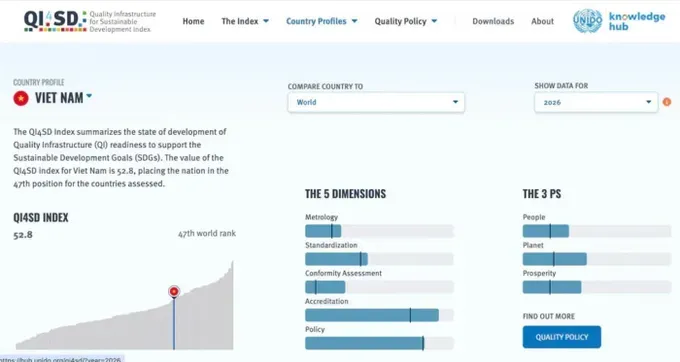
According to the Ministry of Science and Technology, UNIDO released its 2026 Quality Infrastructure for Sustainable Development (QI4SD) Index at the 2026 Global Quality Forum, held in Vienna, Austria, from November 4 to 6. Vietnam scored 52.8 points, ranking 47th among 170 countries and territories assessed.
The QI4SD is an index developed by UNIDO and first released in 2022 to assess the level of development of a country's or territory's quality infrastructure system and its capacity to contribute to the achievement of the United Nations Sustainable Development Goals (SDGs). The index is based on 37 indicators across five components, including standardization, metrology, accreditation, conformity assessment, and quality policy.
Quality infrastructure (QI) does not refer to physical infrastructure such as roads, bridges, factories, or data centers. Rather, it encompasses a system of organizations, regulations, standards, procedures, and technical services designed to ensure that products and services meet requirements for quality, safety, and environmental protection. It enables countries to measure, inspect, certify, and assure the quality of products and services in accordance with consistent standards.
Compared with the 2024 assessment, Vietnam's score increased by 1.6 points, although its ranking fell from 42nd in 2024 to 47th. This was partly attributable to the expansion of the assessment from 155 to 170 countries and territories.
This year, UNIDO also selected Vietnam as one of the countries highlighted for making significant improvements in quality infrastructure during the 2024–2026 period, alongside Colombia, Iran, Nigeria, and Uzbekistan.
According to the Commission for the Standards, Metrology and Quality of Vietnam (STAMEQ) under the Ministry of Science and Technology, UNIDO's recognition is a positive indication of Vietnam's efforts to develop its quality infrastructure in recent years. It underscores the importance of coordinated investment in standardization, metrology, accreditation, and conformity assessment capabilities.
As economies undergo green and digital transformations and move toward more sustainable development models, quality infrastructure is becoming an essential foundation for improving product quality, ensuring safety, facilitating trade, and supporting innovation.
In export-oriented industries, particularly textiles and garments, agricultural products, food, and industrial goods, stronger adoption of international standards and enhanced capabilities in metrology, traceability, and conformity assessment are particularly important in meeting increasingly stringent market requirements.
The 2026 QI4SD results not only recognize Vietnam's progress but also highlight the need to translate improvements in quality infrastructure capabilities into tangible benefits for businesses, citizens, and the wider economy.