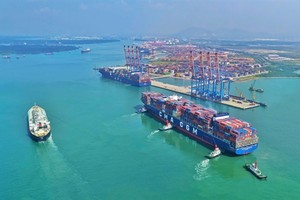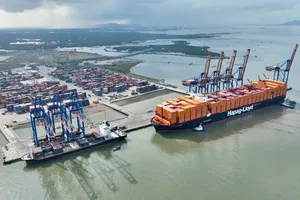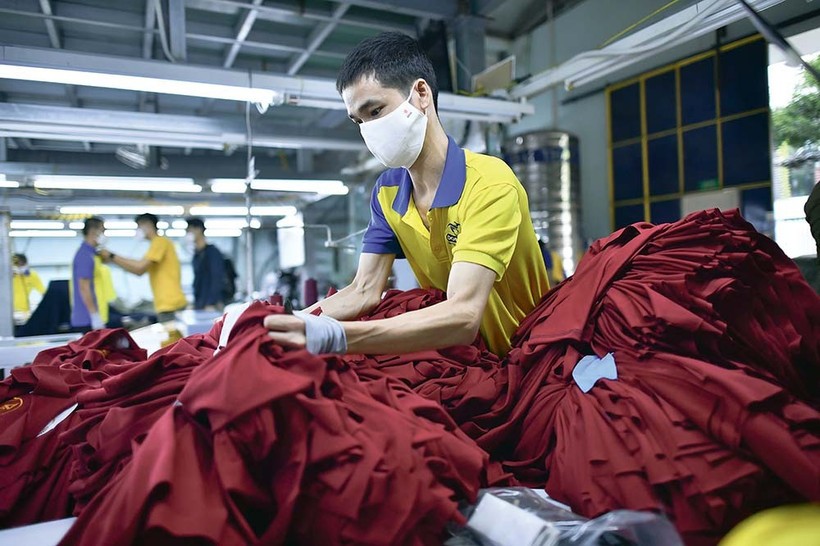
Vietnam’s average export growth has stayed in double digits year on year, while the share of exports to the US, the country’s largest market, has remained strong over the past 11 months, despite mounting tariff pressures.
Measuring tariff impacts
The effects of US reciprocal tariffs on Vietnam’s economy, especially exports, have been far milder than initial projections. HSBC’s latest reported showed that Vietnam’s trade flows, foreign direct investment and key macroeconomic metrics have all outperformed forecasts.
HSBC noted that average export growth during January-November hit 28 percent, with shipments to the US rising over 30 percent. Much of this impressive expansion stemmed from front-loading of major orders in the second quarter ahead of tariff imposition.
The National Statistics Office reported that total trade turnover neared US$840 billion by late November, up 17.2 percent from a year earlier. Exports reached more than US$430 billion, a 16.1 percent gain that already topped the full-year 2024 figure.
Customs data showed exports to the US surpassed US$138.6 billion during the period, up 27.2 percent year-on-year.
HSBC flagged a major structural change in Vietnam’s US-bound exports. Back to 2013, light manufacturing sectors like apparel, footwear and toys made up about 60 percent of shipments, while electronics accounted for just a modest 13 percent. Now, electronics dominate the category.
Since early 2025, electronics have eclipsed light manufacturing as the top export to the US, valued at around US$50 billion. Including machinery, equipment, tools and parts, the combined total exceeds US$70 billion.
Yet, the export performance also exposes vulnerabilities. Domestic-sector exports totaled US$102.41 billion down 1.7 percent and representing only 23.8 percent of the overall figure. By contrast, the foreign-invested sector posted US$327.73 billion, up 23.1 percent and accounting for 76.2 percent of total exports.
Lingering risks ahead
Vietnam closes 2025 on a strong trade note, but there’s no assurance the momentum will carry into next year amid escalating global trade risks. HSBC analysts warned that the 2026 export outlook is clouded, with potential impacts hard to gauge.
The Ministry of Industry and Trade’s Agency of Foreign Trade cited ongoing pressures from rising protectionism, tougher green supply chain standards and a tepid global recovery. The full bite of reciprocal tariffs is likely to materialise in 2026, compounded by softer demand in key markets due to persistent inflation.
Much of this year’s growth has come from a narrow set of leading categories, including electronics, machinery and apparel. Electronics, computers and components alone generated US$97 billion in the first 11 months, up 48.5 percent and adding US$24.4 billion year-on-year. Full-year shipments in the group are projected at US$104-105 billion versus US$72.6 billion for all of 2024.
Nguyen Hong Duong, Deputy Director of the MIT’s Department of Overseas Market Development, urged firms to upgrade product quality, increase the share of domestic added value, tighten origin rules and maintain thorough documentation on inputs. Such steps, he said, are critical for smooth verification by importing authorities when required.