Recently, an ill-intention website has posted an article containing accusatory and slanderous content claiming there were “directives to rig the election.” This one-sided approach, lacking verifiable sources and specific evidence, deliberately creates a false impression that the election preparation process lacks transparency and democracy. Such information preys on the psychology of suspicion, a type of “bait” that easily goes viral in the online environment.
On social media platforms like TikTok and Facebook, some posts take the approach of “clickbait leading.” For instance, a TikTok account spread information about “a series of military and police generals running for the National Assembly,” which was staged and edited to create a sense of abnormality, thereby deducing, inciting, and deepening divisions between forces. The trick of these subjects does not lie in complete fabrication, but in piecing together real information and placing it in a misleading context, making viewers easily misunderstand the nature of the issue.
A more sophisticated form involves “pseudo-analysis” articles and videos. On the surface, these contents appear objective, comparing the electoral models between Vietnam and some other countries, but in reality, they lead public opinion in a one-sided direction, deliberately ignoring differences in political institutions, history, and legal conditions. This flawed comparison easily misleads the audience, especially the youth, into thinking that domestic electoral processes are “non-transparent” or “lack choices.”
Along with that, some social media accounts exploit unverified personal stories to create emotional effects. For example, a TikTok account posted a clip of a woman expressing frustration when voting because there was “only one candidate,” which led to a series of speculative comments such as “voting is just a formality” and “the results were pre-arranged.”
More seriously, such contents as above are often unverified for authenticity and do not fully reflect the consultative process and candidate introduction according to legal regulations, yet they easily attract interaction.
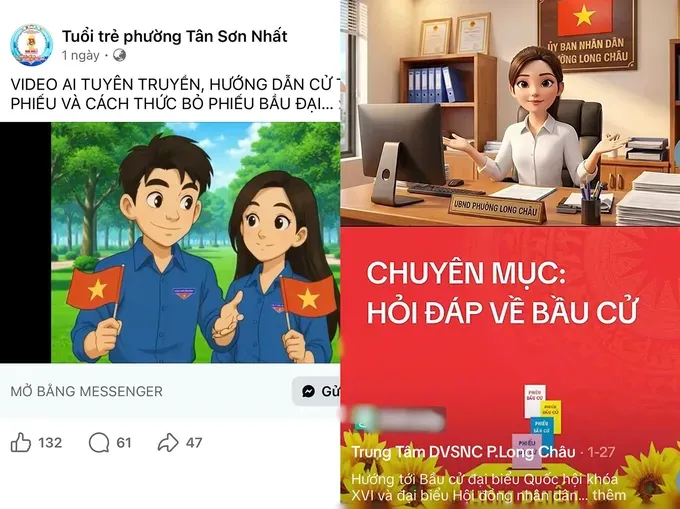
In contrast to the streams of false information, election propaganda work is being digitized to be closer to the people, especially the youth. Many localities have moved beyond traditional methods, proactively bringing official information to platforms in flexible and accessible formats.
In HCMC, the Ho Chi Minh Communist Youth Union pages in Tan Son Nhat and Dong Hoa wards are using AI characters and virtual hosts to guide voters. Additionally, numerous localities have launched TikTok channels featuring short tech videos, successfully attracting thousands of views and interactions regarding the upcoming national election.
From this reality, it can be seen that alongside distorted and false information, a significant force consisting of grassroots cadres and youth union members is proactively “filling the information gap” with accurate and timely content.
Deputy Director Le Thi Anh Dao of the Academy of Politics Region II emphasized that the upcoming National Assembly and People’s Council elections are crucial political events, making them prime targets for hostile forces and political opportunists spreading disinformation.
To counter this threat, she argued that functional agencies cannot simply react to fake news. Instead, they must proactively provide accurate information early and operate a rapid response mechanism to promptly correct distortions. Ultimately, maintaining transparent information on digital platforms is the direct solution to neutralize fake news.
Besides the speed factor, the method of transmission also needs to be innovated. Using infographics, short videos, podcasts, etc., is not merely about "refreshing the format," but is a way for official information to enter the exact spaces where citizens, especially young people, are present.
Simultaneously, it involves mobilizing experts, scientists, and key opinion leaders (KOLs) to express their views through official channels. When false arguments are refuted with scientific reasoning and practical evidence, guiding public opinion becomes more convincing and sustainable.
Citizens must develop the basic competency to protect themselves against misinformation. When facing shocking election news, individuals should pause for five seconds to verify the source, author, motive, and mainstream press presence.
Furthermore, everyone must recognize their direct responsibility in cyberspace. A seemingly harmless like or share can easily amplify false claims. By learning to say no to malicious fake news, the flow of negative information will naturally shrink away.
At the national conference deploying the election work for deputies to the 16th National Assembly and People’s Councils at all levels for the 2026-2031 term, Party General Secretary To Lam emphasized the viewpoint: “The entire consultative process must be conducted democratically, objectively, publicly, and transparently in accordance with legal regulations; increase inspection and supervision of implementation, resolutely preventing negative phenomena such as unhealthy lobbying, ‘buying’ candidacy slots, ‘buying’ votes, or interest groups distorting the meaning of the election.”
According to Vice Chairman Ha Hai of the HCMC Bar Association, under the provisions of Clause 18, Article 3 of Decree 147/2024/ND-CP on the management, provision, and use of internet services and online information, “fake news” is information that is partially or entirely false compared to the truth, created by one or more subjects to serve their own purposes.
The act of providing or sharing fake, false, distorted, or slanderous information can be administratively sanctioned under Decree 15/2020/ND-CP (amended and supplemented by Decree 14/2022/ND-CP), with fines ranging from VND10-20 million (US$383-766) for organizations, along with forcing the removal of the violating content. The fine for individuals is half that of organizations. In serious cases, the act of spreading fake news can also face criminal prosecution under the current Penal Code.