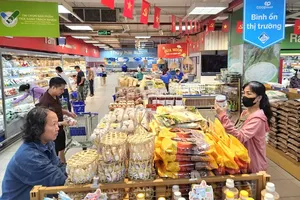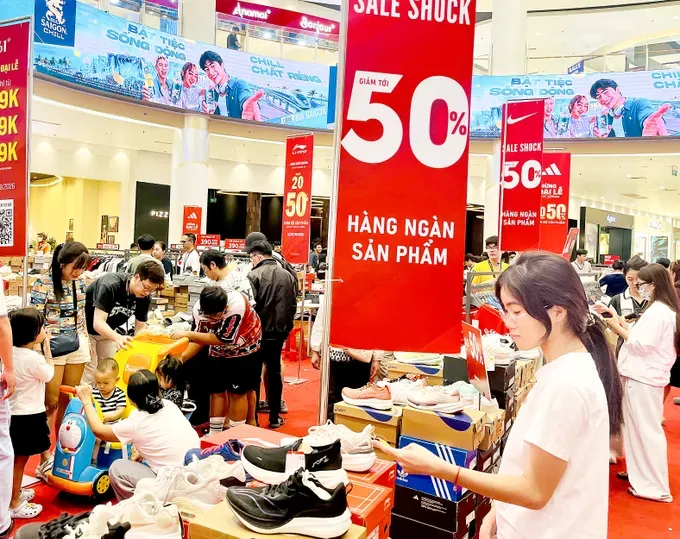
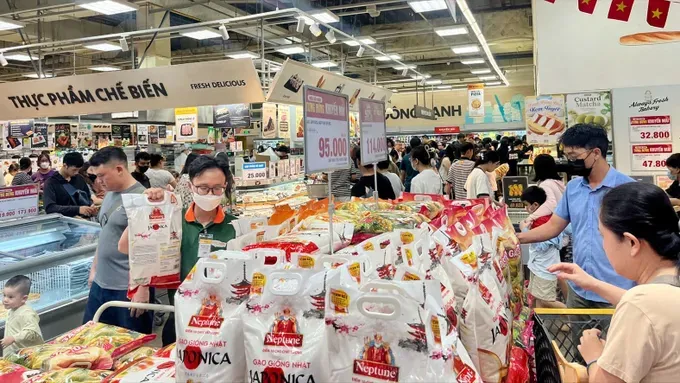
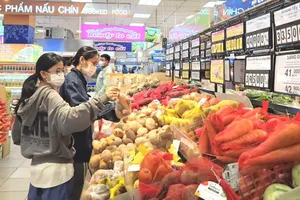
In the late afternoon of August 31, at Emart Phan Van Tri in An Nhon Ward, customers bustled about shopping at food, consumer goods, and fashion counters.
For Ms. Le Ngoc Anh, a resident of Hoc Mon Commune, the decision for her family to stay in the city meant they could proactively visit supermarkets and commercial centers. “On normal days, we can’t just spend without carefully considering our budget, but during the holiday, there are many discount programs, so we saved over VND300,000 (US$12) for this shopping trip,” she explained.
At numerous commercial centers, fashion, footwear, and cosmetics stores have reportedly launched discount programs ranging from 30 percent to 70 percent depending on the specific brand and product. The categories of fresh food, processed food, milk, beverages, and essential consumer goods saw an influx of promotional offers. Many supermarkets applied formats like buy one get one free, buy two get one free, savings combos, and voucher or shopping coupon delivery.
Major retail chains such as Saigon Co.op, GO!, AEON, MM Mega Market, and Bach Hoa Xanh simultaneously amplified their preferential programs, ultimately helping residents gain more choices within a suitable spending limit. Meanwhile, AEON Vietnam adjusted the operating hours at several centers, opening earlier and closing later than usual to accommodate the shopping and entertainment needs of their patrons.
A vibrant atmosphere unfolded at food courts, cinemas, and indoor amusement parks at locations like Emart, AEON, and Vincom. Many families dedicated their entire afternoon and evening at commercial centers, seamlessly combining dining and shopping while watching movies and participating in children’s games.
The crowds seemingly remained dense as evening fell, creating an exceptionally lively holiday atmosphere. Based on preliminary estimates from a handful of supermarkets and commercial centers, the foot traffic during the three-day holiday surged from 70 percent to 150 percent, with some locations doubling their normal volume, ultimately pushing purchasing power up by 15 percent to 40 percent depending on the venue.
To effectively support consumers and sustain purchasing power, many retail enterprises continuously rolled out discount programs, savings combos, and good-price sales. It isn’t just the large retail chains; the three wholesale markets of Binh Dien, Hoc Mon, and Thu Duc also regulated goods sources and controlled quality to ensure a stable supply at reasonable prices, contributing to bringing goods from the market to the dining table at suitable costs.
Following the orientation of the HCMC Department of Industry and Trade, the concentrated promotion program is being systematically built on a five-year roadmap covering the 2026-2030 period, rather than being deployed separately year by year.
This approach aims to forge a seamless demand-stimulation plan, helping enterprises proactively secure goods sources and construct sales programs while granting consumers more opportunities to access goods at excellent prices. Among these, the Supply-Demand Connection and Shopping Season programs are identified as the flagship demand-stimulation activities, organized into two distinct waves each year.
The city also aligns its orientation to integrate shopping with culture, tourism, and entertainment, thereby expanding consumer space and prolonging the stay and spending of residents and tourists; simultaneously, it creates additional outlets for production, distribution, and services.
For Deputy Director Nguyen Nguyen Phuong of the HCMC Department of Industry and Trade, the strategy extends far beyond immediate gains. He noted that alongside discounts and promotions during the September 2 holiday, many large enterprises have already prepared seasonal demand-stimulation programs focusing heavily on the final months of the year.
Maintaining continuous demand-stimulation waves is expected not only to retain the flow of customers but also to create further momentum for people to expand their spending, thereby reviving purchasing power and accelerating production and business activities in the year’s closing months.
Parallel to stimulating demand, HCMC continues to smoothly maintain a market stabilization program for 24 essential commodity groups, featuring retail prices that are at least 5 percent lower than the general market.
The city is vigorously intensifying direct connections between manufacturers and distribution networks to effectively bypass intermediaries, cut down costs, and mitigate the pressure of price hikes reaching consumers. Mobile sales programs at industrial parks and export processing zones continue to be expanded, bringing essential goods closer to workers with preferential rates ranging from 20 percent to 50 percent.
At the end of the day, these solutions simultaneously support price-sensitive income groups while amplifying purchasing power in areas densely populated by workers.

)