More than VND408 trillion in preferential capital has been put on the market by commercial banks this month in response to the Government's policy and the State Bank of Vietnam's direction to lower lending rates and help businesses access capital at reasonable costs. However, many businesses, particularly small and medium-sized enterprises, continue to struggle to access loans or remain reluctant to borrow because interest rates are still high.
Banks facilitate access
CEO Pham Toan Vuong of Agribank said the bank is rolling out a VND70 trillion preferential credit package with interest rates 1-2 percentage points per year below market rates. The package prioritizes businesses with viable production and business plans, clear output markets and cash flows for debt repayment. To facilitate access to capital, Agribank has simplified documentation, shortened processing times and strengthened assessments based on cash flows, supply chains and transaction data.
With a VND2.5 trillion preferential credit package offering interest rates at least 1 percentage point per year below market rates, Vietbank is focusing on short-term production and business needs, payments for imported goods and overseas services, fixed-asset investment, factory expansion and premises rental.
According to Pham Linh, Deputy CEO of Vietbank, the bank is reforming its lending operations to make them more flexible. In addition to real estate as collateral, Vietbank is expanding its assessment to include cash flows, goods, receivables and operational capacity, thereby increasing opportunities for small and medium-sized enterprises to access capital.
Dao Minh Tu, Vice Chairman and Secretary General of the Vietnam Banks Association, said businesses need lower interest rates and access to larger sources of capital with longer loan terms. In addition to mechanisms and policies, bottlenecks also stem from businesses themselves and from the coordination and sharing of information among stakeholders to resolve emerging obstacles.
The pressure is mounting as the banking system's ability to balance capital resources faces increasing constraints. Credit outstanding in the economy remains high, while mobilized capital has yet to meet requirements, limiting the banking system's ability to meet additional demand for capital from the economy. Therefore, the banking system cannot be expected to meet all medium- and long-term capital needs, and the capital market needs to be developed more strongly.
CEO Nguyen Minh Tuan of AFA Capital pointed out that the State Bank of Vietnam has sent a clear signal about its orientation toward stabilizing policy interest rates. However, amid rapid credit growth, less abundant liquidity, and persistent inflation and exchange-rate pressures, coordination between monetary and fiscal policies needs to be strengthened.
Businesses wary of borrowing
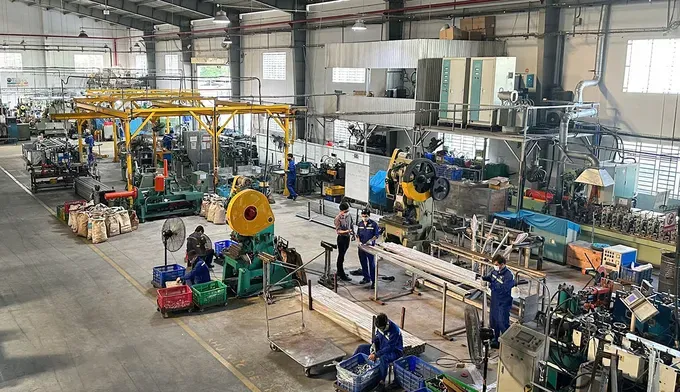
As a company engaged in the manufacturing, processing and installation of doors and aluminum-glass products, Huynh De Door Engineering JSC in Tam Thang Ward, Ho Chi Minh City, needs capital to import raw materials, operate its factory, invest in machinery and carry out projects on schedule. However, it is finding it very difficult to access loans.
According to company director Nguyen Thanh Son, banks require extensive documentation proving cash flows and business plans, as well as substantial collateral, while the company's asset base is limited. In addition, revenue and cash flows at manufacturing and construction businesses can fluctuate from project to project. Long acceptance and payment periods make it difficult for the company to fully meet lending requirements.
Similarly, Nguyen Quoc Anh, director of Duc Minh Rubber Company in Duc Nhuan Ward, Ho Chi Minh City, and chairman of the Ho Chi Minh City Rubber and Plastics Association, pointed to the reality that many businesses in the association are reducing their borrowing because interest rates remain high. In July, Duc Minh Rubber had a loan carrying an annual interest rate of 9.3 percent, but by late August, the rate had risen to 10.3 percent for a short-term loan. Compared with the 6.8 percent rate at the beginning of 2026, the company is now wary of borrowing.
Meanwhile, although it is among the businesses to which banks are relatively open to lending, CEO Le Mai Huu Lam of Cat Van Loi Industrial Electrical Equipment Manufacturing Company in Go Vap Ward, Ho Chi Minh City, said interest rates remain high and capital costs are putting significant pressure on the company. It therefore has to carefully balance its borrowing rather than aggressively taking on more debt to expand production and business operations.