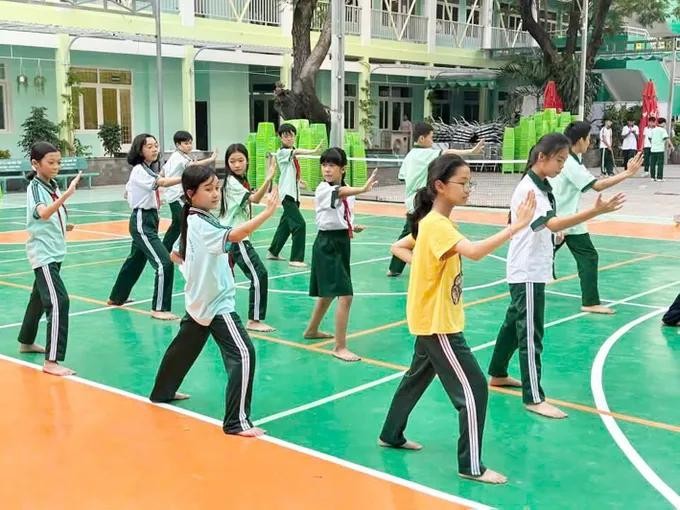
Each afternoon, school sports grounds remain open until 6 p.m., giving students extra time to practice, said teacher Hong Nguyet of Hoang Hoa Tham School in HCMC’s Tan Binh Ward. For those less interested in outdoor activities, intellectual sports such as chess and Chinese chess are available in school libraries.
At Nam Saigon Primary, Secondary, High School in Tan My Ward, tenth grader Do Gia Han expressed excitement about badminton lessons held on three newly renovated courts, fully equipped with lighting, cooling fans, flooring mats, and professional-grade nets.
The school has also refurbished football, basketball, and volleyball courts, as well as facilities for athletics and pickleball. Beyond formal classes, students are encouraged to stay after school for training, helping to create a vibrant sports culture within the campus.
According to Principal Nguyen Xuan Dac of Hoang Hoa Tham Secondary School, teachers integrate life skills education into physical activities. “Students learn to share space fairly, show teamwork, and apologize when accidentally hurting a classmate,” he said. “These lessons help build discipline and healthy exercise habits, supporting both their physical and academic growth.”
Meanwhile, Principal Tran Nghia Nhan of Nam Saigon School said that sports spaces help students discover and develop their athletic interests, encouraging engagement in recreational and social activities. “When students enjoy coming to school, it contributes to building a ‘Happy School,’” he noted. “Their satisfaction strengthens the partnership between families and educators, creating an environment that fosters both competence and character.”
With the same view, Principal Hua Thi Diem Tram of Ha Huy Tap Secondary School emphasized that physical education not only improves students’ health but also cultivates responsibility, independence, creativity, and the ability to apply learned knowledge in practice preparing them to become healthy, and responsible citizens who contribute positively to the country's growth and society.
According to the Department of Student Affairs under the Ho Chi Minh City Department of Education and Training (DoET), in the 2024–2025 school year, 92.23 percent of schools in the city operated sports clubs on campus.
By education level, 77 percent of preschools have playgrounds and physical education rooms equipped with appropriate materials and exercise tools, while 100 percent of primary, lower, and upper secondary schools have designated practice areas. Among these, 34.6 percent of primary schools, 41.7 percent of lower secondary schools, and 72.97 percent of high schools have multipurpose gymnasiums that meet national standards.
Promoting school sports is one of ten key priorities for the 2025–2026 academic year. As of December 2025, the Ho Chi Minh City Department of Education and Training, in coordination with the Department of Culture and Sports and various sports federations, has organized 29 different school sports competitions, ranging from basketball, football, handball, table tennis, badminton, and chess to martial arts, athletics, swimming, weightlifting, aerobic gymnastics, and more.
Nguyen Van Hieu, Director of the Ho Chi Minh City Department of Education and Training, affirmed that the city’s education sector no longer focuses narrowly on exam performance, but instead strives toward holistic student development academically and physically.