In May 2025, the Prime Minister issued Decision No. 1012/QD-TTg, officially green-lighting the “Training and Fostering Human Resources for Nuclear Power Development to 2035” project (Project 1012).
The initiative is designed to prepare a robust workforce, comprising lecturers, engineers, and experts, to operate nuclear power plants. Simultaneously, it aims to develop electrical and mechanical engineering sectors to support the nuclear program and accelerate renewable energy development.
According to Project 1012, by 2030, the Ninh Thuan 1 and Ninh Thuan 2 Nuclear Power Plant projects will require nearly 4,000 personnel, with over 2,000 needing university-level qualifications. This roadmap has opened new career trajectories for students, prompting educational institutions to prepare appropriate strategies and bolster training in energy and engineering fields.
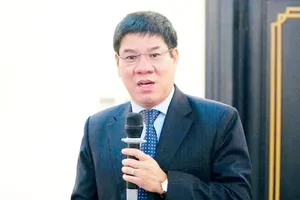
Director Tran Chi Thanh of the Vietnam Atomic Energy Institute (VINATOM) noted that alongside continued engagement with former partners like Russia and Japan to update technology and promote cooperation, the human element remains paramount. This workforce is the decisive factor, influencing everything from project organization and management to the training of high-level experts and engineers.
Vietnam currently possesses the full backing of Party and State policies, as well as support from international partners in technology sharing, workforce training, and safety assurance. However, he warned that any delay could cause Vietnam to lose these favorable conditions.
The national nuclear power project is currently chaired by the Ministry of Industry and Trade, with the participation of Vietnam Electricity (EVN) and Petrovietnam. The Ministry of Science and Technology (MoST) is responsible for safety supervision, assessment, and technical support. The VINATOM assumes the role of scientific and technological consultant, particularly regarding reactor safety.
Project 1012 clearly identifies 11 institutions selected to train and foster the nuclear workforce, namely
- Hanoi University of Science and Technology,
- Hanoi University of Science (Vietnam National University-Hanoi),
- HCMC University of Science (Vietnam National University-HCMC),
- HCMC University of Technology (Vietnam National University-HCMC),
- Electric Power University,
- Da Lat University,
- VINATOM (MoST),
- Da Nang University of Science and Technology (Da Nang University),
- Hanoi University of Civil Engineering,
- HCMC Electric Power College (EVN),
- Vietnam Petroleum College (Vietnam National Industry – Energy Group).
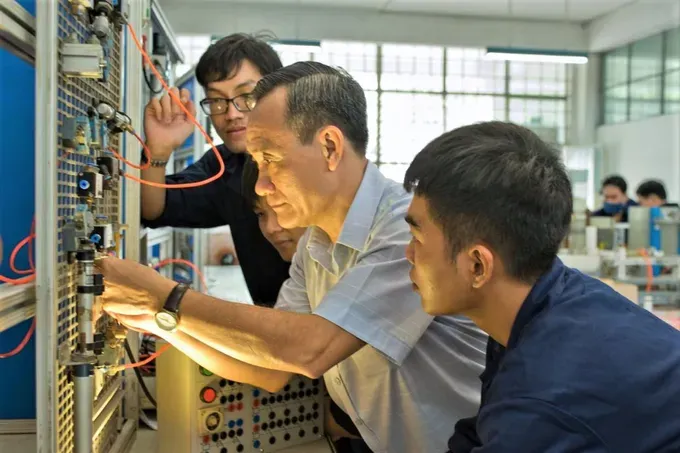
Faced with the immense demand for personnel in nuclear power and renewable energy, the HCMC University of Technology (VNU-HCM) has developed a detailed plan covering training, facility investment, and research cooperation. In 2026, the university expects to enroll students in Nuclear Engineering with a quota of about 60 students/year, while continuing to train related fields like Electrical-Electronics, Mechanical Engineering, Telecommunications Engineering, and IC Design.
The university is also expanding its training facility in Khanh Hoa Province to serve workforce development for the Central region, home to the Ninh Thuan 1 and 2 nuclear plants. In parallel, it plans to construct seven modern laboratories for teaching and research.
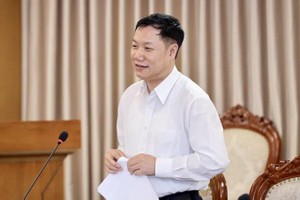
At the HCMC University of Science (VNU-HCM), Assoc Prof Dr Tran Thien Thanh, Deputy Dean of the Faculty of Physics and Engineering Physics, recalled that in 2010, the Government issued Decision No. 580/QD-TTg establishing the State Steering Committee for the Ninh Thuan Nuclear Power Project. Since 2012, the university has enrolled students in Nuclear Engineering.
In the 2013-2015 period, the benchmark score for this major was consistently among the highest in the school, fluctuating between 23-23.75 points. However, from 2016-2024, when the nuclear project was paused, the benchmark dropped sharply. By 2025, following the National Assembly’s resolution to restart the Ninh Thuan project after years of interruption, the score rebounded.
“With our prepared facilities, laboratories, and international cooperation network, the university expects to double the enrollment quota for Nuclear Engineering compared to the 35 students/year level of the 2020-2024 period,” the Dean informed.
Other universities, such as the HCMC University of Industry, HCMC University of Technology and Education, Nguyen Tat Thanh University, and other selected institutions, also plan to launch new majors or increase quotas in fields like Nuclear Engineering, New Energy, and Energy Management, alongside engineering, electrical-electronics, and technology disciplines.
Drafting student support policies
The Ministry of Education and Training is currently collecting opinions on a draft Decree regulating scholarship policies for students in basic sciences, key engineering fields, and strategic technologies. The target audience includes undergraduates, master’s students, and doctoral candidates.
The decree aims to provide scholarships and living expenses to help learners cover tuition and study-related costs. Learners will be granted state scholarships based on the tuition ceiling (100 percent for outstanding academic results, 70 percent for good, and 50 percent for satisfactory).
Additionally, learners will receive state support of VND3.63 million/month (US$138) to cover living expenses during their study period at educational institutions.