Participation of many Vietnamese higher education institutions (HEIs)
For the past 15 years or so, the topic of university rankings has become a subject of intense interest within Vietnam’s higher education system. It’s not hard to see why. Vietnamese university names have begun to percolate into and steadily ascend the major international rankings, whether at the regional, continental, or global level.
This is especially true for the six rankings belonging to the “SATUQU” group, namely SCImago (Spain), Academic Ranking of World Universities – ARWU (China), The Times Higher Education – THE and Quacquarelli Symonds – QS (the United Kingdom), US News (the US), and University Ranking by Academic Performance – URAP (Turkey).
In recent years, Vietnam has even introduced two of its own domestic university rankings, Vietnam’s University Rankings – VNUR and Scientometrics & Research Administration Policies – SARAP. This move reportedly reflects an effort to localize the criteria sets and create evaluation tools better suited to the domestic context and the strategic goals of the nation's HEIs.
Many HEIs have eagerly entered the race, proactively anchoring their development strategies to ranking objectives, and they’ve achieved some noteworthy results.
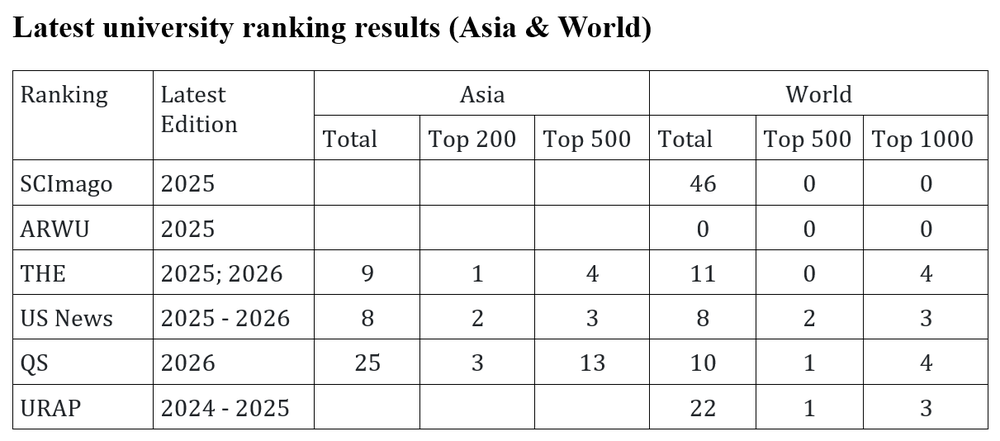
SCImago is the list where Vietnam has its strongest presence, with 46 institutions. That said, none have yet cracked the top 500 or top 1,000, and their overall positions are, frankly, still quite low. On the flip side, ARWU is widely considered the pinnacle of elite global rankings, and as of now, no Vietnamese institution has made that list.
For THE, Vietnam has 9 HEIs on the Asia list, with only one in the top 200 and four in the top 500. On its global list, Vietnam has 11 institutions, four of which are in the top 1,000, but none have yet entered the top 500.
For US News, Vietnam has 8 HEIs ranked in Asia (two in the top 200, three in the top 500). All eight of these also appear on the global list, where two have broken into the top 500 and three are in the top 1,000. URAP, which uses a relatively similar approach, recognizes 22 Vietnamese HEIs on its global ranking, with one in the top 500 and three in the top 1,000.
Obviously, the QS rankings appear to be a bit easier for Vietnam. The nation boasts 25 HEIs on the Asia list and 10 on the global list. This includes 3 in the Asia top 200, 13 in the Asia top 500, and 1 in the global top 500, with 4 in the global top 1,000.
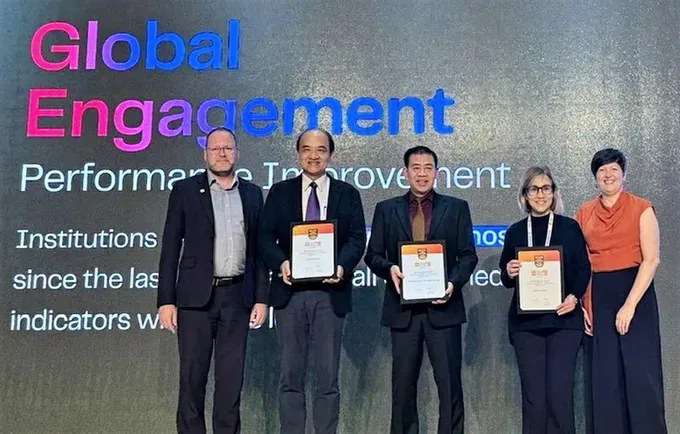
Assoc Prof Dr Phan Hong Hai, President of HCMC University of Industry (center), is receiving the international “Global Engagement - Performance Improvement” award from QS in the Republic of Korea.
Inevitable trend
According to current regulations, HEIs have four core missions: training, scientific and technological research, international cooperation, and quality assurance. World university rankings are essentially an evidence-based mechanism for measuring these missions.
Participation is valuable. It helps HEIs benchmark their academic competence globally, identify weaknesses, bolster transparency, and creates a substantive, internal motivation for quality improvement, rather than just chasing short-term accolades.
For these reasons, recent Politburo resolutions (No. 57, 59, 72) have codified participation with concrete goals. The question is no longer “should we or shouldn’t we” participate; it’s a “must-do, and as soon as possible.” This is both an inevitable trend and a strategic action to truly integrate Vietnamese higher education globally.

Focus implementation with clear roadmap
Joining the ranking game needs to be a strategic, focused, and phased endeavor. In the initial phase, each HEI should probably select rankings that align with its academic niche, its areas of strength, its development model, and its data readiness.
In the long run, however, a sustainable HEI should aim to be recognized by multiple prestigious tables (like the SATUQU group), as this is the most convincing evidence of comprehensive development across different evaluation standards. This participation needs to be organized as a data-driven governance process with standardizing internal data, establishing systems to track and analyze metrics, building a dedicated unit for statistics and international benchmarking, and driving continuous quality improvement based on that hard evidence.
But there’s a major caution. This can’t be allowed to become a short-term, superficial race. It can’t become the “ultimate goal,” to the point where academic integrity is sacrificed, investment priorities are skewed, or pressure mounts to simply “paint a pretty picture” of achievements. Rankings are only valuable when they reflect genuine, substantive quality.
Therefore, it is critical to aim for sustainable ranking, a state where the rank and the quality are truly commensurate. An initial phase might involve choosing a few breakthrough areas to get on the board, but the long-term plan must ensure comprehensive development, fully meeting all the legal duties of a higher education institution.
Rankings should be seen as a strategic anchor for improving quality, not the final destination. The ultimate goal is to be recognized, evaluated, and respected by the international academic community, even without leaning heavily on the indexes.
Participating in university rankings isn’t just a measurement mechanism; it also creates significant added value for an HEI’s development. Appearing on prestigious lists helps affirm an institution’s academic status within the scientific community and society at large.
This ranking achievement can also be seen as a form of reputation transfer, forging a new, valuable asset in terms of its academic brand. This is a critical foundation for expanding development opportunities, creating positive spillover effects, and increasing the ability to attract external resources.
At a national level, having many ranked HEIs helps raise the national intellectual image, increases competitive capacity in the knowledge economy, and promotes integration into the global university community.