Insufficient manpower and materials
After missing two deadlines set by the Prime Minister on December 19, 2025, and on January 1, 2026, the completion timeline for the Can Tho–Ca Mau Expressway, particularly the Hau Giang–Ca Mau section, remains unclear, as investors and contractors have yet to set a new target date.
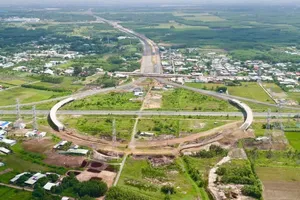
In early January 2026, Sai Gon Giai Phong (SGGP) Newspaper reporters observed that most service roads, interchanges and connecting routes along the project remained unfinished. Critical items such as fencing, ITS cable pits, lighting systems, road shoulders, drainage works, and slope reinforcement were incomplete, while construction sites showed minimal manpower.
An inspection of the Ministry of Construction on December 29, 2025, confirmed that many contractors had failed to mobilize sufficient manpower, materials and equipment, including traffic safety systems and asphalt concrete, leading to continued delays.
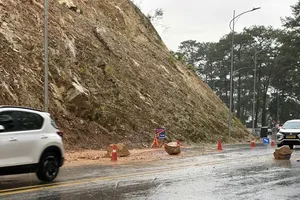
For the Hau Giang–Ca Mau section of the Can Tho–Ca Mau Expressway, although it was open to traffic on December 22, several components such as road shoulders, drainage steps and slope reinforcement have still been uncompleted.
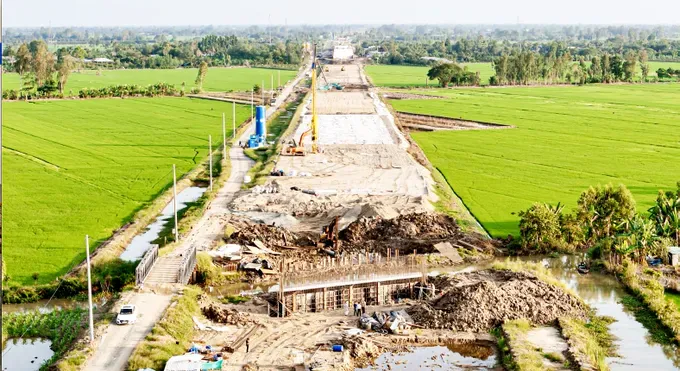
Meanwhile, progress on the Chau Doc–Can Tho–Soc Trang Expressway is also behind schedule across three subprojects No. 2, No.3 and No.4. For subproject 4 alone, by the end of 2025, the total value of completed construction reached just over VND3.5 trillion (US$133 million) out of a contract value of VND8,092 billion (US$308 million), equivalent to 44.1 percent, about 10 percent behind schedule.
Phase 1 of the My An–Cao Lanh Expressway, constructed by a joint venture between Dongbu Corporation (the Republic of Korea) and Vietnam Construction and Engineering Investment Joint Stock Company (VNCN E&C), has also progressed very slowly, failing to meet the milestones committed under directives from the Ministry of Construction. Since groundbreaking on July 26, 2025, total construction output has reached only about VND14.7 billion (US$558,565).
At the construction site, contractors have deployed work teams across six sections, but activities are largely limited to stripping organic soil, building service roads, and constructing embankments. According to the planned construction schedule, key equipment, including five excavators, four bulldozers, four dump trucks and eight rollers have yet to be mobilized as required.
Explaining the delays, a supervising engineer on the My An Commune section said that there are multiple causes, primarily shortages of construction materials and incomplete site clearance. The project still faces obstacles at 25 locations involving 31 households, while 65 technical infrastructure sites have yet to be relocated.
Actions against underperforming contractors
According to the Ministry of Construction, delays on the Hau Giang–Ca Mau Expressway, including the failure to bring the Hau Giang–Ca Mau section into operation as scheduled, are attributed to several contractors’ failure to mobilize sufficient manpower, materials and equipment. Specifically, VNCN E&C, Thi Son and Hai Dang did not adhere to the construction schedule or fulfill their commitments.
In response, the Ministry of Construction has issued a document requesting that the My Thuan Project Management Board, as the project investor, take strong measures, including considering contract termination, replacing contractors, and reassessing the eligibility of these firms when evaluating participation in future bidding packages and projects under the ministry’s oversight.
Sharing with Sai Gon Giai Phong Newspaper’s reporters about the causes of delays in subprojects No.2, No.3 and No. 4 of the Chau Doc–Can Tho–Soc Trang Expressway, Deputy Director of the Can Tho City Project Management Board for Transport and Agricultural Construction Investment Pham Minh Tri said that there are two main reasons, including shortages of construction materials and weak contractor capacity.
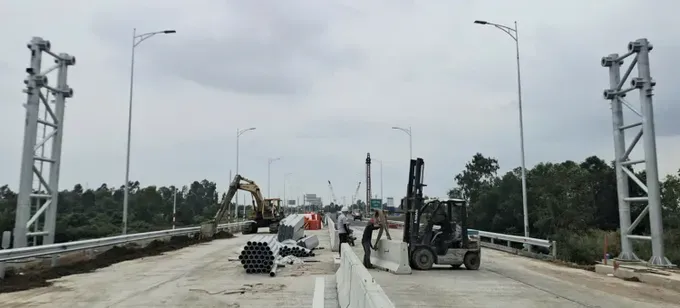
For contractors with slow progress and weak capacity, following an assessment, three contractors had their work packages withdrawn and reassigned to other contractors.
At the same time, the project management board has proposed that the Can Tho People’s Committee consider imposing strong sanctions.
Regarding construction material supply, Mr. Pham Minh Tri indicated that the Chau Doc–Can Tho–Soc Trang Expressway passes through three localities of Hau Giang, Can Tho and Soc Trang, but only Soc Trang has sand mines, with very limited reserves and poor-quality sand.
To ensure project progress, the Can Tho City Project Management Board for Transport and Agricultural Construction Investment is seeking approval from the Ministry of Construction and relevant provinces to transfer remaining sand supplies allocated to the Can Tho–Ca Mau Expressway to this project.
According to Mr. Ngo Thai Chan, Director of the Can Tho City Department of Agriculture and Environment, there are currently nine licensed river sand mines in the city supplying the Chau Doc–Can Tho–Soc Trang Expressway project, with total reserves of nearly 9 million cubic meters. However, to date, more than 2.5 million cubic meters have been extracted.
While the average permitted capacity exceeds 25,400 cubic meters per day, actual extraction stands at only about 10,000 cubic meters per day, or roughly 40 percent of capacity.
The department is reviewing operations and conducting on-site inspections of river sand mining units supplying the expressway project. Operators that fail to meet licensed output levels or deliberately delay extraction will have their licenses revoked.