Long Son Commune is the first locality in Ho Chi Minh City to implement a waste-at-source sorting model. After six years, the initiative has gradually become routine, turning into a daily habit for most households, government offices, and businesses in the area.
Waste-sorting becomes daily routine in Long Son
Within a breezy single-story residence adjacent to the river, Vo Phuoc Hanh, a member of Hamlet 3, organizes vegetables after her return from the market. Rather than discarding leftover scraps, she gathers them in a small container located behind her house to convert into organic fertilizer through composting. In front of her residence lies a sizable sack filled with cardboard, beer cans, and plastic bottles.
She remarked, "These are recyclable materials I have sorted over the last two months. There is quite a substantial amount this time—this weekend, I plan to take them to a recycling exchange point to trade for gifts. Although it may not appear to be much, I can acquire many essential items such as cooking oil, fish sauce, sugar, and milk."
This practice has become part of daily life in Long Son after years of guidance and implementation of waste sorting at source. Each household typically has two to three bins. Most families separate waste into two main categories including recyclables and residual waste. Some households go further, adding a third category for organic waste.
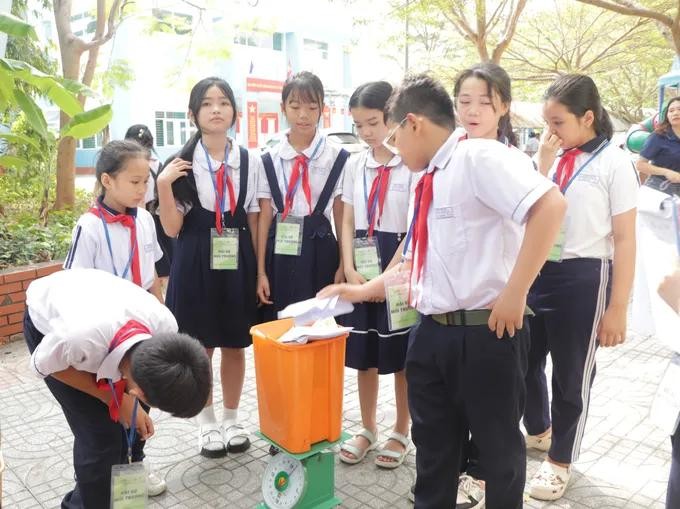
Before the model was expanded to households, the Commune’s two primary schools had already introduced waste sorting at source in 2020. Le Thanh Hai, an English teacher supporting the program at Long Son 2 Primary School, said the school has 830 students across 28 classes. Each classroom is equipped with two bins for waste separation, recyclables and other waste, to ensure hygiene. Every Monday, the school conducts awareness sessions for teachers and students, helping them better understand environmental protection and proper waste sorting.
During recess, students bring the bins down to the schoolyard. Phan Le Lan Thanh, a fifth-grade student and environmental ambassador at Long Son 2 Primary School, explained: “Instead of throwing all waste into one bin like before, we are now guided to sort waste into two separate bins with different colors. Cardboard, paper, newspapers, plastic containers, and metal cans go into the orange bin for recyclables, while other waste goes into the green bin. Waste sorting helps students build environmental awareness and reduce waste. Recyclables can also be sold to exchange for school supplies or to raise funds to support disadvantaged classmates.”
Long Son Commune expands waste-sorting drive
Regarding the program, Vice Chairman Lu Sy Phuong of the Long Son Commune People’s Committee said that after successful pilot implementation in schools, a waste-sorting project aimed at promoting a circular economy was launched in 2022. The initiative was jointly carried out by SCG Chemicals Company, Long Son Petrochemicals Company and Long Son Commune in Hamlet 1, with the participation of more than 1,000 households and three scrap collection facilities.
The project collected over 9.2 tons of recyclable waste and guided residents to reuse around 8 tons of food waste as organic fertilizer. It also provided equipment and occupational safety training for 15 individuals involved in collecting recyclable materials.
By the year 2024, the program had grown to encompass all households in Hamlets 1, 2, and 3, in addition to religious and cultural locations such as Nha Lon, Long Son Communal House, Hung Long Tu Pagoda, and Ba Ong Pagoda, five educational institutions, and the Long Son Border Guard Station.
To date, about 43 percent of households in Long Son Commune (1,795 out of 4,200), along with four religious institutions, five schools, the Long Son Border Guard Station, and Long Son Petrochemicals Company have adopted waste sorting at source. Approximately 20 percent of food waste generated is repurposed into organic compost, and no household solid waste is buried in landfills in the commune.