Measures ranging from public awareness campaigns to stricter control of fishing vessels have brought clearer changes in fishermen’s awareness in Ho Chi Minh City regarding the prevention of illegal, unreported, and unregulated (IUU) fishing. As fishermen better understand the law, compliance becomes more voluntary, helping protect livelihoods and contributing to the country’s efforts to remove the European Commission’s (EC) “yellow card".
Understanding the law to avoid violations at sea
On a morning in March 2026, in Phuoc Thang Ward, a mock trial on IUU fishing violations drew particular attention as it was held directly at the hall of Fisheries Surveillance Division No. 2. The “defendant” was a boat owner who, for profit, organized fishermen to cross into foreign waters and disabled the vessel monitoring system to evade authorities. When the 10-year prison sentence was announced, many fishermen attending the trial were left stunned.
Among them, Tran Van Cuoi, 48, in Phuoc Thang Ward, a boat owner with over 20 years of seafaring experience, expressed his surprise. He shared that in the past, many fishermen believed IUU violations would only result in administrative fines or temporary bans from fishing. “Watching the trial made us realize the consequences are far more serious than we thought. It’s not just fines—there can be imprisonment, affecting the lives and future of our families", he said.
For fisherman Nguyen Van Viet in Rach Dua Ward, it was not merely the harsh sentence that was notable, but also the series of repercussions, especially the immediate effect on marine resources and the standing of Vietnamese seafood in global markets. "If the 'yellow card' is not lifted, exports will encounter stricter regulations, seafood prices will decline, markets will become volatile, and ultimately, it will be the fishermen who bear the consequences," he stated.
Colonel Cao Xuan Quan, Deputy Political Commissar of Coast Guard Region 3 Command, noted that through such mock trials, the reenactment of violations and the severity of penalties help people clearly understand the consequences of wrongdoing. Once they understand the law, fishermen are more likely to comply proactively and avoid engaging in IUU fishing from the outset.
Preventing IUU fishing from the shore
A standard morning at Cat Lo Port in Phuoc Thang Ward commences with regular inspections. Officials examine every fishing boat including licenses, registration, and vessel monitoring systems prior to granting permission for departure. The awareness among fishermen has enhanced, showing a reduction in complacency compared to the past.
Fisherman Tran Van Sy in Phuoc Thang Ward shared that after understanding the regulations on IUU fishing and the significance of removing the EC’s “yellow card,” he now ensures all equipment and documents are in order before every trip. According to him, compliance helps increase the value of seafood; in contrast, pursuing short-term gains through IUU fishing could prevent Vietnam from lifting the “yellow card", which would be a major loss.
According to Phan Trong Hanh, Vice Chairman of the People’s Committee of Phuoc Thang Ward, in addition to strictly controlling vessels before departure, the locality has tightened fleet management, especially for vessels that do not meet operational requirements. The ward currently has 20 such vessels, including 3 anchored outside the province, all of which are monitored daily.
Vessels anchored outside designated channels are equipped with monitoring devices, while the rest are manually inspected each morning. “The ward manages more than 140 fishing vessels, including 117 offshore vessels. From 2025 to the first quarter of 2026, no IUU fishing cases have been recorded”, Vice Chairman Phan Trong Hanh stated.
In Long Hai Commune, at anchorage areas, many vessels remain idle with the words “Fishing vessel not qualified for operation” painted on their hulls. These are vessels that have not yet met operational conditions and are being strictly managed to prevent IUU fishing.
Huynh Son Tuan, Secretary of the Long Hai Commune Party Committee, said that among more than 1,200 vessels, around 180 are still unqualified, and managing this group is a top priority. Management measures are being implemented with the highest level of political determination, ensuring that no vessel is allowed to move without authorization.
These vessels are closely monitored for anchorage location, with daily updates of images and coordinates; all are equipped with vessel monitoring systems. The commune also coordinates with other provinces where vessels are anchored to complete GPS installation and update vessel data, ensuring all unqualified vessels are under supervision. At the same time, Long Hai has inspected and removed informal landing sites, prohibiting the offloading of seafood outside regulated ports. Border guard forces are on duty 24/7, firmly preventing unqualified vessels from going to sea.
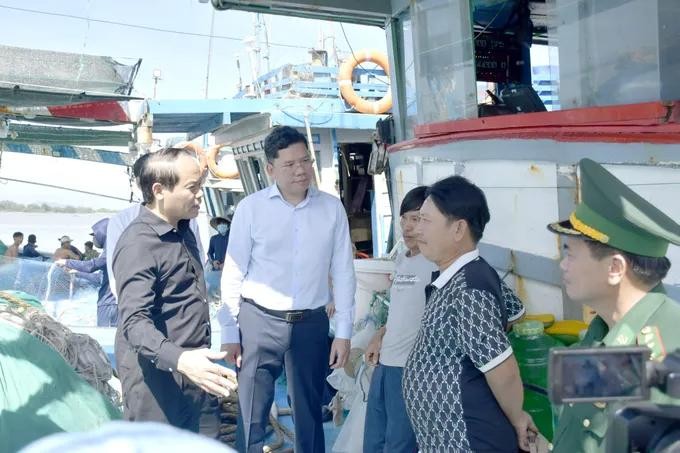
Speaking with Sai Gon Giai Phong Newspaper, Vice Chairman Hoang Nguyen Dinh of the Ho Chi Minh City People’s Committee, emphasized that combating IUU fishing must begin with strict management of the fishing fleet at the shore—reviewing each vessel, accurately assessing conditions, and decisively preventing unqualified vessels from setting sail. “Locking down” idle vessels, eliminating “ghost vessels” and “inflated data” are key measures to tackle IUU fishing at its root, moving toward transparent and sustainable fishing practices, thereby contributing to the removal of the “yellow card” and ensuring long-term livelihoods for fishermen.