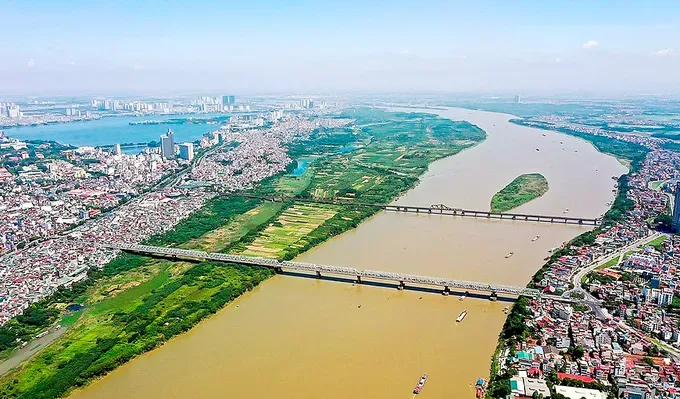
Throughout Hanoi’s history, the Red River has been the vital waterway to form the capital’s land, serving as the cradle for the nation’s political and cultural center. However, for many decades, it appears Hanoi hasn’t truly stretched itself or “turned its face to the river” like many developed nations have successfully done.
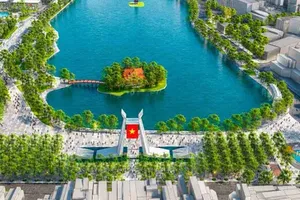
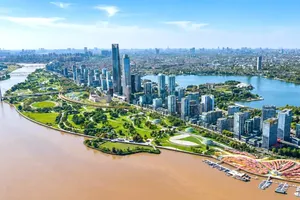
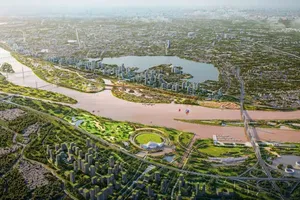
For years, the vast plains and highly potential riverside spaces along the Red River have primarily been exploited through fragmented, uncoordinated small-scale agriculture. Consequently, the approval of the Red River Landscape Boulevard Axis project marks an extraordinary turning point, aiming to transform the Red River into one of Hanoi’s new strategic development axes, specifically the ecological, cultural, and urban landscape ones.
As reported by the Hanoi People’s Committee, the project spans across 16 communes and wards, comprising five component project groups with a sprawling land use scale of approximately 11,418ha.
Of these, transportation system comprises of the 45.35-km Huu Hong (Right Bank) dike boulevard and the roughly 35-km Ta Hong (Left Bank) dike route. An ecological park chain will be developed along both sides of the river, alongside resettlement urban areas in Long Bien (201ha) and Linh Nam (98ha), plus a reconstruction zone for the Bat Trang craft village (120ha).
Massive investments will be made in water management and landscaping to embank the river and regulate its bed and banks along both sides, with a specific focus on the left bank (33.9 km) and the right bank (30.8 km).
Preliminarily, the project’s total investment stands at nearly VND737 trillion (US$29 billion). The implementation roadmap is split into two phases running from 2026 to 2038. From now until 2030, Hanoi will throw its weight behind backbone infrastructure, such as the boulevard axis, river embankment works, and residential urban areas to get the ball rolling.
Hong Ha Ward is undeniably one of the critical areas falling under the project’s master plan. Many local residents have expressed their support for the policy to develop a more civilized and modern capital, yet they can’t help but fret over their livelihoods and accommodations once the homes and fields they’ve long been attached to are cleared.
For Mr. Tran Huy Linh, a farmer aged 62, the impending changes bring hope and anxiety. “The community wants the city to develop; with a boulevard and parks, land values will improve, but we’re waiting to see how compensation plans unfold,” he explained. He questioned whether the new relocation site would be better than their current situation.
Similarly, Mrs. Le Thi Ha, a local resident aged 59, fully supports modernizing the city. “If we relocate, we just hope to receive adequate compensation and a spot to conduct business,” she shared.
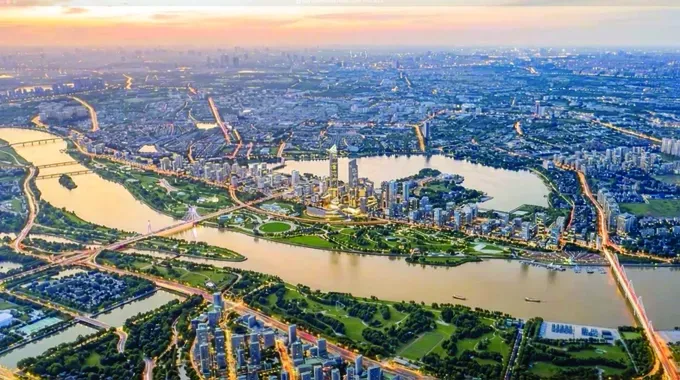
Addressing these concerns, Hong Ha Ward stated the project includes massive parks and riverbank beautification. Local authorities consider resettlement a pivotal task, rigorously reviewing demographic data and excelling in mobilization efforts so everyone supports the expanding city.
Statistics from the Hanoi People’s Committee reveal that the current population within the project’s impact zone sits at roughly 247,431 people, equating to 70,474 households. It appears this sheer demographic scale is putting immense pressure on site clearance and resettlement operations.
However, the overarching stance of Hanoi’s leadership is to consistently safeguard the people’s legitimate rights and interests, minimizing any adverse impacts on their livelihoods, while ensuring every single step guarantees absolute openness and transparency.
Vice Chairman Truong Viet Dung of the Hanoi People’s Committee noted that to roll out the project and secure public consensus, the city is adopting a “one step ahead” strategy, prioritizing investments in resettlement and reconstruction projects before synchronizing other components.
Most notably, as a rule of thumb, the city guarantees that resettlement arrangements will adhere to the principle that the new residence must be equal to or strictly better than the old one. Meanwhile, the city has already prepared a massive real estate fund comprising 79,000 to 85,000 apartments and resettlement plots, fundamentally satisfying the relocation demand.
Among these, the urban area in Long Bien will supply around 40,000 to 42,000 apartments; the Linh Nam urban area will chip in 15,000 to 16,000 apartments. At the end of the day, the 700-hectare multi-purpose urban area in Thu Lam (Dong Anh Commune) is also finalizing its 1/500 master plan, adding between 16,000 and 18,000 resettlement plots to the mix.
Hydraulic calculations completed to ensure safety during storm seasons
Regarding water management and flood discharge safety, the Ministry of Agriculture and Rural Development, alongside the Hanoi People’s Committee, reportedly just greenlighted the hydraulic calculation report, reaching a firm consensus on matters related to dike safety.
Specifically, the project dedicates an entire subset of component projects to invest in embanking and regulating 33.9km of the left bank and 30.8km of the right bank.
According to several irrigation and dike experts, the flood discharge corridor has been the most glaring bottleneck for the Red River’s riverside space over the years. However, this time around, harmonizing the water management puzzle will empower authorities to confidently push forward with embankments and riverbank regulation. This won’t just guarantee safety for citizens during tempestuous storm seasons, but it’ll also carve out a sustainable ecological space for Hanoi’s future.