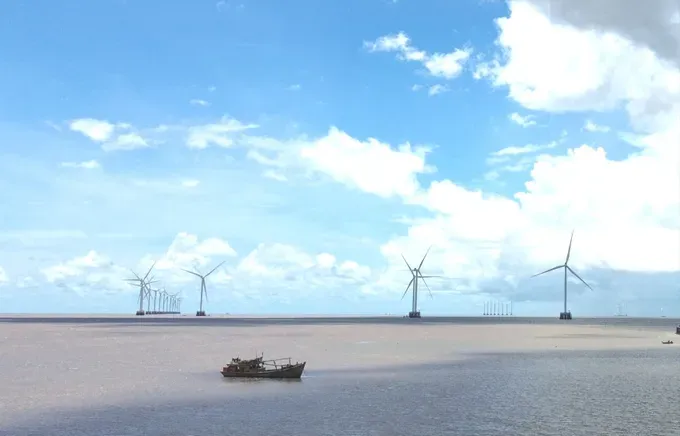
The Mekong Delta has recently attracted strong interest from renewable energy investors, particularly in wind power, as many localities aim to position themselves as green energy hubs for both the country and the wider region. However, the implementation of wind power projects is encountering numerous obstacles that require urgent resolution.
Ca Mau Province currently has 14 wind power plants in commercial operation, with a combined capacity of 694 MW. By 2026, the Province expects four additional wind power projects, totaling 417 MW, to be completed and put into operation. Despite this momentum, several projects are facing significant difficulties. Notably, Bac Lieu Wind Power Plant – Phase 3, with a capacity of 141 MW and invested by Super Wind Energy Company, has completed construction of 33 turbines but remains stalled due to land acquisition issues, as affected households are demanding compensation levels higher than regulated rates.
Another project, Khai Long – Ca Mau Tourist Area Wind Power Plant Phase 1 (100 MW), invested by BCG Khai Long 1 Wind Power Joint Stock Company, is encountering challenges in connecting to the national power grid. Although the project’s feasibility study has been completed, progress has stalled because Khai Long Wind Power Plant Phase 2 has not yet selected an investor, leaving shared transmission infrastructure unresolved. To address this, the investor has proposed adjusting the connection plan by investing directly in a 110 kV transmission line, rather than depending on Phase 2 of the project.
According to many investors, the current transmission grid infrastructure has not kept pace with the rapid development of renewable energy. In several areas, particularly in Vinh Long Province, grid overloading and congestion have prevented projects from fully transmitting generated power, leading to inefficiencies and wasted social resources.
At the conference “Renewable Energy in the Mekong Delta – A New Breakthrough in Green and Circular Economy Development,” recently held in Vinh Long, Bui Van Thinh, Chairman of Binh Thuan Solar and Wind Power Association, noted that investment in wind power has slowed compared to the 2018–2021 period, largely due to electricity pricing mechanisms. He explained that wind power investors must install wind measurement towers before bidding, each costing between VND2 billion–VND3 billion and requiring at least 12 months of data collection, resulting in high upfront costs. Even after winning bids, investors often spend an additional 1–1.5 years negotiating power purchase agreements, while still facing uncertainty over grid capacity to absorb output, significantly increasing project risks.
According to To Minh Duong, Deputy Director of the Department of Industry and Trade of Ca Mau Province, the provincial People’s Committee has established a working group to address obstacles facing wind power projects. Regarding land acquisition at Bac Lieu Wind Power Plant – Phase 3, local authorities are actively working to persuade residents to accept the approved compensation plan. For Khai Long Tourist Area Wind Power Plant Phase 1, the department has advised the provincial leadership to report the issue to the Ministry of Industry and Trade for consideration and adjustment. “We will focus on resolving issues within our authority, and where necessary, propose solutions to the central government,” Mr. Duong said.
Similarly, Tran Quoc Tuan, Director of the Department of Industry and Trade of Vinh Long Province, affirmed the Province’s commitment to supporting wind power investors. In particular, Vinh Long plans to proactively act as an “arbitrator” for shared infrastructure projects, rather than leaving enterprises to negotiate independently. Through the Department of Industry and Trade, the Province will take the lead in selecting and imposing unified plans for shared transmission lines to ensure synchronization, reduce investment costs, and make more efficient use of the power grid.
Vinh Long Province has also called on the central government and the electricity sector to accelerate investment in key transmission grid projects in the Mekong Delta, expand mechanisms for socialized investment in the power grid, and issue clearer and more transparent procedures for negotiating power purchase agreements. In addition, the Province has urged for specific guidance on converting forest land to energy land for wind power projects. The electricity sector, meanwhile, is expected to prioritize the development of 220–500 kV substations and transmission lines in areas with high wind potential, study the deployment of energy storage projects, and expedite technical appraisals and power purchase agreement signings for projects that have completed their dossiers.
Under development plans to 2030, many Mekong Delta localities aim to become renewable energy centers for the region and the country. Ca Mau Province alone plans to develop more than 3,000 MW of wind power across 48 projects, while Vinh Long Province targets a total renewable energy capacity of 4,179 MW. According to a survey by the Institute of Energy under the Ministry of Industry and Trade, Vinh Long has the potential to exploit around 3,900 MW of onshore and coastal wind power by 2030, in addition to approximately 1,000 MW of offshore wind power.