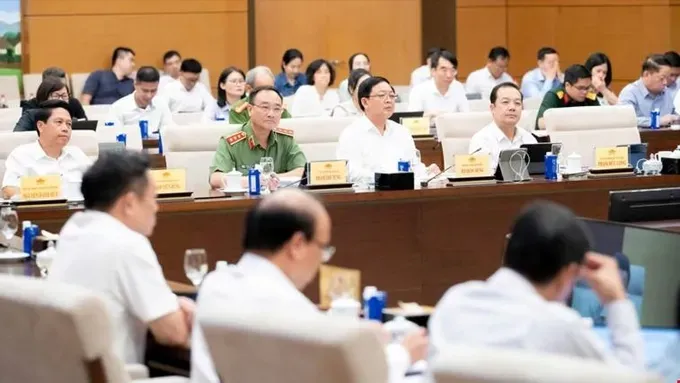
Late in the afternoon on September 23, the National Assembly Standing Committee gave opinions on the draft Law on Handling of Administrative Violations (Amended).
The draft law proposes raising the maximum administrative fine for individuals from VND1 billion to VND1.5 billion, and for organizations from VND2 billion to VND3 billion.
It also proposes adding several fields where maximum fine levels could be applied up to two times higher than the general fine for the same violation in cities and special economic zones.
Furthermore, the draft increases fine limits for summary sanctioning without written reports, rising from VND500,000 to VND1 million for individuals, and from VND1 million to VND2 million for organizations.
Reviewing this content, Chairman Phan Chi Hieu of the National Assembly's Law and Justice Committee argued that setting fines too high, beyond the financial capacity of most individuals and businesses, would fail to yield effective results.
Therefore, alongside fine increases, more fundamental solutions should be considered, such as remedial measures and supplementary penalties (revoking licenses, suspending operations).
In addition, the draft law proposes adding new enforcement measures to compel execution of sanctioning decisions.
Specifically:
- Temporary exit suspension for individuals or legal representatives of organizations that have not fulfilled administrative sanctioning decisions when immediate prevention of absconding is deemed necessary.
- Sealing off headquarters, locations, facilities, or parts of production, business, and service facilities applied as enforcement for penalties.
- Requesting suspension of electricity and water supply for construction works, production, business, and service facilities as an enforcement measure; temporarily suspending vehicle inspection registration.
- Requesting suspension of internet services, telecommunications services, digital infrastructure, or implementing technical blocking and access restrictions for organizations and individuals failing to comply with penalties in the electronic environment as prescribed.
According to the Government's submission, one area of differing opinions involves adding enforcement measures that "request suspension of internet services, telecommunications services, digital infrastructure, or implement technical blocking and access restrictions against organizations and individuals non-compliant with penalties and remedial measures in the electronic environment."
Accordingly, some opinions suggested carefully evaluating the necessity and impact of this measure, as it could directly restrict the rights and interests of individuals and organizations.
Law and Justice Committee Chairman Phan Chi Hieu noted that adding certain enforcement measures requires further review and adjustment to ensure suitability and feasibility.
National Assembly Vice Chairman Nguyen Khac Dinh and Committee on Citizen Petitions and Supervision Chairwoman Le Thi Nga both emphasized the need for sufficiently strong measures to compel compliance with sanctioning decisions. However, strict conditions, orders, and procedures must be regulated to ensure the effectiveness of sanctioning decisions without unreasonably affecting citizens' fundamental rights.