According to recent data from the General Statistics Office, informal workers account for 61.9 percent of total employed people in Vietnam. The informal labor force is expanding, while social welfare policies have failed to keep pace.
Gig drivers face high hazards without safety nets
On Dang Van Tron street in Tran Bien Ward, Dong Nai City, on the afternoon of September 9, a pickup truck suddenly swerved into the oncoming lane, colliding with a car and two motorcycles. The pickup truck dragged a 39 year old Grab driver and his motorcycle onto the sidewalk, crashing into a residential wall. The accident killed the 39 year old Grab driver on the spot while he was en route to work.
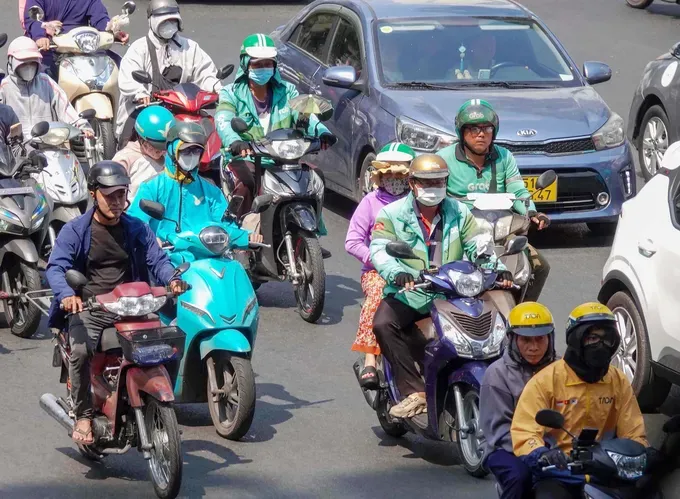
Traffic accidents like this represent a common risk faced by tech-based drivers (a segment of platform workers) while working. At the conference "Social Security for Tech Drivers - Current Situation and Solutions" jointly organized recently by the Labor Consultation and Support Center of the Ho Chi Minh City Labor Federation and Ho Chi Minh City Social Insurance, Vice Chairman Phung Thai Quang of the Ho Chi Minh City Labor Federation and Director of the center, observed that ride-hailing driving has become the primary livelihood for many workers.
In addition to working long hours in harsh environments, tech drivers frequently encounter risks such as traffic accidents, scams, robberies, and harassment.
A survey of 141 tech drivers active on the Grab, Green SM, and Be platforms conducted by the center revealed that 73.8 percent of drivers had experienced at least one collision or accident on their way to work, while over 65 percent had encountered situations involving scams, robberies, or harassment.
Meanwhile, drivers are designated as partners of digital platforms rather than employees under traditional labor relationships, leaving them outside the scope of mandatory social insurance, health insurance, and unemployment insurance.
Among the surveyed drivers, 73.4 percent reported participating in health insurance, primarily through household health insurance with trade union support, while the remainder had no insurance coverage. Furthermore, according to Ho Chi Minh City Social Insurance, among more than 400,000 active tech drivers in the city, only about 700 participate in voluntary social insurance.
Labor laws lag behind platform work
As the era of digital transformation unfolds, the country's digital economy is expanding at an impressive pace, serving as a bright spot in Southeast Asia. Alongside this momentum, the labor market is shifting significantly, with traditional employment models giving way to more flexible arrangements, most notably freelance and platform work.
A report released in December 2025 by the International Labour Organization (ILO) indicated that by 2024, Vietnam had approximately 7.5 million people working on digital platforms, accounting for nearly 14 percent of the total labor force. Figures from the Vietnam General Confederation of Labor show that over 70 percent of platform workers do not enter into labor contracts.
The relationship between workers and platform providers is mostly structured as a civil cooperation agreement, leaving workers vulnerable and without guaranteed rights regarding employment, income, insurance, or dispute resolution protection.
Amid the rapid advancement of the Fourth Industrial Revolution, information technology adoption, digital transformation, and artificial intelligence, the Ministry of Finance forecasts that several sectors employing large workforces such as garments, footwear, manufacturing, processing, and electronics assembly will accelerate automated machinery usage to replace direct labor.
Consequently, workers will have to transition into alternative employment forms, such as self-employment, delivery and transport services, retail, brokerage, short-term work under one month, or part-time informal labor.
Informal workers face shared disadvantages, including job insecurity, low income, absence of labor contracts, lack of mandatory social insurance, and exclusion from allowances or social welfare benefits.
According to lecturer Dinh Thi Chien at Ho Chi Minh City University of Law, the primary cause of this situation is the lack of legal regulations governing new labor models. Current labor, social insurance, occupational safety and health, and employment laws remain anchored in traditional labor structures. They lack a defined legal concept for platform-based employment relationships, creating regulatory gaps in working conditions, social security, and collective bargaining representation.
Ministries debate social insurance expansion
To expand coverage and guarantee social security for workers, the Ministry of Finance recently submitted recommendations on the draft Law amending and supplementing several articles of the 2024 Law on Social Insurance. The ministry proposed adding mandatory social insurance coverage for individuals earning income from services, delivery, transport, retail including lottery agents and mobile lottery vendors, online sales, brokerage, digital platforms, technology apps, or flexible employment models.
This proposal aligns with recommendations from National Assembly delegations in Ho Chi Minh City, Hanoi, and Gia Lai, as well as local governments and internal affairs departments across various localities, including Hanoi, Hue, Dong Nai, Ha Tinh, Nghe An, Vinh Long, Son La, Hung Yen, Lao Cai, Dak Lak, Phu Tho, and Dien Bien.
Explaining the basis for its proposal, the Ministry of Finance cited actual employment relationships (where platforms control pricing, dictate schedules, and evaluate performance), workers' social security rights, alignment with labor contract provisions in the 2019 Labor Code and 2024 Law on Social Insurance, international labor conventions, and Resolution No. 28-NQ/TW on expanding social insurance coverage toward universal social security while protecting workers against health risks.
In response, the Ministry of Home Affairs—the drafting agency for the bill—noted that the 2024 Law on Social Insurance added five new categories to mandatory social insurance. The National Assembly Standing Committee will determine mandatory social insurance expansion for additional groups with stable jobs and regular incomes based on government proposals suited to socioeconomic conditions in each period.
Since the 2024 Law on Social Insurance has been implemented for just over a year, adding further groups to mandatory social insurance requires careful evaluation across multiple aspects to ensure legal consistency regarding contributions, benefits processing, and legal liability. Therefore, the Ministry of Home Affairs will coordinate with the Ministry of Finance and relevant ministries to conduct thorough research before submitting recommendations to competent authorities for consideration.
According to the Ministry of Home Affairs, informal workers who are not subject to compulsory social insurance are eligible to participate in voluntary social insurance. The Party and the State have implemented various policies to support and encourage workers to join the voluntary social insurance scheme, such as contribution subsidies and one-off maternity allowances.