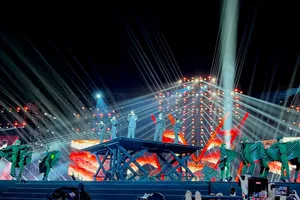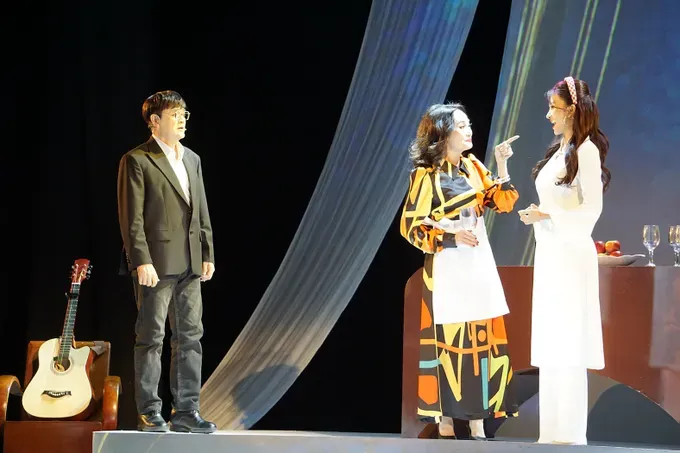
The two performances of “Ao xua du nhau” (Though the Old Tunic is Rumpled) by the Moon Stage at Saigon Opera House on the evenings of August 29 and 30 drew massive crowds. Scripted by Nguyen Thi Minh Nguyet and artistically advised by People’s Artist Tran Ngoc Giau, the play drew its creative inspiration from Cao Huy Thuan’s short story “Soi toc” (A Strand of Hair).
The original work inherently lacks direct conflicts, primarily placing humans before the fragile boundary of morality and self-respect. From that raw material, Nguyet masterfully developed a narrative revolving around four characters alongside a tragic incident causing agonizing misunderstandings and a prolonged 10-year separation.
The performance seamlessly integrates spoken drama with Trinh Cong Son’s haunting music, fine arts, dynamic lighting, and projected imagery. Thanks to this synergy, it has left a profoundly unique impression, forging a refreshing novelty for the HCMC theatrical scene during this year’s holiday.
For Ms. Le Thi Mai, a local theatergoer, this visual blend made all the difference. “It’s not just a traditional play; the combination of music and lighting genuinely amplifies the emotional weight,” she explained outside the theater.
Subsequently, on the evening of September 2, Xom Kich Stage officially premiered “Pheo” at HCMC Intermediate Dance School. Scripted, directed, and acted by Meritorious Artist Vu Xuan Trang himself, the play was heavily adapted from Nam Cao’s classic “Chi Pheo”. This theatrical adaptation heavily focused on the profound dreams and the desperate yearning for redemption of the male lead, Chi Pheo, as well as the fundamental right to be recognized as a human being.
In reality, during recent performing seasons, the HCMC stage has recorded a substantial number of plays meticulously constructed from literary works. A prime example is IDECAF Drama Theater’s massive investment in “Duoi bong giai nhan” (In the Shadow of a Beauty), directed and scripted by Quang Thao, drawing inspiration from “Truyen Kieu” (The Tale of Kieu).
Another instance is “Ong gia doan lo to” (The Old Man of the Lotto Troupe), deeply inspired by writer Nguyen Ngoc Tu’s short story. She is a prolific writer whose numerous works are frequently adapted by city troupes, such as “Mot moi tinh” (A Romance), “Canh dong bat tan” (The Endless Field), and “Bao gio song can” (When the River Runs Dry). Several of these productions have achieved immense success, significantly contributing to forging a prestigious brand reputation for these bustling theatrical stages.
The paramount advantage of adapted drama is the inheritance of a robust ideological foundation, a compelling plotline, and a character system that has genuinely stood the test of time. The author’s prestige and the original work’s triumph also guarantee a loyal audience base, eagerly willing to hit the theaters to witness characters step directly out of the book pages.
However, literature and theater are undeniably two distinct genres boasting fundamentally different artistic languages. Literature can delve deeply into descriptive narratives, effortlessly penetrating the reader’s stream of consciousness. Meanwhile, a stage performance must captivate the audience through dynamic actions and palpable conflicts, channeled strictly through the direct, physical presence of the actors.
If the adapter relies too heavily on the original text, the play easily morphs into a mere illustration, heavily burdened with dialogue yet painfully lacking vitality. Conversely, adapting a deeply familiar piece forces scriptwriters into a tight corner when attempting to alter the storyline or character traits. They must meticulously deliberate before injecting comedic segments or trendy plot twists, as it’s highly susceptible to triggering backlash from an audience already accustomed to the original masterpiece.
Consequently, the more familiar the adapted work is, the more immense pressure the production crew bears regarding the public’s ingrained memories and inevitable comparisons.
Another pressing issue is that literature shouldn’t be viewed as a mere “lifebuoy” for the current severe shortage of high-quality scripts. If they strictly rely on renowned works, theaters run the hazardous risk of responding sluggishly to the burning issues of modern urban life, family dynamics, the environment, technological advancements, and the intricate psychological transformations of today’s humanity.
Therefore, developing literature-adapted drama must run parallel with nurturing new authors and commissioning fresh scripts. It’s compulsory to facilitate writers, playwrights, and directors to compose works carrying the vibrant breath and voice of this era, thereby contributing to a lively theatrical ecosystem that adequately meets the contemporary audience’s soaring entertainment demands.
For Meritorious Artist Ca Le Hong, a veteran in the local theater scene, this literary resurgence brings a sense of profound optimism.
“The fact that audiences care about literary drama is an immensely encouraging signal because literature harbors profound stories, vivid characters, and rock-solid ideologies,” she explained, reflecting on the current theatrical landscape. “However, not every great masterpiece is inherently suitable for the stage. The adapter must carefully select elements, forge dynamic actions, and create theatrical conflicts while steadfastly preserving the original spirit without blindly chasing easy, superficial trends,” the artist said.


)