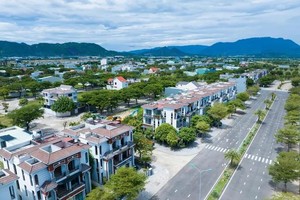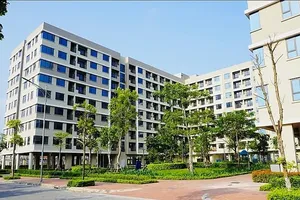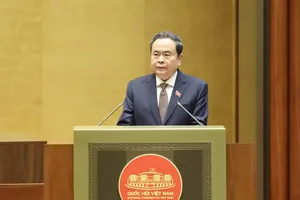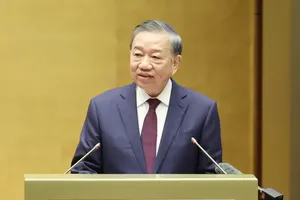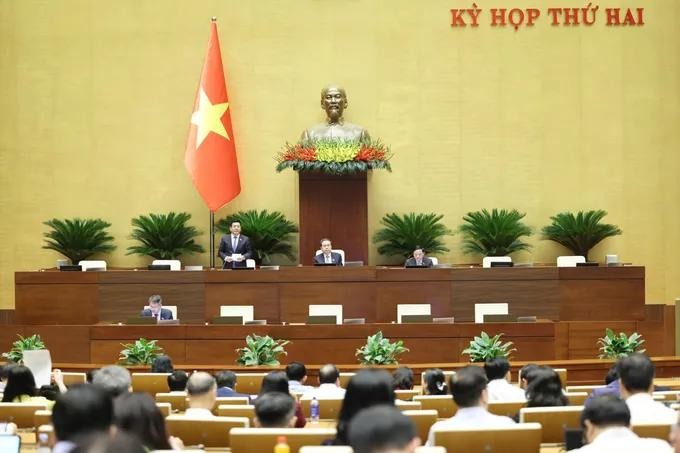
On the morning of October 22, National Assembly deputies heard the Government’s proposal and a review report on the draft revised Housing Law. The reviewing body urged measures to prevent abuse of housing policies and curb housing speculation.
Rental housing development promoted
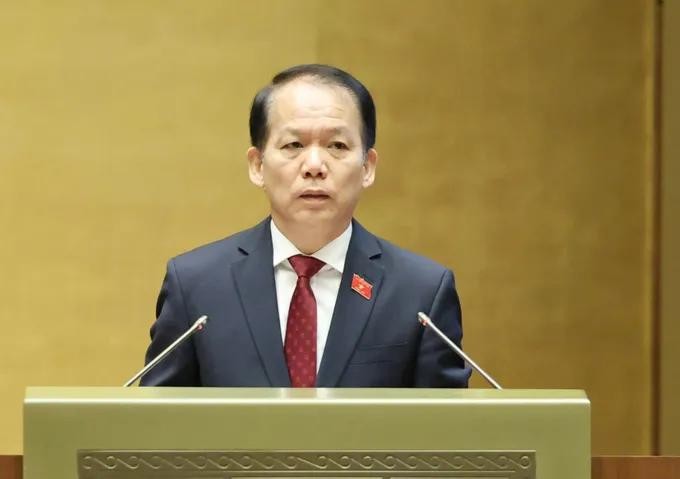
Presenting the Government’s proposal, Justice Minister Hoang Thanh Tung said the draft revised Housing Law fully institutionalizes the Party’s and State’s viewpoints, guidelines, and policies. It focuses on housing development with the goal of ensuring that everyone has a place to live, linked to social welfare guarantees, while introducing breakthrough policies to develop rental housing and meet people’s housing needs.
The draft revises and supplements provisions on the development of four housing categories and the corresponding policies for each category. These include commercial housing, rental housing, official residences, and policy-based housing.
The draft adds a new chapter on rental housing development and amends regulations on housing ownership in Vietnam by foreign organizations and individuals to align with Resolution No. 21-NQ/TW and the draft revised Land Law. Under the proposal, the provision allowing foreign organizations and individuals to own detached houses would be removed.
The draft law also refines policies on renovating and rebuilding apartment buildings, adding implementation principles linked to urban renewal and simplifying procedures for selecting project investors. In addition, it introduces public-private partnership investment in the form of build-transfer (BT) contracts, helping diversify resource mobilization methods for projects.
The proposal also revises regulations on areas where the subdivision and sale of land plots are restricted, applying them to Class III urban centers and other areas. Local authorities would be empowered to determine areas where land subdivision and sale are permitted.
At the same time, provincial people’s committees would be authorized to decide whether investors in commercial housing projects must reserve part of the residential land area within projects, allocate residential land at another location outside the project, or make an equivalent monetary payment. The provision is intended to ensure investors fulfill obligations related to rental housing and social housing.
Social housing can be resold after five years if eligibility requirements are met
The draft revises provisions on the resale of social housing after five years. Specifically, after five years from the date the buyer has fully paid for the home, the owner may resell it to eligible social housing purchasers, provided a certificate of ownership has been issued. Personal income tax obligations would be implemented in accordance with tax laws.
The draft also revises rental pricing rules to ensure that State incentives for rental housing are translated into rental price benefits for tenants. Rental rates would be agreed upon between investors and tenants and calculated based on the full recovery of construction investment costs, maintenance funds, operating expenses, taxes, fees, charges, other legitimate costs, and profits under the business plan. Rental rates must not exceed the pricing framework set by provincial people’s committees.

While presenting the review report, Chairman Phan Chi Hieu of the National Assembly’s Committee for Legal and Judicial Affairs called for strict and transparent controls over beneficiaries of preferential housing policies to prevent policy abuse.
He also stressed the need to curb housing speculation, minimize the subdivision and sale of land plots in urban areas, particularly major cities, and introduce incentive mechanisms to encourage the development of reasonably priced rental housing that meets people’s housing needs.