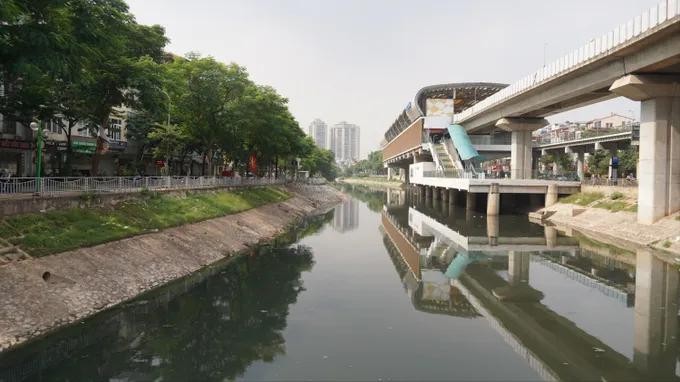
On hot days, along many inner-city rivers in Hanoi city, foul odors still drift into residential areas with the wind. Along several sections of the Kim Nguu and Lu rivers, the water is pitch-black and covered in scum. Numerous sewer outlets carrying wastewater from residential areas still discharge directly into the rivers, causing these waterways in the heart of the urban area to suffer ongoing pollution.
Resident Pham Trung Phong, 67, in Hoang Mai Ward near the Set River, shared that the foul odor rising from the wastewater severely affects residents' health and daily activities.
“In the hot season, air pollution gets even worse. Besides spreading bad smells, polluted canal water causes mosquitoes to breed heavily, raising the risk of disease outbreaks. Not a few families have had to relocate because they could not bear the pollution,” Phong said.
According to the Project on "Restoring Environmental Quality and Developing the System of Four Inner-City Rivers: To Lich, Kim Nguu, Lu, and Set," domestic wastewater accounts for about 81 percent of the city's total surface water pollution load.
Total domestic wastewater volume across the city reaches approximately 960,000 cubic meters per day and night. On the inner-city river routes alone, the number of discharge outlets remains large, including 90 culverts along the Set River, 93 along the Lu River, and 76 along the Kim Nguu River.
Deputy Director Nguyen Minh Tan of the Hanoi Department of Agriculture and Environment said inner-city rivers are under immense pressure from urbanization, population growth, and socioeconomic development activities. Over a long period, many rivers have received large volumes of untreated wastewater while suffering from diminished flows, narrowed spatial areas, and a gradual loss of natural functions.
At many locations, pollution parameters such as BOD5, COD, nitrogen, and phosphorus exceed national standards multiple times, with dissolved oxygen concentration dropping below 0.5 mg/L at times. When oxygen levels in the water drop severely, the rivers' self-cleaning capacity is restricted, and the aquatic ecosystem suffers as well.
Hanoi establishes green corridors
Starting in 2025, Hanoi has implemented comprehensive solutions to restore the To Lich River. Wastewater on the river is being incrementally collected and channeled to the Yen Xa Wastewater Treatment Plant, with a flow rate of around 200,000 to 230,000 cubic meters per day and night. Simultaneously, the city replenishes water from West Lake and the Red River at a flow rate of about 200,000 to 270,000 cubic meters per day and night, helping maintain a stable water level of around 3.5 meters.
These measures lay the groundwork for the city to continue restoring the remaining rivers, moving toward basin-wide pollution treatment rather than handling individual river sections separately.
In July 2025, the Hanoi People's Committee approved the Project on Restoring Environmental Quality and Developing the System of Four Inner-City Rivers: To Lich, Kim Nguu, Lu, and Set, featuring 32 programs and projects to be implemented during the 2025–2030 period. The project focuses on wastewater collection and treatment, pollution source control, water replenishment, flow improvement, and riverside landscape renovation.
By 2030, Hanoi city aims to collect and treat 100 percent of wastewater generated within the river basins according to quality standards, while raising the urban wastewater treatment rate across the entire city to between 50 and 55 percent. The Yen Xa Wastewater Treatment Plant, designed with a capacity of 270,000 cubic meters per day and night, continues to play a vital role in reducing the volume of untreated wastewater flowing into the inner-city river system.
For the Lu River, an interceptor sewer pipeline over 7.6 km long is being deployed to collect wastewater along both banks and convey it to the Yen Xa Wastewater Treatment Plant. In parallel, dredging and treating contaminated bottom sludge along the To Lich, Kim Nguu, Lu, and Set rivers are set to eliminate residual pollution sources and improve drainage capacity.
Another critical approach is water replenishment to maintain ecological flow during the dry season. Hanoi is studying options to supplement water from the Red River or via Ho Tay (West Lake), the Nhue River, and the Duong River, while calculating connections between the system of four rivers and 125 regulating lakes in the inner city alongside the Yen So pumping station. These solutions will contribute both to water regulation and to drainage support during the rainy season.