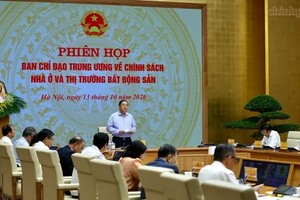
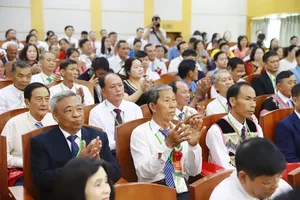
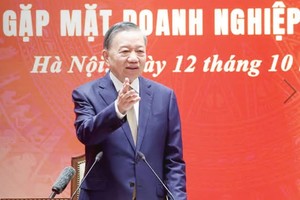
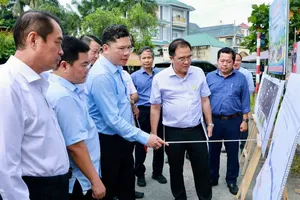
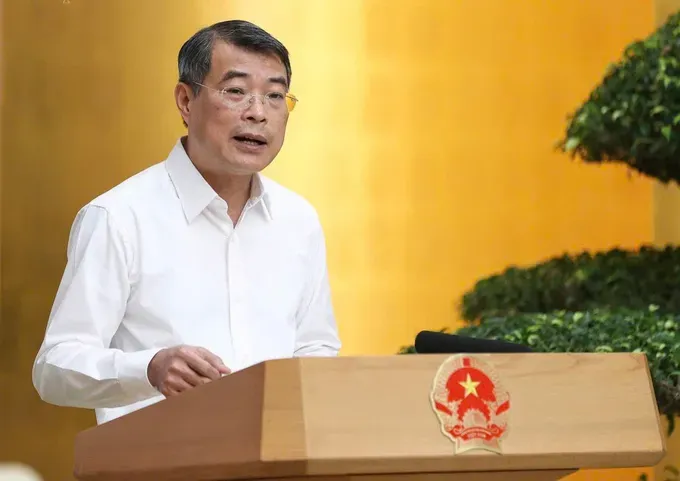
Prime Minister Le Minh Hung, Head of the Central Steering Committee for the National Target Program on social, cultural, rural development in ethnic minority and mountainous areas for the 2026–2035 period on the morning of October 15 chaired a conference to implement the program.
Information at the conference indicated that in executing Resolution No. 46/2026/QH16 approving the investment policy for the program, the Government issued Decree No. 367/2026/ND-CP specifying details, mechanisms, and policies for implementation. Simultaneously, the Prime Minister issued Decision No. 1966/QD-TTg to consolidate the central steering committee and orient the consolidation of local steering committees.
According to Minister of Finance Ngo Van Tuan, consolidating four national target programs into one unified program reorganizes management, administration, and execution. The new framework grants more authority to localities while demanding higher accountability, simplifying procedures while requiring stricter financial discipline.
In his concluding remarks, Prime Minister Le Minh Hung emphasized that the integrated program covers a very broad scope, incorporating multiple goals, sectors, policy beneficiaries, and resources directly related to people's livelihoods, especially in rural, ethnic minority, and mountainous areas, as well as vulnerable populations and policy-beneficiary group. The requirement is to organize unified and continuous implementation, ensuring that the transition to the new program does not disrupt policies, tasks, and legitimate rights of the people.
Under the motto "synchronized policies - unified action," with people as the central subject, the Prime Minister requested focusing on strictly grasping and implementing key tasks. Specifically, the integration of national target programs must create substantive changes in management, reduce focal points and procedures, overcome dispersion and duplication, and enhance resource efficiency. It must ensure no changes or narrowing of targets, scope, beneficiaries, rights, and priority levels approved by the National Assembly, while avoiding task or policy disruptions during the transition.
Along with that, administrative decentralization and delegation of power must be accelerated alongside necessary resources, execution conditions, and supervision. Local initiative and creativity should be enhanced based on the principle that local authorities decide, implement, and hold ultimate responsibility for results.
The Prime Minister pointed out the need to concentrate state resources on focused and key investments, prioritizing essential tasks that directly impact people's lives such as daily water, residential land, production land, and ensuring livelihoods, disadvantaged areas, and vulnerable groups. Investments must avoid dispersion and duplication, while strictly preventing loss, waste, and negative practices, linking leaders' responsibilities to implementation results.
The Prime Minister required provincial and municipal people's committees to focus on accelerating the execution and disbursement of central budget funds from the 2021-2025 national target programs carried over to 2026 (the current execution and disbursement rate remains low at around 39 percent). Localities must proactively mobilize local matching funds, effectively combine legitimate resources, and leverage policy credit, commercial credit, and contributions from businesses, cooperatives, and communities.
The Prime Minister emphasized the determination to effectively implement the program, contributing to building modern new rural areas, achieving sustainable poverty reduction, fostering sustainable economic development, ensuring social security, comprehensively developing ethnic minority and mountainous areas, and preserving national cultural identity while ensuring all citizens enjoy development achievements with no one left behind.