Across generations, that memory has been preserved not only in history books but also in family traditions, village markets, the sound of traditional flutes, reunion meals and journeys home.
Independence Day in new homes
")
On a morning in Muong Than Commune, Lai Chau Province, the autumn sunlight poured like honey over the new houses. In yards not yet shaded by trees, children ran about, chattering. Their calls and laughter gave the resettlement area, still bearing the scars of a land recently ravaged by natural disasters, a new rhythm of life. Adults slowly arranged their belongings and looked around their homes in amazement, as only a short time earlier they had not known where to begin again.
On July 17, 2026, a flash flood in Muong Than left 17 people dead or injured and swept away or buried hundreds of hectares of rice fields and crops, livestock and property. Numerous transportation, electricity and water facilities were damaged, with total losses estimated at nearly VND250 billion. Twenty-four households lost their homes.
The family of Nung Thi Tu was among the first to receive a resettlement home. Recalling the day the flood struck, she said the house and all the property her family had painstakingly accumulated over many years were swept away. The greatest blessing was that the entire family remained safe. After 16 days of living in temporary conditions and anxiously watching prolonged rains, stepping into the new home brought Tu a simple wish: to be able to work and rebuild her life with peace of mind.
“Now that we have a new home, my family will work hard to stabilize our lives,” Tu said.
In front of the houses, rows of trees planted and tended by soldiers and local residents had just begun to take root. Inside, belongings were gradually finding their places. Outside, children already had space to play. The houses, built in a short time through the joint efforts of the military, police, agencies, businesses and people from many places, now carry the everyday sounds of a residential community: people calling to one another, children's laughter and cries, and the bustle of footsteps coming and going.
The homes were completed just in time for Independence Day. Along highland roads, the red national flags were beginning to brighten the landscape. For families who have just survived devastating floods, this year's Independence Day carries an added meaning: returning to a normal rhythm of life and standing once again on their own land to make a new beginning.
.")
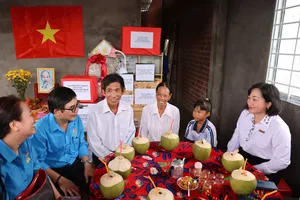
In neighboring Muong Kim Commune, Hoang Van Tien is also preparing to celebrate Independence Day. Every year, his family does simple things: cleaning the house, rearranging the ancestral altar and hanging the national flag in front of the gate. On the altar are neatly arranged three portraits: President Ho Chi Minh, General Vo Nguyen Giap and Party General Secretary Nguyen Phu Trong. Tien looks at each portrait before turning his gaze toward the flag in front of the house.
“Thanks to the Party and President Ho Chi Minh, my family and the people in the village have the prosperous life we have today,” Tien said.
A major festival
Hang Thi Sua, 38, from Than Uyen Commune, Lai Chau Province, has looked forward to Independence Day since she was a child. On the misty morning of September 2 each year, her parents would take her down to the town center to join the celebrations. As she grew older, she went with groups of friends from her village. It was also through those trips to the town center that she met her future husband.
Now a wife and mother, she remains excited about the holiday. Since August, she has been preparing to travel to the town center with her husband and children.
Sua's story is also the story of many H'Mong people in Than Uyen and neighboring Communes. From late August, highland villages begin preparing for September 2. Women finish the final touches on the finest traditional outfits they will wear when going into town, while cleaning and rearranging their homes. Men take time to meet and practice traditional flute and reed-pipe melodies so they can socialize and perform at the festival.
But Independence Day did not begin as the major festival it is today. Vang San Suoi, 72, from Than Uyen Commune, said that in the past, H'Mong people celebrated only one Tet festival at the end of the year. After September 2, 1945, National Day gradually became a second Tet celebration.
In the early years, people called it the Festival Day. Every September 2 morning, people from different villages would make their way to the center to meet, socialize and shop. Roads were difficult at the time, and those living in remote villages sometimes had to descend the mountains the previous afternoon to arrive in time for the celebration and morning market. Young and old, men and women alike wore their finest clothes. When they met, they played flutes, danced, sang and enjoyed themselves.
A national holiday thus became an annual gathering for communities living amid the mountains and forests of the Northwest.
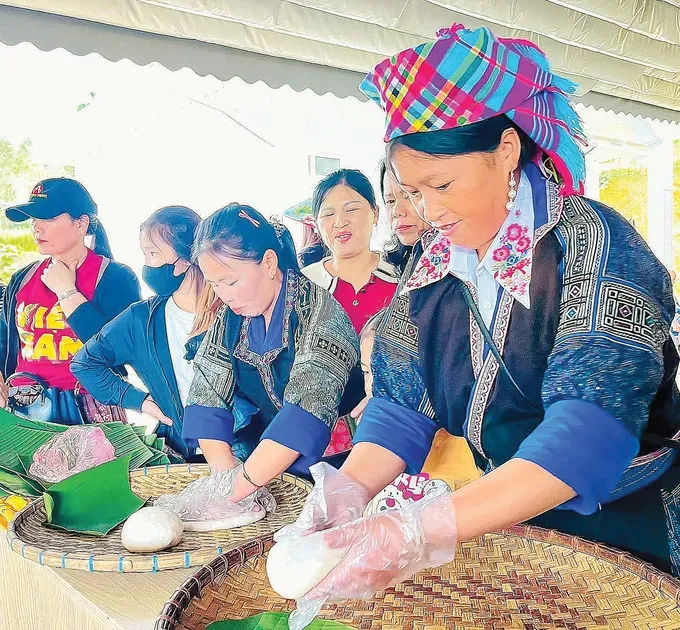
In 2012, Than Uyen organized its first Cultural and Sports Festival of the H'Mong ethnic group over two days, September 1-2. Since then, Independence Day has been associated with the Than Uyen Cultural, Sports and Tourism Festival, gradually becoming a cultural hallmark of Than Uyen Commune, Lai Chau Province and the Northwest region.
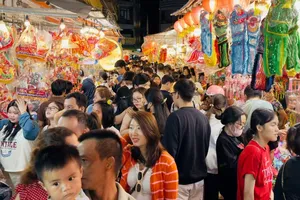
As the festival has expanded, so has the space in which Independence Day is celebrated. People no longer gather only at the stadium. The Nam Pat market, Ta Gia night market, Thai, H'Mong, Dao and Kho Mu cultural spaces, and tourist sites in Muong Kim, Muong Than and Khoen On all form part of the series of activities.
Visitors can watch horse races, visit markets, listen to traditional flutes, sample local dishes and follow roads into the villages to get closer to the daily lives of local communities.
Returning to the former resistance base to celebrate September 2
Leaving the festivities in Than Uyen and traveling to the Muong Khoi area, now part of Dai Dong Commune, Phu Tho Province, Independence Day takes on a different rhythm.
Here, the Muong people call Independence Day by a simple name that is celebrating Second Day. The name Independence Day has become common only in recent years, while celebrating Second Day has been passed down among the Muong through generations.
Several days before September 2, families begin preparing. Glutinous rice is readied, bamboo leaves are dried in advance, and glutinous rice flour is kneaded and shaped into small cakes, sprinkled with peanuts and sesame and wrapped in leaves. Uoi cake - Muong sticky rice cake - is placed on the family meal tray, served to guests and wrapped as gifts at the end of the meal.
But Festival Day does not begin only in the kitchen. It is also a day when people wait for relatives to return home.
Bui Thi Khiem, 62, from Dai Dong Commune, said she had known about celebrating Independence Day since she was a child. After starting her own family, she continued the tradition so her children could return home for a family reunion. For people born and raised in Muong land, the holiday has gradually become as familiar as the traditional Lunar New Year.
Bui Thien Van, a former official of the former Lac Son District Culture Office, said that beyond the memory of Independence Day, the Muong Khoi area also carries another layer of memory — the Muong Khoi Resistance Base.
The area once hosted the Truong Son guerrilla anti-Japanese military training school in late July and early August 1945. When news of the General Uprising reached the area, on the night of August 19, people from the hamlets gathered with self-defense forces carrying torches and singing revolutionary songs.
Two days later, nearly 50 self-defense fighters and hundreds of local residents headed toward Hoa Binh town. On August 23, 1945, the people seized control of Hoa Binh town.
By National Day on September 2, elders and local authorities organized rallies as well as cultural and sports activities, slaughtered buffaloes to share among residents for the celebrations, and had families set up altars to the Fatherland and display flags and portraits of President Ho Chi Minh.
From then on, Festival Day became a tradition and eventually a custom.
These stories have passed through generations, following people who have moved away and later returned home to celebrate Independence Day.
More than 20 years ago, Bui Van Binh, 40, left Muong Khoi for Hanoi to build a career. In that time, the road home has changed dramatically. High-rise buildings gradually replaced old houses along the road, while the bamboo hedges beside rice fields were no longer continuous as they had been when he left.
Yet every late August, he arranges his work schedule and takes his wife and children from Hanoi back home to celebrate Festival Day.
In the early years, he traveled by bus. The old vehicle had cramped seats and a sputtering engine; many sections of the road were bumpy, and the bus repeatedly stopped to squeeze in more goods and passengers.
Later, after getting a motorbike, he drove his wife and children more than 100 kilometers home. On one trip in the rain, their young child sat between the couple, and the entire family arrived soaked.
This year, a car stops in front of the gate. Binh switches off the engine. The children open the doors and run down, calling out, “Grandpa and Grandma, we're home!”
His wife, Pham Thi Hang, hurries into the kitchen, where her mother-in-law has prepared a full family feast. Nearly 20 years as a daughter-in-law have also meant nearly 20 times that Hang has returned home with her husband and children to celebrate Festival Day.
Perhaps the enduring value of a national holiday lies in such simple things. After 81 years, Independence Day is both a milestone in history and a deeply rooted way of life which is a reunion between those who stay and those who have gone far away, between generations of a family, and between the present and the memories of their ancestors.
From Muong Than to Than Uyen, and from Muong Kim to Muong Khoi, every August these places connect the present with that historic autumn. Red flags fly over newly built homes, in front of traditional houses and beside highland markets, while along the roads, people who have moved away return home to celebrate Independence Day.
Since 2023, the Lai Chau Provincial Party Committee's Standing Committee has agreed to organize a province-level Independence Day celebration every year on the occasion of National Day in Than Uyen District (now Than Uyen Commune).
The province has also identified preserving and promoting this tradition in conjunction with tourism development as a priority, aiming to turn Independence Day into an attractive cultural tourism product with Lai Chau's distinctive character.
Horse races, markets and experiential activities draw visitors beyond the stage and into every corner of the region. Independence Day is held over several days, but what Lai Chau seeks to preserve goes beyond a festival. It is a shared community memory passed down through generations and continuing to live on in today's daily life.