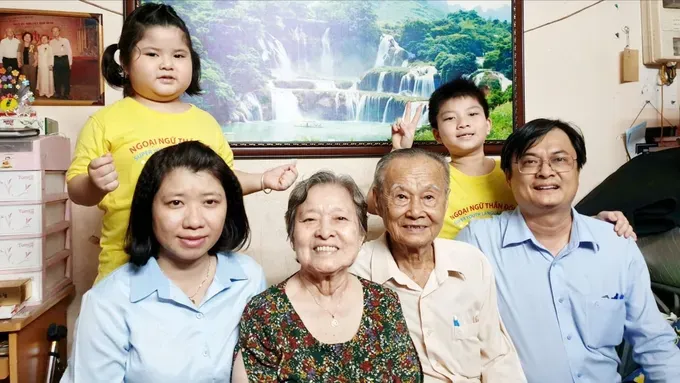
Born in 1934 in Tan Nhut Commune of HCMC, Le Hong Tu learned blacksmithing at age 14. At the time, French colonial forces were relentlessly sweeping the area. Workshop owners ruthlessly exploited workers, pushing laborers into starvation. Nurturing an ambition to overthrow this unjust society, Mr. Tu pursued his education and became enlightened by the revolution.
He actively joined the patriotic student organization operating under the Saigon Zone of the Vietnam National Salvation Youth Union. Having narrowly escaped capture multiple times, he was forced to frequently change jobs. Wherever his journey took him, he’d immediately build strong revolutionary bases.
In 1955, he served as the Union’s Secretary at Van Lang School. It was here that he guided Ms. Nguyen Thi Chau into the organization. Although his heartfelt confession of love was passionate, it was met with a silent gaze. Because her family was destitute, Ms. Chau had firmly promised her mother she wouldn’t marry early in order to care for her young siblings.
Deeply understanding her chaotic worries, he didn’t pressure her. He stated the revolution would eventually triumph and everyone would secure the opportunity to build a happy family. For Mr. Tu, a fleeting evening meeting before embarking on a new mission became a defining moment. “Right now, you haven’t thought about getting married. But if that decision ever changes, please think about tonight, think about me,” he emotionally declared.
In late 1960, he covertly returned to Saigon to find his beloved. Riding a Mobylette to bypass undercover police, they convincingly played a romantic couple. They strategically discussed plans to distribute leaflets welcoming the National Liberation Front of South Vietnam. Before parting, he reiterated his vow: “Even if I have to travel entirely around the globe to reach you, I am perfectly willing.”
As she stepped onto the passenger bus, she looked back and called out his name emotionally. Nobody knew that simple wave preceded 15 grueling years of absolute separation. Ms. Chau was harshly imprisoned twice, with her final capture happening directly during the historic 1975 Saigon uprising.
Meanwhile, Mr. Tu was ruthlessly tortured in a grim prison environment for 15 agonizing years. He narrowly escaped execution exactly three times. Ultimately, his life was saved thanks to the iron-clad voice of justice and severe warnings issued by the National Liberation Front of South Vietnam, running parallel with fierce protests from the everyday masses.
“While our proud mountains stand and sacred waters flow,
As long as I draw breath, my love for you will glow.”
From Con Dao prison, death-row inmate Le Hong Tu sent his beloved Nguyen Thi Chau profound poetry overflowing with immense love. Ms. Chau understood his vows in the line “As long as I draw breath” weren’t merely romantic promises, but an unwavering belief in their nation’s blissful reunification.
For political prisoners of that tumultuous era like Mr. Tu and Ms. Chau, daily life inside the prison walls was undeniably an endless string of days facing brutal enemy interrogations. However, those savage torture tactics simply couldn’t extinguish their iron-clad communist will, nor could they completely crush their soaring aspirations for love.
A tiny signal from their “other half” instantly awakened fond memories of fighting side by side. Over half a century later, Mr. Tu still remembers vividly their meeting at Binh Tay Bridge. For his journey, she discreetly thrust a farewell gift into his hands consisting of a few essential items and exactly VND200 – a hard-earned sum she painstakingly saved by skipping breakfast for a whole month.
A tiny keepsake ultimately supplied immense fortitude, allowing the brave soldier to overcome savage beatings inside blood-soaked solitary cells. Meanwhile, a piece of silver scavenged from a garbage can, which he patiently filed into a heart engraved with a hammer and sickle and the initials “T.C.”, transformed into a priceless gift. It brilliantly ignited her hope for a joyous reunion.
For Mr. Tu, recounting the darkest moments reveals incredible strength. “My deepest memory actually occurred right as I was about to be dragged out to the execution grounds,” he emotionally shared. A fellow inmate passed a message stating his fiancée sent heartfelt regards. Later, when she visited Uncle Ho on his birthday in 1969, Ms. Chau respectfully declared she was firmly Le Hong Tu’s fiancée. For him, this public acknowledgment represented a massive sacrifice.
On the glorious day the South was liberated, the two resilient former prisoners hosted a beautifully simple wedding ceremony. Two years later, their beloved son was born amidst unblemished happiness.
Following April 30, 1975, Ms. Chau was assigned as Chairwoman of the Provisional Revolutionary People’s Committee of District 10, while he eventually retired as Vice Chairman of the HCMC Labor Confederation.
Brimming with pride and actively continuing the family’s patriotic tradition, their son, Mr. Le Nguyen Hong Quang, currently serves as the Head of the Inspection Commission of the Minh Phung Ward Party Committee in HCMC. His wife, Dr. Tran Thi Huyen Thanh (Secretary of the Dong Hung Thuan Ward Party Committee in HCMC), is also the daughter of two staunchly resilient former political prisoners from the fierce resistance war against America.
Having suffered a severe stroke recently, Ms. Chau unfortunately can’t speak anymore. However, whenever she listens to her husband recount their epic story, her gentle smile radiates pure happiness. Even at 92, he desperately wants to personally care for his life partner. As he patiently fed her, Mr. Tu confided, “Uncle Ho taught us to love our compatriots and our homeland. My absolute closest compatriots are my family. Why on earth shouldn’t we love each other?”
“My pristine dress of white, untouched by worldly sorrow,
Had never dared to dream of some far-off tomorrow.
Yet seeing our homeland bleed in this bitter endeavor,
I vow this purest white shall bind my heart forever.”
These are the deeply poignant verses that schoolgirl Nguyen Thi Chau carved directly into the grim walls of the General Police Directorate prison back in 1962 using only a simple hairpin.
“When first you spoke of love,
I faltered and withdrew.
Yet in my yearning soul,
My silent passions grew.
Our nation's march is long,
Our bleeding homeland cries.
I crushed my longing heart,
And silenced all replies.
They doomed you to your grave,
I wept within my cell.
Fierce wrath against our foes,
‘I am his wife,’ I tell.
My darling, I believe,
Your spirit will not die.
Despite their brutal laws,
I'll wait as years go by.”
This is the touching poem that Tran Trong Tan (former Deputy Secretary of the HCMC Party Committee) personally wrote and generously gifted to Mr. Le Hong Tu and Ms. Nguyen Thi Chau.