The initiative to prioritize early vehicle electrification in Con Dao Special Zone and four communes in Can Gio—Binh Khanh, An Thoi Dong, Can Gio, and Thanh An—has garnered significant public attention. To ensure a smooth transition, stakeholders stress the need for robust support policies, simplified procedures, synchronized charging infrastructure, and, above all, minimal disruption to residents' livelihoods.
Safeguarding long-term livelihoods
Con Dao Special Zone is slated for the most aggressive timeline. Beginning January 1, 2027, all operating buses must run on electricity or green energy. By June 1, 2027, the conversion of all motorcycles and motorbikes must be completed. By December 31, 2027, all automobiles excluding trucks over one metric ton and certain specialized vehicles—must transition.
The goal is for 100 percent of road vehicles circulating in Con Dao to use electricity or green energy by January 1, 2030. With approximately 9,656 motorcycles and 717 automobiles, Con Dao possesses a manageable vehicle volume for synchronized deployment. However, this rapid pace necessitates tailored support policies, particularly for those relying on vehicles for their daily subsistence.
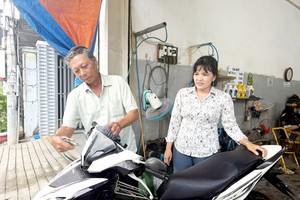
Tran Van Tuan, a vehicle service business owner on Nguyen Hue Street in Con Dao Special Zone, noted that motorbikes serve not only as transport and accumulated assets but also as core livelihood tools. "We agree with switching to electric vehicles, but we hope policies account for the financial capacity of different family groups. For poor households, near-poor households, and workers relying on vehicles for a living, mandatory vehicle replacement within a short timeframe could impose heavy financial burdens," Tuan stated.
According to Tuan, policies must clearly define support levels, disbursement timelines, procedures, and incidental conversion costs. For commercial drivers, ride-hailing operators, and shippers, charging wait times directly affect daily earnings. Consequently, charging stations must be strategically placed in residential areas, hotels, tourist sites, parking lots, commercial centers, and transit hubs. Battery-swapping cabinets are also essential to prevent electric motorcycle riders from losing hours waiting for recharges.
In Binh Khanh, An Thoi Dong, Can Gio, and Thanh An communes, vehicle volumes are much larger, totaling over 34,000 motorcycles and roughly 2,600 automobiles. Residents argue that charging infrastructure should not be concentrated solely in urban centers but distributed according to actual demand, primarily in residential zones, high-traffic corridors, and frequent commuting routes.
Nguyen Tan Nha, owner of a motorbike dealership in Can Gio commune, suggested that transition policies should be categorized by income group and vehicle usage purpose. Poor households require the highest tier of financial assistance, near-poor households can benefit from a mix of direct aid and preferential loans, and commercial workers need comprehensive support covering both vehicles and operational conditions. Transport businesses similarly require preferential credit, interest rate subsidies, and extended transition timelines to plan their investments effectively.
Targeted support and anti-fraud measures
Under the proposed framework, poor households will receive full coverage for the value of an electric motorbike and associated fees, while near-poor households will receive substantial cost-sharing. For transport businesses, Ho Chi Minh City plans to offer vehicle investment subsidies and preferential credit while encouraging private investment in charging infrastructure.
Bui Hoa An, Deputy Director of the Ho Chi Minh City Department of Construction, stated that alongside the technical roadmap, the proposal dedicates significant focus to financial support policies to help citizens and businesses gradually transition. The city will also mobilize social resources to develop charging networks and battery-swapping cabinets, reducing fiscal pressure and expanding corporate participation.
A notable feature of the initiative is the complete digitization of application, review, and disbursement procedures. Residents and businesses can submit applications directly at commune-level people's committees or online via the VNeID platform. Processing times are estimated between 10 and 17 working days, depending on the target group.
However, digital procedures must be paired with grassroots assistance. For elderly residents or those unfamiliar with online systems, local officials must provide step-by-step guidance. Furthermore, support levels, eligibility criteria, processing progress, and results must remain transparent.
Alongside support policies, the framework mandates strict inspection, monitoring, and violation enforcement. Falsified declarations or attempts to exploit the policy for profit will result in denied support, while disbursed funds found to involve violations will be reclaimed according to regulations.
Con Dao Special Zone and the Can Gio area serve not only as early implementation pilots but also as testbeds for the feasibility and effectiveness of the vehicle transition policy. Practical insights gained here will provide the city with a solid foundation to evaluate and adjust policies before scaling them up to low-emission zones and other regions.