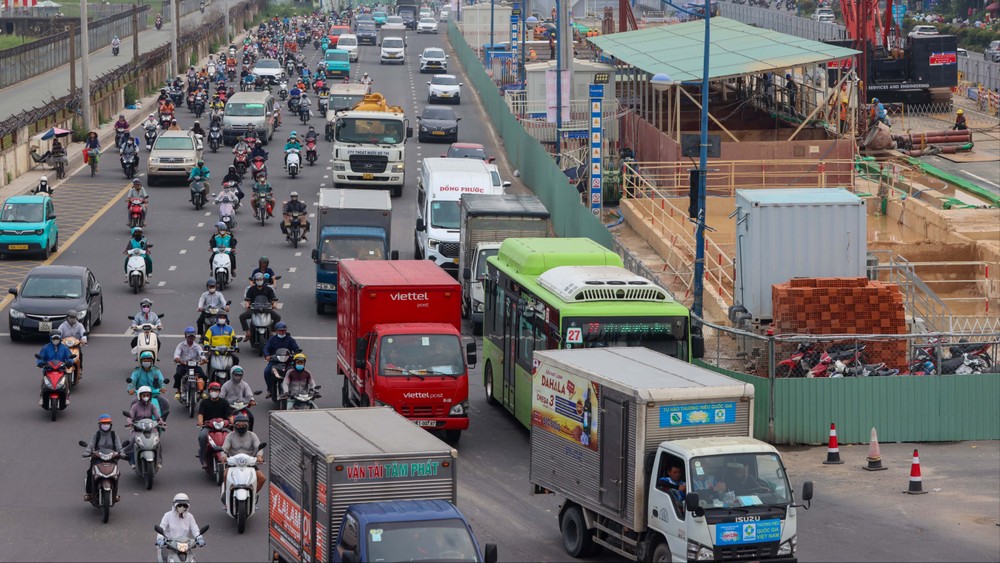
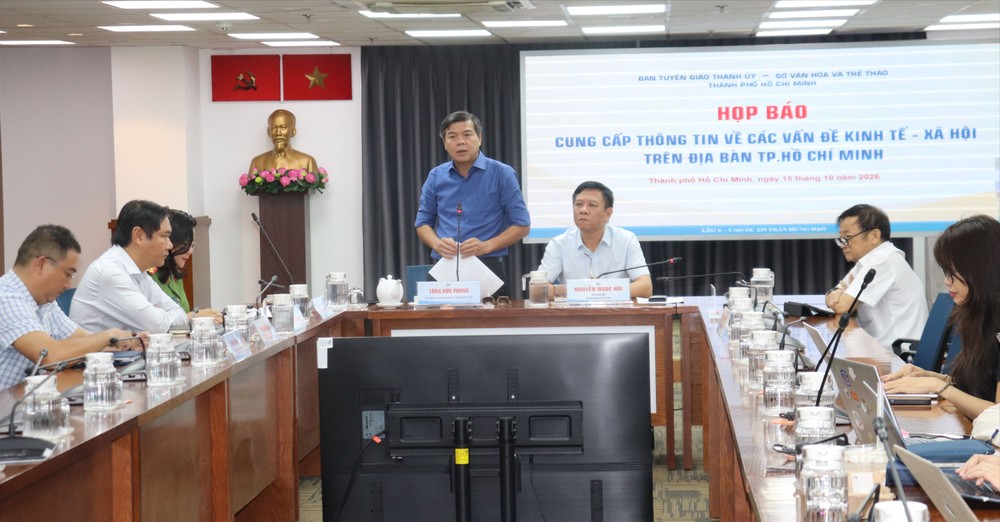
At a press briefing on socio-economic issues on October 15, the municipal Department of Construction outlined traffic conditions following the implementation of traffic regulation and diversion measures for the Ben Thanh–Tham Luong metro project.
The briefing was jointly organized by the municipal Party Committee's Commission for Information and Education and the Department of Culture and Sports. It was chaired by Mr. Tang Huu Phong, Deputy Head of the commission, and Nguyen Ngoc Hoi, Deputy Director of the department.
According to the Department of Construction, Metro Line 2 runs along major radial roads that already carry heavy traffic volumes. The project is accelerating work on utility relocation, infrastructure reinstatement and the installation of barriers in preparation for underground station construction. The occupation of portions of roadways has consequently placed substantial additional pressure on surrounding traffic networks.
On Truong Chinh Street, between Tay Thanh Street and the Cong Hoa junction, expanded construction barriers for underground stations, including Station S10, have reduced the inbound carriageway from five lanes to approximately 3.5 lanes.
The resulting bottleneck has caused prolonged congestion during the morning rush hour, when large volumes of vehicles travel from the city's northwestern gateway toward the center.
At Bay Hien Intersection, where Station S7 is located, construction barriers have narrowed turning radii and reduced traffic throughput at a major at-grade junction connecting four key roads: Truong Chinh, Cach Mang Thang Tam, Hoang Van Thu, and Ly Thuong Kiet.
Along Cach Mang Thang Tam Street, around Stations S2, S4, S5, and S6, narrow road sections, numerous residential alleys, and closely spaced intersections have compounded traffic difficulties. Construction barriers force vehicles to slow down, increasing the risk of collisions as traffic streams merge and vehicles change lanes.
To ease congestion, the Department of Construction has coordinated with Ho Chi Minh City Police and the Ho Chi Minh City Management Authority for Urban Railways (MAUR) to implement immediate adjustments.
On the Tay Thanh–Cong Hoa section of Truong Chinh Street, rigid central dividers have been removed and replaced with traffic delineator posts and movable barriers, allowing lane allocations to be adjusted according to traffic demand at different times of day. During the morning peak, from 6 a.m. to 9 a.m., the number of lanes serving traffic toward the city center has been increased to 4.5, while three lanes remain available in the opposite direction.
During the evening peak, from 4 p.m. to 7:30 p.m., traffic heading toward An Suong is given four lanes, while the opposite direction retains 3.5 lanes.
Ho Chi Minh City will implement coordinated measures, requiring investors and contractors to work in stages, clear completed sections promptly and restore road surfaces with steel plates or asphalt after underground works to minimize traffic disruption.