Following its administrative restructuring, Ho Chi Minh City has entered a new development phase where its core strengths in finance, services, and science and technology connect directly with industry, manufacturing, logistics, seaports, and the marine economy. This integration opens opportunities to form new value chains while demanding growth driven increasingly by productivity and innovation.
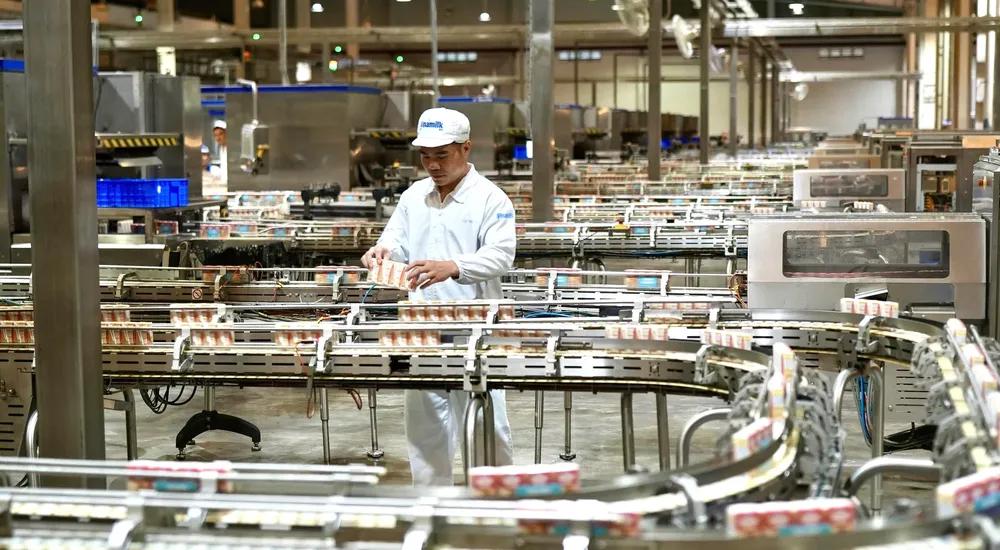
Production line at Vietnam Dairy Products Joint Stock Company (Vinamilk), Ben Cat Ward, Ho Chi Minh City. Photo: Hoang Hung
Ho Chi Minh City needs larger, leading enterprises
Enterprises must serve as the central driver of this transformation process. According to preliminary results from the 2026 Economic Census, Ho Chi Minh City had 296,759 active businesses employing roughly 4.66 million workers as of late 2025. However, a large quantity does not automatically translate into a sufficiently robust corporate structure.
The central question is not merely how many additional enterprises the city needs, but what caliber of businesses it requires. Ho Chi Minh City needs more large enterprises, but more importantly, it requires companies with leading capabilities: mastering technology, improving corporate governance, enhancing international competitiveness, participating more deeply in value chains, linking markets, and encouraging other businesses to upgrade. Achieving this goal requires creating conditions for enterprises to grow, gain strength, and assume leadership roles.
What matters is not just scale, but a balanced corporate structure and strong integration across different enterprise tiers. Ho Chi Minh City requires a solid foundation of small and medium-sized enterprises (SMEs) alongside dynamic startups, paired with large-scale companies capable of accumulating resources, organizing value chains, and expanding into broader markets.
These enterprise tiers complement and link with one another, creating a robust ecosystem that allows businesses to scale up and raise their competitive edge. Scale matters because it enables companies to mobilize resources and make long-term investments in research and development (R&D), technology, workforce training, corporate governance, branding, and market expansion.
Clearing growth barriers helps more businesses reach competitive scale. However, becoming large is not an end in itself. Scale must be converted into productivity, technological capability, advanced governance, and a higher standing in value chains.
This focus does not diminish the innovative potential of small enterprises and startups, where many new ideas and business models originate. Therefore, the core question is not just how large a business becomes, but to what end that scale is used. Ho Chi Minh City's task is translating scale into genuine competitive power.
Growing large to build strength and leadership
Scale generates resources, but the ability to transform those resources into new capacity ultimately determines corporate strength. Transitioning from a large enterprise to a leading enterprise requires a crucial bridge: growing large to become strong.

First is technological capacity and innovation: moving from technology usage to absorption, adaptation, and step-by-step mastery, while investing in R&D to create higher value-added goods and services. Second is managerial and organizational capacity. As enterprises grow larger and their operations become more complex, they require transparent, data-driven governance, workforce development, and risk controls to secure sustainable growth. Third is market presence and international competitiveness: building brands, satisfying rigorous standards, expanding market footprint, and moving toward higher value-added segments within regional and global supply chains.
Yet these three capabilities alone are insufficient. Leading enterprises must also possess network-building and organizational skills: connecting stakeholders, structuring supply chains, generating market demand, and opening opportunities for other businesses to join value chains. Not every large firm possesses leading capabilities, though in many sectors, sufficient scale is a prerequisite for accumulating and organizing resources. "Growing large to become strong" is not the final step. The next question is whether a company's growth helps elevate other businesses alongside it.
A firm's inner capabilities determine its strength, while its spillover impact is reflected in the upgrading of surrounding entities. A leading enterprise cannot function as an isolated island of strength. Spillover occurs first through supply chains: higher orders and stricter standards prompt suppliers to invest, upgrade technology, refine governance, and build capacity. Second is the diffusion of technology and knowledge: leading firms collaborate with technology companies, startups, universities, and research institutes to develop, test, and commercialize new products. Third is human resource and governance spillover: partnership, training, and talent mobility help suppliers and partners raise their management quality and workforce capabilities. Fourth is market access spillover: a leading firm's brand reputation, distribution network, and international presence allow suppliers and partners to reach markets they could rarely access on their own, creating a gateway for the entire network.
However, linkage does not automatically yield positive spillover. Overly asymmetrical relationships can create dependency rather than operational upgrading. Effective spillover requires stable partnerships, transparent standards, fair benefit-sharing, and clear incentives to invest in capacity building. The ultimate metric is whether participating entities are genuinely upgraded together.
Building ecosystems for enterprise growth, leadership, and spillover

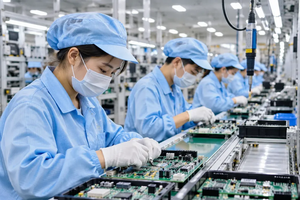
Production line at OPC Pharmaceutical Joint Stock Company, Tan Khanh Ward, Ho Chi Minh City. Photo: Hoang Hung.
A strong economy relies on entire enterprise formations upgrading together, rather than a few isolated large firms. Spillover is not a matter of large enterprises "helping" smaller ones out of charity; it rests on mutual interest. Leading firms need capable suppliers, small businesses need market demand, startups need clients, and universities and research institutes need real-world challenges. When these interests align, sustainable links take shape.
Moving from individually strong enterprises to a co-upgrading system depends heavily on the quality of the surrounding ecosystem. What must Ho Chi Minh City do to foster these linkages?
To cultivate leading enterprises, Ho Chi Minh City must establish an environment that enables companies to scale up while converting size into competitive strength and positive spillover. Following its merger, the city must fully leverage its expanded development space and institutional leeway.
First, the city must shift from a traditional business-support mindset toward removing structural growth ceilings. On their journey from small to large and leading statuses, enterprises encounter hurdles in capital, land access, technology, talent, data, governance, and market access. The city needs to identify each specific bottleneck, using institutions, infrastructure, and market mechanisms to unlock resources. Businesses do not merely need subsidies; they require an environment that allows them to push past growth limits.
Second, the city must transition from supporting individual businesses to actively building markets, supply linkages, and ecosystems. Municipal authorities should create real-world challenges and pilot environments for enterprises to innovate technologically, invest in R&D, and demonstrate their capabilities. Linkages must form around value chains, actual orders, technology, and real demand such as large firms and foreign direct investment (FDI) enterprises should strengthen ties with domestic suppliers; SMEs and startups can participate in solving manufacturing and technology problems; universities and research institutes should align R&D with corporate demands; and financial resources must serve production and innovation. Through this framework, domestic firms can integrate more deeply into global value chains.
Third, the city must shift from selecting enterprises through administrative decisions to fostering a competitive market environment where capable firms naturally rise to the top. While the city can prioritize specific industries, sectors, and value chains to address bottlenecks, invest in infrastructure, and generate market demand, it should not handpick individual companies to hold leading status. Competition and market mechanisms must serve as the screening tool for capacity.
Ultimately, no policy can replace a company's internal capabilities. The city creates favorable conditions and market forces apply pressure, but enterprises and business leaders themselves determine their growth through long-term investments in technology, governance, human resources, R&D, branding, and internationalization. This represents a co-evolutionary process between enterprises and the business ecosystem: as firms grow stronger, organize networks, expand markets, and encourage other businesses to upgrade, they form an enterprise ecosystem with elevated international competitiveness.
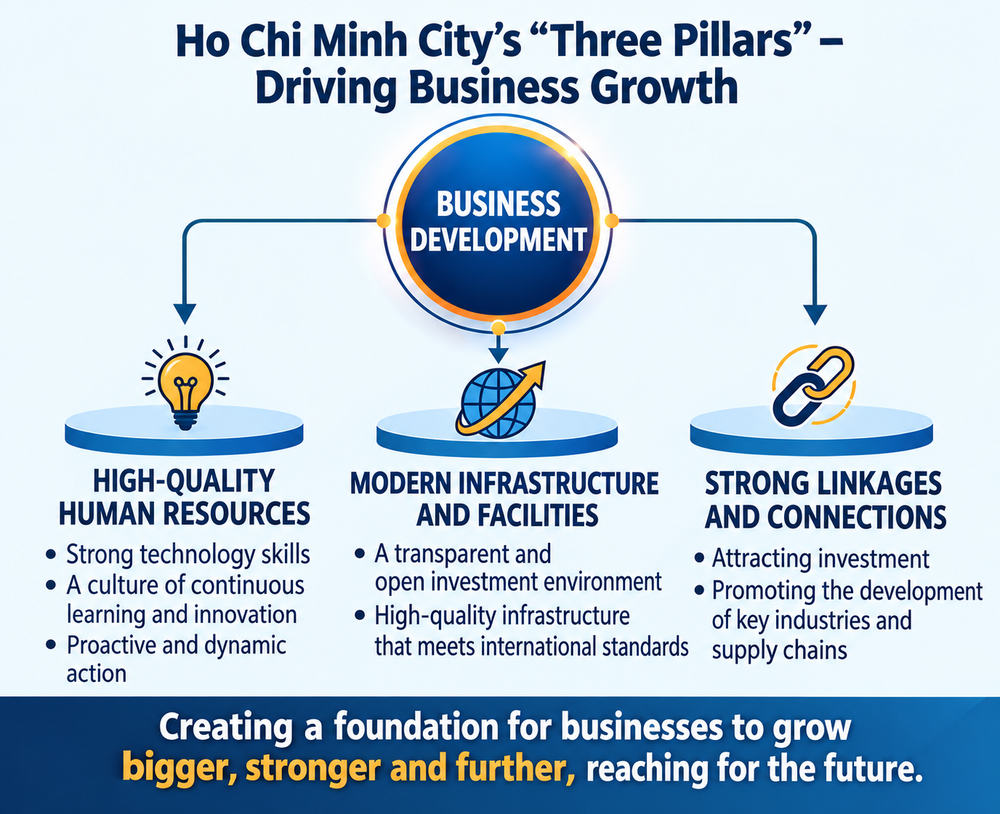
For Ho Chi Minh City, developing leading enterprises means more than increasing the number of businesses or producing more large corporations. While the city needs enterprises capable of competing at scale, size alone—measured by revenue, assets or market share—is not enough. What matters is whether that scale translates into stronger capabilities, greater competitiveness and a wider impact across the business ecosystem.
Achieving this ambition requires entrepreneurs with the vision and determination to make long-term investments in technology, management, human capital and brand development, while expanding their presence in international markets. As the city enters a new phase of development, the focus must shift from growth in size to building strength, from strength to industry leadership, and from leadership to creating value across the wider economy.
The ultimate goal is to build a business community in which leading enterprises do more than drive their own growth. By strengthening supply chains, raising industry standards and creating opportunities for other businesses, they can help enhance the competitiveness of Ho Chi Minh City as a whole and make a greater contribution to the national economy.