According to economic experts, to increase value during the remaining months of this year, businesses in the coffee and fruit and vegetable sectors need to reduce reliance on raw exports, step up deep processing, build brands, and expand markets.
According to the Vietnam Coffee - Cacao Association (Vicofa), in the first nine months of 2026, Vietnam exported nearly 1.5 million tons of coffee, reaching approximately US$6.6 billion. Vicofa forecasts that export volume this year could increase by 8 percent to 10 percent, but export turnover will be unlikely to reach high levels due to falling export prices.
The cause stems from Vietnam still relying heavily on green coffee beans, while high value lies in processing, distribution, and branding. Meanwhile, statistics from the Vietnam Fruit and Vegetable Association (Vinafruit) show that total national fruit and vegetable export value reached nearly US$7.4 billion, up 19.9 percent compared to the same period last year.
The sector's growth momentum in recent times has come from contributions by various product groups, in which durian continues to serve as one of the key drivers of fruit and vegetable exports. During the same period, durian exports reached a turnover of more than US$3.5 billion, an increase of nearly 50 percent compared to the same period in 2025.
Items such as coconut, dragon fruit, passion fruit, pomelo, mango, and the processed fruit and vegetable group also contributed to maintaining turnover. In reality, Vietnam has for many years been a leading coffee-exporting country in the world, yet the high-value segment in the global coffee chain still resides in processing, distribution, and branding.
Chairman Phan Minh Thong of the Board of Directors of Phuc Sinh Group observed that the raw coffee market has reached saturation and businesses aiming to grow are required to invest in deep processing. In July 2026, Phuc Sinh Group invested in the Phuc Sinh Dak Nong Export Agricultural Product Production and Processing Center in Lam Dong Province, with a capital source of over VND500 billion.
This is not merely a new factory but a strategic move aimed at enhancing deep processing capacity and increasing value for coffee and domestic agricultural products. Vietnam should not export raw materials; it must create higher-value products to boost competitiveness in the international market.
According to Vicofa Chairman Nguyen Nam Hai, Vietnamese businesses have recently recognized major opportunities in investing in deeply processed products such as instant coffee, roasted and ground coffee, and blended coffee, as demand steadily rises across many markets.
In the Chinese market, consumer demand for instant coffee and roasted and ground coffee is currently very large and growing. By early October, many Vietnamese instant coffee and roasted and ground coffee processing enterprises had secured export orders to China through December 2026. Deeply processed coffee utilizes only about 8 percent to 10 percent of raw materials but can contribute 17 percent to 18 percent of export turnover.
Vu Ba Phu, Director General of the Vietnam Trade Promotion Agency operating under the Ministry of Industry and Trade, stated that considering the constrained land resources designated for domestic coffee production and the existing elevated levels of productivity and yield, enhancing the monetary value of coffee exports necessitates concentration on advanced processing techniques, with particular emphasis on establishing a robust brand identity for the national coffee sector.
In the coming period, the Ministry of Industry and Trade, together with the Vietnam Coffee and Cocoa Association (Vicofa) and relevant organizations, will support businesses in developing a comprehensive strategy to enhance brand value and promote Vietnamese coffee to international markets.
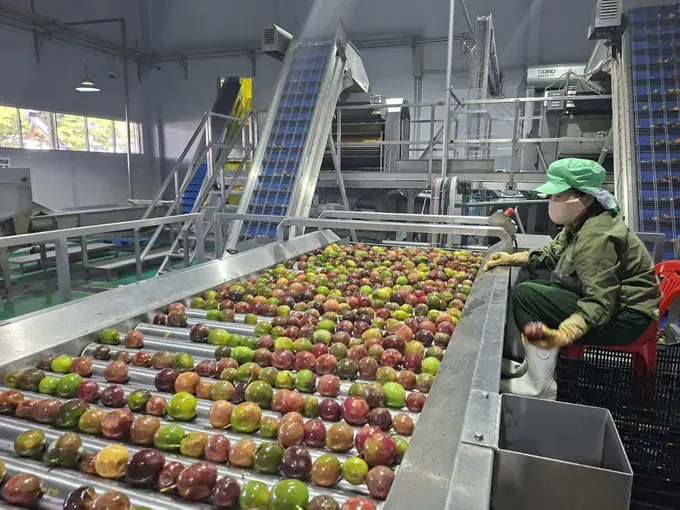
Meanwhile, Vice President Nguyen Dinh Tung of Vinafruit assessed that the structure of exported fruit and vegetable goods is undergoing a positive shift as the proportion and turnover of processed goods increase; businesses are increasingly interested in investing in deep processing such as frozen products, dried products, or fruit juice concentrate.
The potential to expand export market share for processed fruits and vegetables remains vast. Therefore, incentive policies are needed to encourage major corporations to invest heavily in deep processing plants directly in concentrated fruit and vegetable raw material areas, thereby enabling Vietnamese agricultural products to enhance their value.