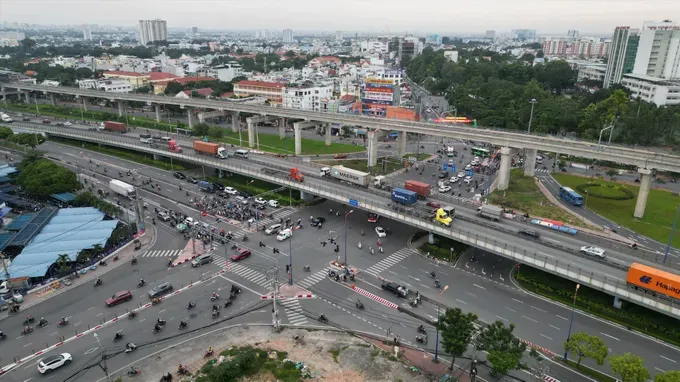
According to the city's Department of Construction, the seven overpasses are among the city's priority transport infrastructure projects, with a combined preliminary investment of more than VND2.7 trillion (US$103 million). The projects are intended to increase traffic capacity, ease congestion, meet growing travel and freight transport demand, and strengthen connectivity following Ho Chi Minh City's administrative boundary expansion.
In the city center, three steel overpasses are planned. One overpass will be built at the Dan Chu Roundabout intersection, connecting Vo Thi Sau Street with 3 Thang 2 Street. The intersection links six major roads, including Vo Thi Sau, Cach Mang Thang Tam, 3 Thang 2, Ly Chinh Thang, Nguyen Phuc Nguyen, and Nguyen Thuong Hien, and is one of the city's most congestion-prone locations, particularly during construction of the Ben Thanh–Tham Luong metro line.
The project had previously been studied but was put on hold to ensure compatibility with the underground metro station and minimize impacts on the urban landscape.
The other two overpasses will be built along 3 Thang 2 Street at its intersections with Le Dai Hanh Street and Ly Thuong Kiet Street. They are designed to separate through traffic from turning vehicles, reducing traffic conflicts at these high-volume intersections.
In the Binh Duong area, a steel overpass is planned at the intersection of Cach Mang Thang Tam Street and Huynh Van Cu Street in Thu Dau Mot Ward. The junction is a key transport link connecting National Highway 13, Phu Cuong Bridge, and several major arterial roads. Given the limited land available for road widening, the overpass is considered an urgent solution to ease congestion and improve the capacity of the existing transport network.
In the Ba Ria–Vung Tau area, Ho Chi Minh City is studying plans to build three steel overpasses at the intersections of National Highway 51 and Phuoc Binh Road; National Highway 51 and B1 Road leading to the My Xuan B1 Industrial Park; and Provincial Road DT.994C and 30 Thang 4 Street in the Eo Ong Tu area.
These locations are all major hubs for industrial parks, seaports, urban developments, and tourism corridors, carrying heavy traffic volumes and frequently experiencing congestion.
According to the Department of Construction, the city will consider applying special mechanisms to these urgent projects to shorten investment preparation procedures and bring them into operation as soon as possible. Steel overpasses offer several advantages, including rapid construction, cost efficiency, ease of dismantling if future planning adjustments are required, and minimal disruption to existing infrastructure.
Previous experience has demonstrated the effectiveness of this approach. Steel overpasses built in Ho Chi Minh City between 2013 and 2020, including those at Hang Xanh, Thu Duc Intersection, Cay Go, Lang Cha Ca, and Go Vap roundabouts, have significantly improved traffic conditions. According to transport authorities, congestion at some intersections fell by 70–80 percent after the overpasses were put into operation, providing a strong basis for the city to continue investing in this type of infrastructure at other traffic bottlenecks.