To achieve a set target of double-digit growth, apart from its three traditional pillars comprising exports, public investment and consumption, Ho Chi Minh City has identified three new strategic pillars, comprising the Vietnam International Financial Center in Ho Chi Minh City (VIFC-HCM), urban railways and a Free Trade Zone (FTZ).
Milestones for 2026
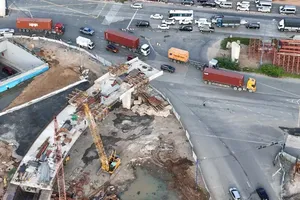
Among the series of key infrastructure projects launched on the morning of January 15, 2026, to celebrate the 14th National Congress of the Communist Party of Vietnam (CPV), the construction of Metro Line No.2 (Ben Thanh – Tham Luong) attracted public attention.
The project served as a vivid demonstration that once institutional bottlenecks rooted in outdated mechanisms are removed, the project implementation can be significantly accelerated, avoiding a repeat of the hard-learned lessons from Metro Line No.1 (Ben Thanh – Suoi Tien).
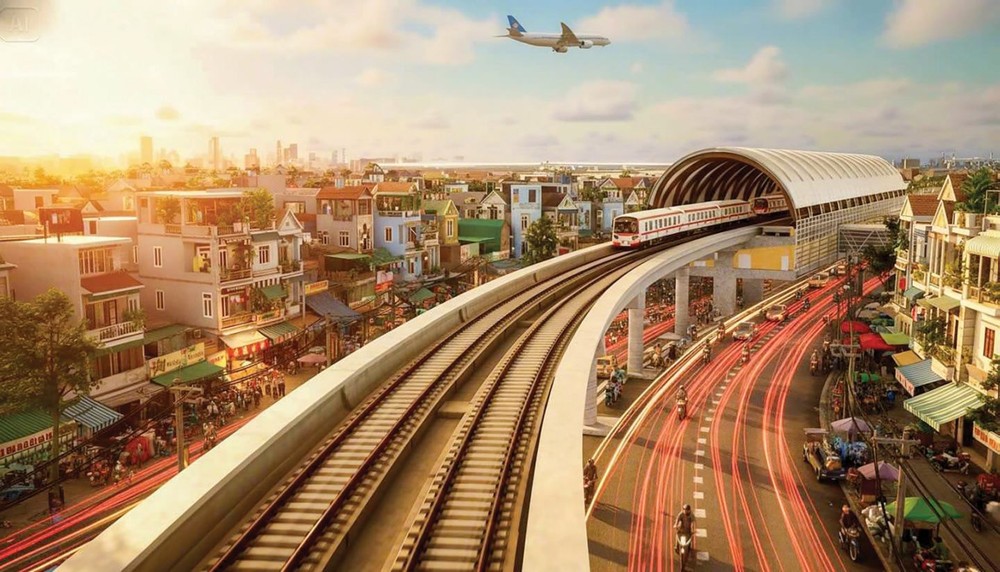
Thanks to ODA funding for public investment, along with pilot application of special mechanisms under National Assembly Resolution No.188, which streamlined approval procedures, helped the project symbolically the “first launch” of 2026, break ground earlier than anticipated.
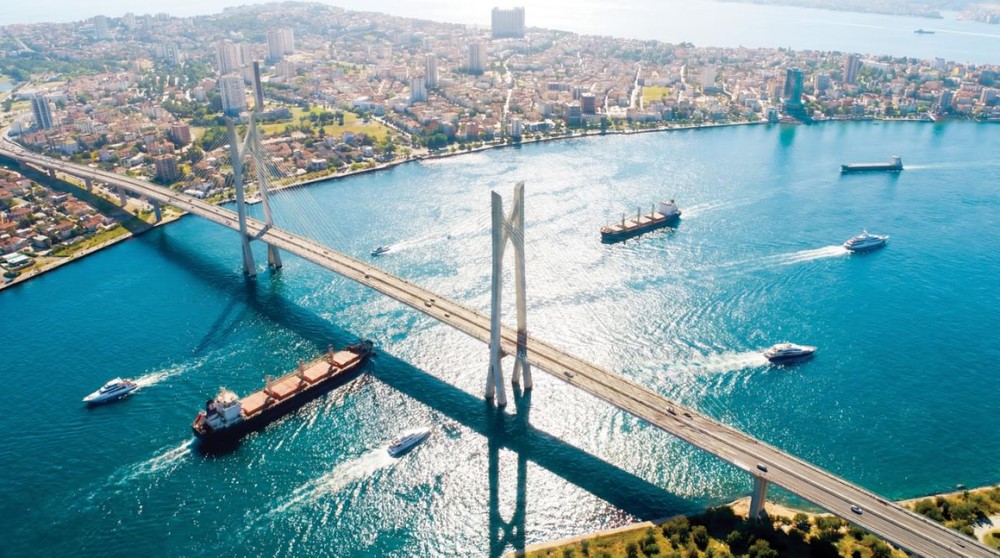
At its third meeting on January 7, 2026, the Ho Chi Minh City Party Committee agreed on adjusting the master plan of the coastal overpass project connecting Can Gio and Ba Ria–Vung Tau, which had previously been proposed under a PPP (BT contract) model.
Vingroup will fully finance the project, while the city government will reimburse the investment through land allocation under the Build–to–Transfer (BT) form.
The core significance lies in the fact that an expanded Ho Chi Minh City following administrative consolidation is not only larger in physical scale, with stronger intra-regional and inter-regional connectivity, but also opens up a new dimension of maritime economy and port-based development on a peninsula with a 35-kilometer-long coastline, which will contribute to restructuring the regional and urban economy.
New strategic pillars and governance model
Among Ho Chi Minh City’s three new strategic pillars, VIFC-HCM and the FTZ are envisioned as a “two-in-one” engine, creating a tightly linked corridor connecting flows of goods, cash and investment capital of Vietnam, into Vietnam, and within global trade networks.
The essence is not merely the establishment of a financial institution, but a real-world test of a new governance model for Vietnam. Of which, the central government will act as the institutional architect, while local authorities shall serve as innovative and flexible operators.
With the roadmap, VIFC-HCM is not only a financial hub, but it is also a testament to the city’s ability to harmonize national unity with local dynamism in an increasingly deep global integration.
An expanded Ho Chi Minh City, with administrative boundaries tripled and a projected population of 19–20 million by 2050, presents a development landscape defined by three key pillars.
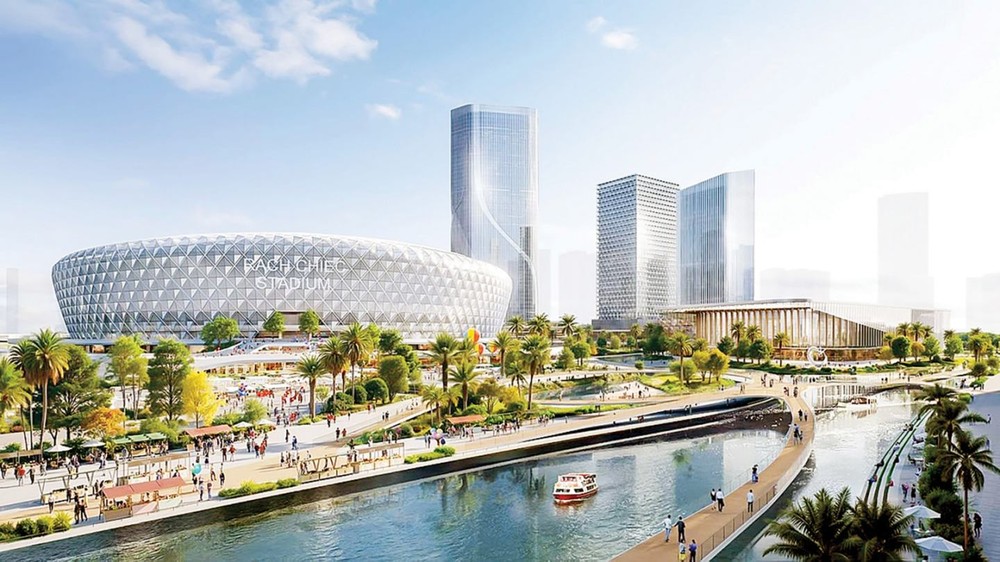
Vietnam’s entry into what is widely described as a “new era of national rise” is no coincidence. After 50 years of peace and integration, the country has accumulated significant internal strengths, alongside limitations that once hindered progress, making comprehensive renewal of both the nation and its people imperative, with a refreshed mindset and a stature befitting the times.
Challenges and planning solutions
Before and even after the issuance of regional resolutions, the reality has shown that the Southeast region, formerly comprising six provinces and cities, remains fragmented and overlapping in numerous aspects.
Three of the four localities in the Southern Key Economic Region, comprising Ho Chi Minh City, Binh Duong, Ba Ria–Vung Tau and Dong Nai, share similar structural limitations. Population density remains excessively concentrated in the urban core with over 65 percent, while coastal areas and logistics potential have yet to be fully exploited.
Comprehensive planning must serve as the basis for regulating population distribution, employment and social infrastructure, aiming for a balance between the urban core, satellite cities, industrial corridors and ecological zones.
Transportation infrastructure, institutions, environmental management and economic development are all under disproportionate pressure. Notably, there is still no governance mechanism commensurate with the scale of the region; strategic transport networks are fragmented along administrative boundaries and lack synchronization. Each locality follows its own development orientation, leading to competition and duplication.
Accordingly, in the environmental sector, the Saigon–Dong Nai–Thi Vai river corridor and coastal areas are under heavy pressure from urbanization and industrialization. Therefore, it is important to have a comprehensive, strategic and action-oriented solution to shape a new Southeast region after administrative streamlining into a mega urban–industrial, port and ecological region which would leverage Ho Chi Minh City’s advantages while fostering synergy with surrounding cities, towns and satellite zones.
Toward regional megacity status
Since July 1, 2025, Ho Chi Minh City’s transformation has extended far beyond administrative restructuring, marking a strategic turning point that redefines it as one of Southeast Asia’s largest metropolises and a regional hub for finance, logistics and innovation. An integrated network of ring roads, expressways, railways and inland waterways, linked with international gateway airports such as Tan Son Nhat and Long Thanh, will position the city as a regional infrastructure platform for large-scale transit, distribution and consumption.
The city’s role as an international financial and services center is becoming increasingly clear. The Thu Thiem–Thu Duc corridor is being developed to accommodate high-value sectors, including fintech, asset management, MICE tourism (Meetings, Incentives, Conferences, and Exhibitions), as well as advanced education and healthcare. This ecosystem will support ASEAN enterprises in capital mobilization, risk management and value-chain upgrading.
Industrial and high-tech belts are being seamlessly integrated with research and development ecosystems in artificial intelligence (AI), semiconductors, and clean technologies, forming competitive regional R&D–manufacturing–logistics chains while attracting high-skilled talent from across ASEAN.
At sea, the coastal urban cluster of Vung Tau–Long Hai–Ho Tram, together with the Can Gio eco-city and Con Dao Special Zone, positions Ho Chi Minh City as an ASEAN hub for tourism and the maritime economy. The area will serve as a center for maritime services, logistics, LNG (Liquefied Natural Gas) and offshore wind power under green standards, while also emerging as a premier destination for resorts, marine sports, and yachting.
A key strength of the city lies in its harmonious cultural, religious, and ethnic diversity. This social cohesion underpins integration and helps shape a distinctive, attractive urban identity for a new megacity in the region.
Shifting the development model for rebalance and sustainability
Ho Chi Minh City is transitioning from a model centered on processing industry and basic services to one driven by creativity, knowledge, green growth and digital transformation.
The city is focusing on key sectors such as finance, high technology, artificial intelligence, smart logistics, renewable energy, and river, coastal, and cultural tourism. By capitalizing on the complementary advantages of former Ho Chi Minh City (services, finance, technology), Binh Duong (industry and logistics), and Ba Ria–Vung Tau (seaports, tourism, energy), it seeks to establish new growth centers and integrated industrial–urban–service complexes, while promoting stronger private-sector participation in infrastructure and innovation.
To regulate urban–rural functions, the city is clearly zoning a special urban core (services and creativity), transition zones (industry and logistics), and rural ecological zones (green agriculture and eco-tourism), ensuring environmental balance and reducing population pressure on the urban core.
Urban development follows a transit-oriented development (TOD) model, prioritizing areas along metro lines, railways and expressways, integrating land use, transportation, housing and services to create multifunctional urban areas, improve land-use efficiency and reduce transport-related emissions.
International hubs are being defined, including the Vietnam International Financial Center headquartered in Thu Thiem, the eastern exhibition and convention center, the Long Thanh–Cai Mep cargo transshipment hub, and expanded coastal tourism in Can Gio–Long Hai–Ho Tram–Nui Dinh.
In reality, all these initiatives are designed, built and operated on the foundation of political stability and a geo-economic core position in East Asia and ASEAN which have turned Ho Chi Minh City into a gateway to the East Sea and a strategic connector between continental and maritime economic corridors.
On the morning of November 21, 2025, the Ho Chi Minh City Institute for Development Studies (HIDS) organized a scientific workshop titled “Strategic Solutions to Promote Double-Digit Economic Growth in Ho Chi Minh City for the 2026–2030 Period.”
Speaking at the event, Dr. Phan Tan Hung from the Ho Chi Minh City Cadre Academy emphasized that the synchronized implementation of key measures to improve the business environment would create a new, effective governance platform being an essential prerequisite for Ho Chi Minh City to realize its double-digit growth target, build a smart urban model and strengthen business community confidence.
Meanwhile, at the scientific seminar “Developing and Adjusting Planning Contents for Ho Chi Minh City after Administrative Reorganization for the 2021–2030 Period, Vision to 2050,” held on November 28, 2025, also organized by HIDS, Dr. Nguyen Ngoc Hieu from Vietnamese–German University noted that planning has to ensure harmony between state interests and business interests, balancing long-term goals with short-term objectives.
At the workshop “Special and breakthrough mechanisms and policies to attract investment and strategic investors to Ho Chi Minh City in the New Context,” held on the afternoon of November 27, 2025, and co-organized by the Central Policy and Strategy Commission and the Ho Chi Minh City Party Committee, People’s Council and People’s Committee, Dr. Nguyen Dinh Cung, former Director of the Central Institute for Economic Management observed that Ho Chi Minh City is facing unprecedented pressure and opportunity to shift from extensive growth to a model based on productivity, quality and efficiency, driven by science, technology and innovation.
According to Mr. Nguyen Trung Chinh, Chairman and CEO of CMC Technology Group, with its economic scale, innovation capacity and market potential, Ho Chi Minh City has sufficient conditions to rise into the group of leading megacities in Southeast Asia, standing alongside advanced economies in digital economy, technology and smart urban governance, toward a civilized and livable city where technology serves people and development is harmonious across society.