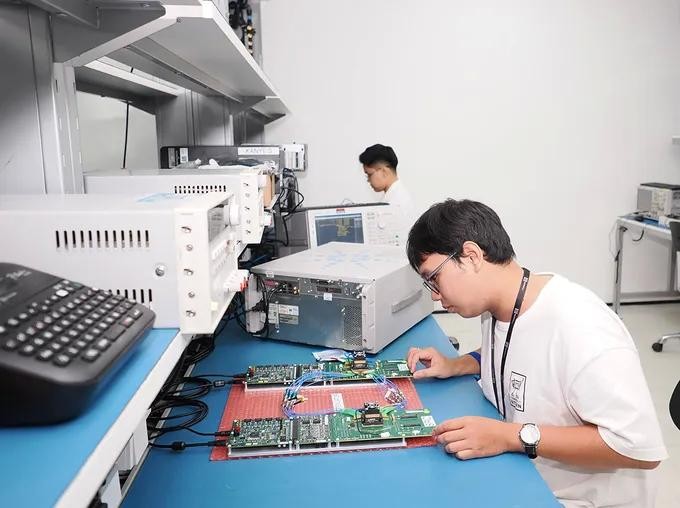
Ho Chi Minh City is organizing its development space through a functional division of research, production, and logistics, creating a foundation for deeper integration into the semiconductor value chain.
Semiconductor strategy gains strong momentum
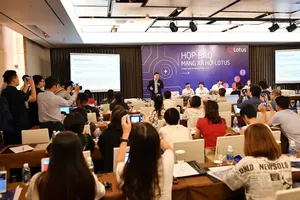
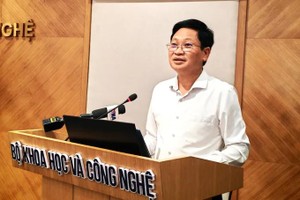
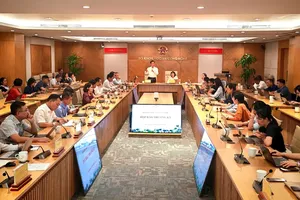
At the recent workshop "Formulating Policies and Solutions to Promote the Development of Vietnam's Semiconductor Industry," organized by the Department of Information Technology Industry under the Ministry of Science and Technology in coordination with the Ho Chi Minh City Department of Science and Technology, Deputy Minister of Science and Technology Bui Hoang Phuong affirmed that the legal corridor for the semiconductor industry is gradually being finalized. This includes the Law on Digital Technology Industry and the Strategy for the Development of Vietnam's Semiconductor Industry through 2030, with a vision to 2050.
On this foundation, Vietnam aims to capitalize on global supply chain shifts to focus on developing specialized semiconductor chips and science and technology human resources, gradually mastering stages from research and design to packaging and testing.
In tandem with institutional refinement, the human resource challenge is being addressed to meet industry demands. To date, the country has attracted over 170 foreign investment projects in the semiconductor sector. The chip design segment alone involves more than 50 foreign enterprises, 10 domestic firms, and a workforce of approximately 7,000 engineers.
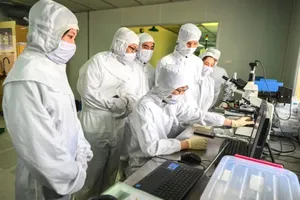
The ongoing construction of Vietnam’s first semiconductor manufacturing plant by Military Industry-Telecoms Group (Viettel) marks a shift from orientation to concrete action. Built at Hoa Lac Hi-Tech Park (Hanoi) on a 27-hectare site, the plant will serve national industries such as aerospace, telecommunications, the Internet of Things (IoT), automotive manufacturing, medical equipment, and automation.
Similarly, FPT Group has established an Advanced Semiconductor Chip Testing and Packaging Factory, aiming to foster an interconnected semiconductor value chain in Vietnam and realize major directives on mastering core and sovereign technologies. These moves demonstrate the increasingly clear momentum of businesses in implementing established policies.
According to Tran Dang Hoa, Chairman of FPT IS (FPT Group), strategic competition between nations increasingly revolves around high-tech supply chains from Artificial Intelligence (AI), cloud computing, and 5G/6G to electric vehicles and defense systems. All depend on a core foundation: semiconductor chips.
With state policy guidance, FPT is committed to partnering in and promoting an alliance within the domestic semiconductor ecosystem, advancing research and development of semiconductor chips—a national strategic technology—to help Vietnam move deeper into the global value chain.
According to Associate Professor Nguyen Van Hieu, Chairman of the Ho Chi Minh City Semiconductor Industry Association, the market equation must be deciphered.

Developing the semiconductor industry is a long-term challenge involving numerous supporting industries and electronic equipment with large investment capital. For instance, building a chip factory requires careful calculation regarding markets, components, application potential, and cost.
However, businesses have yet to identify which types of chips or electronic components constitute a production strength that will be widely applied in Vietnam and remain competitive for export. There is also a lack of linkage and cooperation between enterprises for large-scale investment projects.
Current realities show that Vietnam primarily accesses or acquires technology and patents from abroad, having not yet effectively utilized the existing foundations of major corporations to accelerate development. Courting "giants" to invest in chip manufacturing and packaging plants in Vietnam also faces difficulties due to the lack of an economic solution.
Therefore, it is necessary to leverage the Government’s role as a "fulcrum" while strongly encouraging domestic enterprises to participate—especially state-owned or state-invested enterprises—to create a sustainable development platform and gradually master technology and domestic applications.
Flexible policies and coordinated planning drive semiconductor growth
According to the Ho Chi Minh City Department of Science and Technology, the expansion and interconnection of the city’s new development space has gradually formed a relatively complete urban-industrial-logistics structure for the semiconductor industry. This approach allows for the efficient allocation and exploitation of resources based on the functions and advantages of each locality, rather than fragmented development.
Within this structure, central Ho Chi Minh City serves as the hub for research, development, and high-quality human resource training. The Binh Duong area handles large-scale industrial production with ready technical infrastructure, while the Ba Ria-Vung Tau area serves as an international logistics gateway, connecting sea and air routes. This division of roles creates a link between research, production, and circulation.
Organizing development space through functional links and roles is considered an appropriate approach, as the semiconductor industry simultaneously requires R&D capacity, industrial production, and large-scale supply chain connectivity. This provides a foundation for Ho Chi Minh City to participate more deeply in the global semiconductor value chain.
Nguyen Huu Yen, Deputy Director of the Ho Chi Minh City Department of Science and Technology, stated that the city is approaching industry development through concentration, increased connectivity, and the proactive creation of "sandboxes" for policy testing. Policies must be tied to practical needs and remain flexible during implementation to ensure effectiveness and sustainability.
According to the Ministry of Science and Technology, based on major central directives, Ho Chi Minh City has clearly identified its role as a pioneer in deploying the semiconductor development strategy, with a focus on transforming long-term goals into immediately implementable tasks within the urban context.
The Department of Science and Technology has been assigned the coordinating role, focusing on four breakthrough pillars: human resource development based on actual demand; forming an advantageous semiconductor product ecosystem; enhancing R&D capacity for core technologies; and refining institutions toward flexibility with experimental mechanisms. These are seen as the consistent pillars shaping Ho Chi Minh City's participation in the semiconductor value chain in the coming period.
According to Plan 98/KH-UBND of the Ho Chi Minh City People's Committee for implementing the Semiconductor Industry Development Strategy and the Vietnam Semiconductor Industry Human Resources Development Program in Ho Chi Minh City for 2026, the focus is not only on attracting investment but also on building a complete ecosystem—from R&D and training to promoting innovation and startups in the field of integrated circuits and semiconductors.
A notable highlight is that Ho Chi Minh City will proactively promote cooperation with leading global technology corporations such as AMD, NVIDIA, and Qualcomm. The goal is to receive technology transfers, enhance circuit design capacity, and gradually participate deeply in the global semiconductor value chain.
In parallel, the city aims to attract at least four foreign direct investment (FDI) projects in the semiconductor sector, prioritizing projects with high added value, environmental friendliness, and significant economic contributions.
Regarding infrastructure, Ho Chi Minh City will invest in building an international-standard semiconductor research center while developing circuit laboratory systems at universities and a national shared laboratory at Vietnam National University, Ho Chi Minh City.
Furthermore, the high-performance computing center at Quang Trung Software City will be upgraded to serve chip design and AI applications, and the Saigon Hi-Tech Park will be expanded into a hi-tech urban area featuring a large-scale semiconductor industrial complex.