High housing demand, along with movements in mechanisms, policies, and land bank preparation, are creating further conditions to attract investment into this segment.
Business interest surges in social housing segment
Vice Chairman of the Ho Chi Minh City Federation of Labor Phung Thai Quang stated that the unit has collaborated with nine enterprises, aiming for the goal of 128,000 units for workers to rent by 2030.
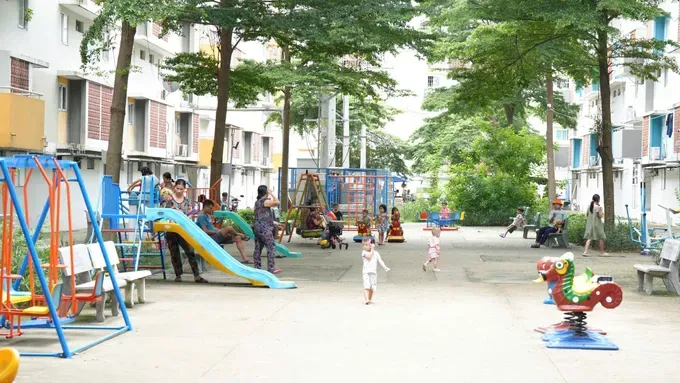
A notable development is the Hoa Sen An Ha project in Tan Vinh Loc Commune, a 2.16-hectare social housing project developed by Hoa Sen Group and scheduled to break ground in the first quarter of 2027. This project marks the entry into the social housing segment by this corporation specializing in sheet steel production and trading.
Earlier this year, Hoa Sen Group signed a commitment with the Ho Chi Minh City Federation of Labor regarding the deployment of at least 20,000 social housing units for workers and laborers, contributing to achieving the city's goal of developing 200,000 social housing apartments by 2030.
Vice Chairman Truong Ngoc Thanh Nhan of the Tan Vinh Loc Commune People's Committee said several other enterprises also wish to invest in the social housing segment in the area.
For instance, Dai Duong Social Housing Investment and Development Joint Stock Company plans to invest in a project with an area of 1.61 hectares and a population of nearly 3,200 people while Hoc Mon Trading Joint Stock Company plans to invest in a project with an area of 1.17 hectares and a scale of about 2,200 people.
These projects will contribute to residential infrastructure development, improve housing conditions, and meet the demand of mechanical population growth during urbanization in the localities.
Recently, on October 13, the Ho Chi Minh City People's Committee approved the investment policy for a social housing project by Vingroup, with a scale of nearly 192 hectares in Ba Diem Commune, a preliminary total investment capital of over VND64,000 billion, and an expected population of nearly 67,500 people.
Delta Joint Stock Company, an enterprise within the Vinhomes ecosystem, was assigned as the project investor. The project is oriented to develop high-rise social housing alongside systems of technical infrastructure, schools, healthcare, commerce, services, and green parks.
Responsible agencies further favorable conditions for investors
Huynh Thanh Khiet, Deputy Director of the Ho Chi Minh City Department of Construction, stated that according to the social housing development targets assigned by the Government, during the 2026-2030 period, the city must complete 181,257 units (10 times higher than the 2021-2025 period).
Through review, the city currently has 193 land plots/projects expected for social housing and worker accommodation development, with a total land area of 737.168 hectares.
According to Vo Hong Thang, Deputy Director of DKRA Group, an increasing number of developers, including enterprises with strong financial capacity, are participating in social housing project development.
The DKRA Group Deputy Director assessed that alongside the Land Law, Housing Law, Real Estate Business Law, and guiding documents, the Urban Development Law (effective from October 1, 2026) contributes to perfecting the legal corridor, mechanisms, and standards to promote the social housing segment.
The decentralization mechanism allowing provincial People's Councils and People's Committees to proactively decide, locally adjust planning, and approve investment policies helps shorten procedure execution time and increase attractiveness to investment capital.
“Flexible and transparent mechanisms help investors feel confident in deploying large-scale social housing projects with synchronized infrastructure and amenities, better meeting people's housing needs,” Mr. Thang analyzed.
Deputy Director Vo Hong Thang argued that developing social housing opens additional business opportunities. Although the profit margin for the social housing portion is capped at a maximum of 10 percent, investors are permitted to allocate a maximum of 20 percent of the total residential land area or 20 percent of the total residential floor area of the project to construct service, commercial, or commercial housing structures.
This policy contributes to improving investment efficiency and creating added motivation for enterprises to participate in social housing development.
Chairman of the Ho Chi Minh City Real Estate Association Le Hoang Chau proposed that credit institutions increase capital accessibility for real estate investment and business enterprises as well as homebuying residents, directing capital flows into social housing and rental housing.
Efforts should be made to reduce lending interest rates while creating favorable conditions to disburse preferential credit programs for social housing, worker housing, and young people under 35 purchasing social housing, rental housing, and other housing types.
Ho Chi Minh City has proposed redistributing its social and rental housing construction targets across the coming years after acknowledging challenges in meeting assigned goals, even as the Government reports significant progress nationwide. According to an official report, 55,665 housing units have been completed so far, equivalent to 57.2 percent of the planned target, with the figure expected to reach 82,470 units, or 85 percent of the goal, by the end of 2026.