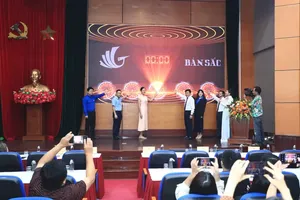
Introducing one’s literary brainchild to readers has always been a challenging process for authors on their literary journey, especially for new and young writers. The launch of the “Van Tre” collection by Kim Dong Publishing House has once again brought attention to the many difficulties surrounding literary creation and book publishing.
The Van Tre collection debuted with two titles including the short-story collection De Ngan Khong Mua by Huynh Trong Khang and the travel memoir Buoc, Dai Loan by Tran Minh Hop. Coincidentally, both Huynh Trong Khang (born 1994) and Tran Minh Hop (born 1988) are currently living and working in Ho Chi Minh City. Both writers have also received the Young Writer Award from the Ho Chi Minh City Writers’ Association.
According to writer Phan Hon Nhien, Deputy Director of Kim Dong Publishing House’s Ho Chi Minh City branch, De Ngan Khong Mua showcases Huynh Trong Khang’s exploratory and experimental storytelling style, rich with cinematic qualities. Meanwhile, Buoc, Dai Loan reflects the results of Tran Minh Hop’s studies abroad in creative writing, bearing clear marks of professionalism, modernity, and close engagement with contemporary life.
Even before the launch of the Van Tre collection, Kim Dong Publishing House had already sought to create opportunities for young writers through the second Kim Dong Literary Award, running from June 2025 to December 2026. In addition to works for children, the competition has expanded to include writings by young authors.
This has been welcomed by emerging writers, particularly after the Van Hoc Tuoi 20 (Literature in one’s twenties) literary award ended in 2022, leaving few literary platforms dedicated to younger generations of authors.
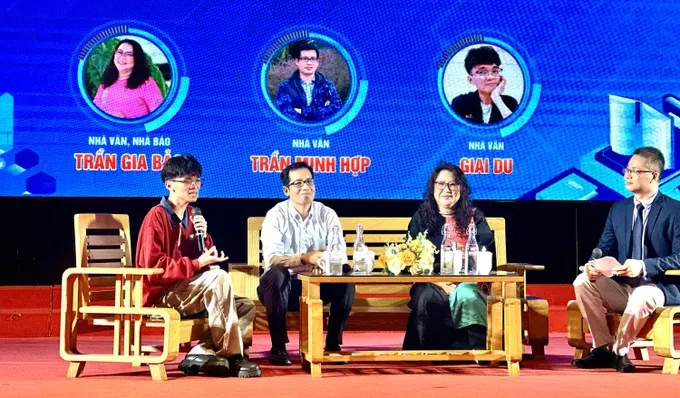
Writer Giai Du, born in 2001 and already the author of several published works, said frankly that young authors without established reputations often struggle to secure publishing support or gain recognition from readers.
The launch of the Van Tre collection and a dedicated literary award comes at the right time, giving young people a chance to test themselves, gain experience, and express who they are, writer Giai Du said.
Young writers navigate digital platforms and AI pressures
However, writer Giai Du argued that such opportunities remain too limited compared with the growing number of young writers today. If authors rely solely on a publishing collection or a handful of rare literary prizes, the road to reaching readers becomes even more difficult.
Young generations face many new challenges, but they also have their own advantages. Thanks to online spaces and digital platforms, literary works can reach a much wider audience, he said.
The digital platforms mentioned by writer Giai Du refer to online literary communities and social media pages dedicated to creative writing. Free from the constraints of printing and distribution costs and requiring far less spending on promotion and marketing, these platforms have become spaces where young and emerging writers can introduce their works directly to readers.
“Most of these websites have their own editorial standards and established readerships. New writers can choose platforms that match their writing style and submit their works there. If a work proves successful and gains attention from readers, authors may attract interest from publishers and book companies. In reality, many young writers have entered literary life through this path,” said Khanh Linh, who manages a literary fan page on Facebook.
A newer challenge facing authors today comes from generative artificial intelligence. While AI-generated writing was once relatively easy to identify, a recent international literary competition awarded a prize to a work written by AI. The truth only emerged after the individual involved revealed it, as the judges had been unable to distinguish between human-written and AI-generated work.
Although acknowledging the growing impact of AI on young writers, one young writer, Phan Hon Nhien, insisted that writing, in any era, remains the simplest and most effective way for people to engage in dialogue with themselves and with the world.
No matter how advanced AI becomes, writers will still have their own place. Of course, expectations will become higher, standards more refined, and competition more intense, writer Phan Hon Nhien said.