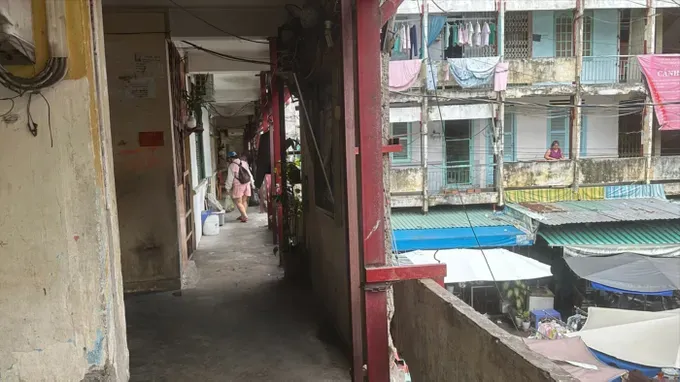
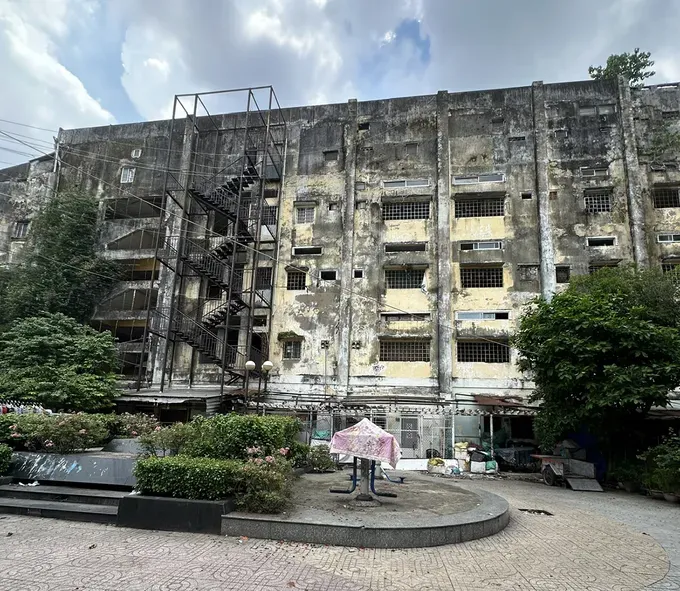
HCMC currently harbors roughly 16 Grade-D apartment complexes, officially classified as severely damaged and highly hazardous, that desperately need to be thoroughly renovated or dismantled and completely rebuilt.
Among them, the Vinh Hoi apartment building situated in Khanh Hoi Ward was constructed well before 1975, featuring a four-story scale that houses exactly 244 units. Local authorities have mapped out a concrete plan to permanently relocate the inhabitants out of the complex since late 2019; however, up to this point, the execution hasn’t been completely finalized.
On-the-ground observations reveal that the building has degraded profoundly, with concrete dangerously peeling off in several spots and piling up in heaps directly on the corrugated iron roofs of the ground floor. In specific areas plagued by extremely weak structural integrity, heavy iron bars are heavily utilized for vital support, seamlessly accompanied by hanging warning signs.
Roughly 50 percent of the apartments have been successfully relocated elsewhere, while well over 100 households still stubbornly hold their ground. For Mr. Huynh Van Ut, a resident dwelling on the ground floor of Block C, the predicament is entirely overwhelming. “Even though we’re living amidst glaring danger, our family simply can’t move out yet because the temporarily arranged apartment hasn’t been completely repaired,” he lamented.
Meanwhile, at the Truc Giang apartment complex in Xom Chieu Ward, residents received temporary accommodations for over four years. Nevertheless, Mr. Dao Duy Dat’s household is still holding the fort. He explained his family was allocated this unit in 2005. In 2015, the municipality signed a directive to sell the housing, but because the asking price was exorbitantly high, he petitioned to purchase it at the previous rate with a policy-based discount.
By 2017, the building was downgraded to the hazardous Group-D category following an inspection, forcing families to relocate. “Authorities floated support scenarios multiple times, but without concrete commitment, we simply can’t move away,” Mr. Dat shared.
At the same time, the 350 Hoang Van Thu building in Tan Son Nhat Ward was handed over to the Duc Khai Tan Binh Company for a new construction project in 2010. The investor compensated 137 households and organized temporary housing for 20 others. However, the project hasn’t broken ground because the supplementary compensation plan remains unapproved. Recently, the HCMC People’s Committee tasked the ward with urgently executing this matter.
For Mr. Ha Tuan Thanh, a newly resettled resident in Zone B of the Nguyen Kim apartment complex on Ly Thuong Kiet Street in Dien Hong Ward, the financial reality is incredibly stark. He noted that his family previously resided in a tiny 30-square-meter unit within the high-rise. When the massive renovation project kicked off, his old apartment was compensated with nearly VND900 million (US$34,240).
After the brand-new complex was finally completed, the family was granted on-site resettlement with a vastly more spacious 60-square-meter apartment, officially valued at nearly VND2.5 billion ($95,000). To successfully secure the new home, the family had to scramble to cover an additional gap of roughly VND1.6 billion ($60,000).
According to Mr. Thanh, citizens are fortunately given favorable conditions to pay off the massive price difference via an installment plan spanning an agonizingly long period of 10 to 15 years.
Practical reality demonstrates that the populace entirely agrees with the overarching policy of rebuilding heavily degraded apartments to guarantee public safety and thoroughly refresh the urban landscape. Nevertheless, individuals residing in these outdated buildings are mostly manual laborers alongside folks with remarkably low or strictly average incomes.
Scraping together tens of millions of Vietnamese dong annually is incredibly challenging, let alone amassing from VND1.6 billion to 2 billion ($60,000 - $76,000) to bridge the financial gap for a brand-new unit. Due to a sheer lack of financial capacity, folks are brutally forced to sell highly coveted resettlement slots or migrate to remote areas, with some retreating to rural hometowns to make ends meet.
Architect Ngo Viet Son Nam explicitly argued that immediately after fresh construction, inherent apartment values skyrocket multiple times over due to vastly larger floor space, superior quality, and relentlessly surging land prices. Ultimately, this harsh reality forces countless households to pay billions of dong just to successfully claim on-site resettlement apartments.
To systematically solve this, the State must roll out highly flexible financial support mechanisms. For instance, authorities could apply preferential credit policies featuring low interest rates and extended installments, while forging specialized policies for deeply impoverished households to guarantee every citizen a fair shot at living in their old neighborhoods once construction projects wrap up.
Head Pham Dang Ho of the Urban Development Division under the HCMC Department of Construction stated that HCMC boasts numerous supportive policy mechanisms for renovating obsolete apartment blocks.
Specifically, Resolution No. 17/2025/NQ-HDND issued by the HCMC People’s Council dictates incentive mechanisms for developers revamping condominiums within the municipal territory. This resolution beckons deep-pocketed investors to eagerly join the crusade of rebuilding aging apartments.
Accordingly, participating developers receive robust financial support covering 50 percent of technical infrastructure construction costs, strictly capped at VND10 billion ($380,500) per project. Moreover, they receive 50 percent backing for demanding relocation and forced eviction costs, squarely in accordance with the strict mandates of the Housing Law.






)