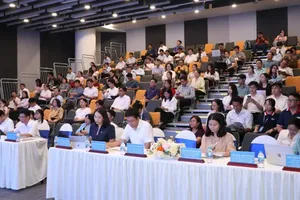
Sai Gon Giai Phong (SGGP) Newspaper’s reporter interviewed Mr. Vo Hoang Ngan, Director of the Ho Chi Minh City Department of Planning and Architecture, to gain further insights into the plan.

According to the Director of the Ho Chi Minh City Department of Planning and Architecture, before the administrative restructuring, the master plans of Ho Chi Minh City, Binh Duong and Ba Ria–Vung Tau had already been appraised by ministries and approved by the Prime Minister, forming an important legal foundation for urban management and development.
These plans initially reflected a regional role allocation, in which Ho Chi Minh City served as a center for high-quality services, finance and innovation; Binh Duong functioned as a modern industrial hub; and Ba Ria–Vung Tau specialized in marine economy and logistics.
However, implementation has revealed certain limitations, particularly the fragmentation of spatial development due to planning based mainly on administrative boundaries, which has prevented full optimization of regional connectivity advantages.
In the new context, the requirement is not only to inherit existing plans but also to restructure development space toward integration, connectivity, and mutual complementarity across the region. The city will focus on reviewing and adjusting planning in a unified and synchronized direction, avoiding overlap and unnecessary competition between areas. Two key orientations are emphasized.
First is spatial functional specialization, where each area is clearly defined within the value chain. In particular, Ho Chi Minh City will serve as a center for finance, high-end services, research and development; Binh Duong will develop high-tech and innovation-driven industries; and Ba Ria–Vung Tau will leverage its strengths in ports, logistics and the marine economy.
Second is regional spatial restructuring, with the formation of interconnected economic corridors and industrial–service–logistics belts operating as a unified system. The vision is to move from administrative boundary-based development to functionally integrated, regionally linked spatial development.
For education and healthcare, the city will continue to reorganize service networks to ensure balanced distribution, improved quality and accessible coverage for residents across the region. Public land allocation will be carried out through a scientific, transparent approach based on population data and real demand.
For industrial zones, the long-term orientation is spatial restructuring of production. Existing inner-city industrial zones will be transformed toward high-tech and environmentally friendly models, while large-scale manufacturing will be relocated to new-generation industrial parks in former Binh Duong area and industrial–port complexes in former Ba Ria–Vung Tau area.
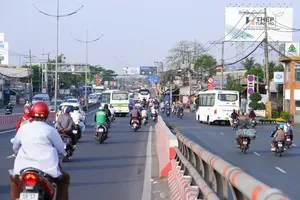
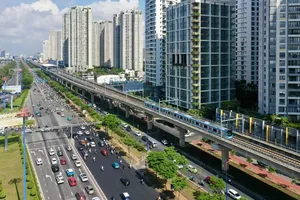
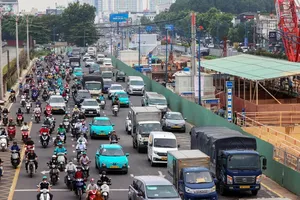
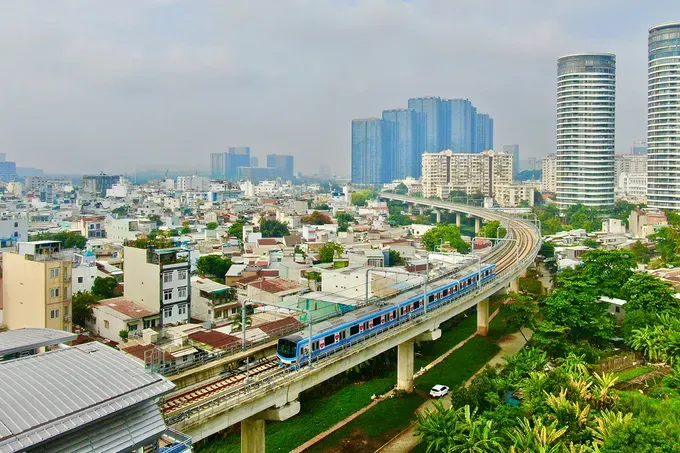
Transport infrastructure will be developed in a multimodal, interconnected, and continuous manner, with key development axes including Ring Roads 3 and 4, interregional expressways and railway networks, especially connections to Long Thanh International Airport.
The goal is to form a unified infrastructure network serving as a central role for regional development.
Ho Chi Minh City targets completion and submission of its master plan for approval in the fourth quarter of 2026. The process includes finalizing the planning framework, selecting qualified international consultancy consortia, conducting planning activities, collecting feedback, and preparing documentation for appraisal and approval.
Relevant agencies are currently coordinating closely to accelerate progress, while simultaneously collecting data and developing development scenarios. This is a strategic task requiring synchronized coordination across the political system, as well as participation from communities, businesses and experts.
With this master plan adjustment, Ho Chi Minh City is not only expanding in scale but also transforming its development model. From a single-center city, Ho Chi Minh City will grow into a multi-polar megacity with strong regional linkages, aiming to become a major economic, financial, and innovation hub in the region and the world.