This approach not only creates jobs and ensures stable livelihoods for coastal residents but also maximizes marine potential and strengthens the city’s position as a key maritime economic hub in Southern Vietnam.
Successful aquaculture models
In An Thoi Dong Commune, nearly everyone knows farmer Dang Van Ut. Almost 30 years ago, when most locals depended on offshore fishing, he pioneered shrimp farming on mangrove land. After several successful seasons of raising black tiger shrimp, the farmer became one of Can Gio’s most prosperous shrimp farmers. Encouraged by his success, he later switched to whiteleg shrimp, achieving equally positive results.
In recent years, recognizing the advantages of coastal aquaculture, the well-known farmer expanded into farming Pangasius fish and golden pompano. He revealed that for Pangasius fish, the grow-out period lasts about 15 months, and the market price exceeds VND200,000 per kilogram. After deducting costs and labor, each crop brings over VND5 billion in profit.
In the Gan Rai Bay area of Long Son Commune, breeder Tran Quoc Hung has been engaged in cage fish farming for nine years, benefiting from the area’s large water surface, stable salinity, and low storm frequency. His efforts have not only provided a stable income for his family but also improved livelihoods for about 100 local households. Alongside cage fish farming, many residents in Long Son Commune also raise oysters, creating additional employment and income sources.
Beyond these examples, aquaculture has expanded across Ho Chi Minh City’s coastal regions, forming several large-scale farming zones such as industrial shrimp farms in Phuoc Hai, Ho Tram, Long Dien, and Long Huong, and cage fish and oyster farms in Tan Phuoc Ward. These areas not only serve domestic consumption but also supply raw materials for seafood processing and export enterprises.
Clean and environmentally friendly practices
In recent years, coastal aquaculture in Ho Chi Minh City has increasingly emphasized environmental protection and food safety. For example, oyster farmers in Long Son Commune have shifted from relying on natural rock oysters to cultivating Pacific oysters using sustainable techniques. Instead of fibro-cement sheets or old tires, they now use oyster shells as substrates reducing pollution and improving yields.
Farmer Nguyen Van Nhat, who pioneered this new method on one hectare of water surface, earns nearly VND2 billion (US$75,893) in net profit annually.
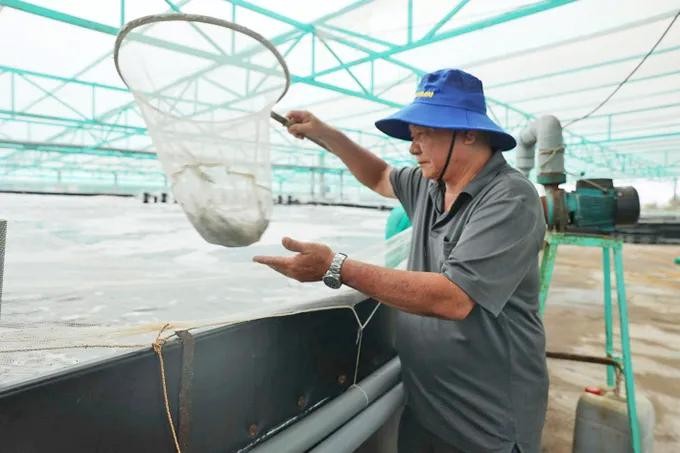
Beyond small-scale farms, many companies and cooperatives are investing in clean aquaculture. Minh Phu Aquaculture Company in Phuoc Hai Commune operates one of the region’s largest high-tech shrimp farming projects, covering 300 hectares with 560 grow-out ponds, 300 water treatment ponds, 280 nursery ponds, and several water reservoirs.
The company’s circular-frame ponds, lined with tarpaulin and supported by steel structures, use bio-technology methods across three production cycles per year. Water treatment relies on probiotics instead of antibiotics or chemicals, reducing power consumption and production costs. This approach maintains a stable environment, achieving a shrimp survival rate of over 85 percent. The company’s annual output exceeds 1,000 tons, supplying its own processing plant and generating profits of around VND30 billion per year.
To support clean and sustainable aquaculture, local authorities have introduced multiple incentive policies. According to Vo Huu Thang, Chairman of the Can Gio Commune People’s Committee, farmers and cooperatives have benefited from urban agricultural restructuring programs that provide access to credit, modern technology, and scientific training.
Thanks to these initiatives, local aquaculture not only helps restore aquatic resources and build strong regional brands but also improves living standards and supports rural development.
According to the Ho Chi Minh City Sub-Department of Fisheries and Fisheries Surveillance, the city currently has 6,448 hectares of aquaculture area, producing over 32,700 tons annually. Of this, freshwater farming covers 930 hectares, while brackish and saltwater farming accounts for over 5,500 hectares.
Ton Cuong, Deputy Director of the Sub-Department, emphasized that coastal aquaculture is increasingly recognized as a strategic industry that ensures livelihoods, drives economic growth, and contributes significantly to the city’s green economy.