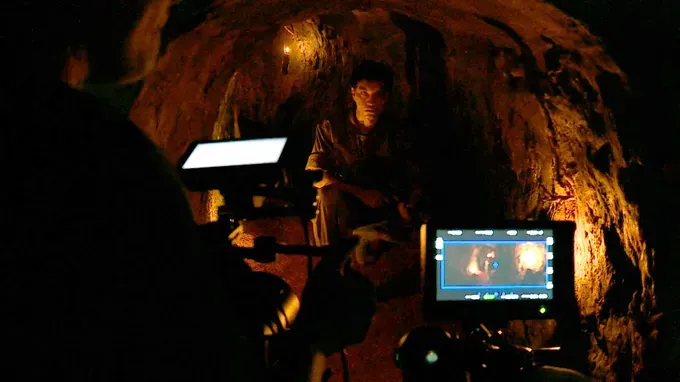
In early December, Director Pham Thien An’s latest project, Heaven in the Wildflower, secured the MPA APSA Film Fund within the framework of the Asia Pacific Screen Awards.
However, to gather sufficient budget to actually make the film, An continues his arduous journey of soliciting investment. This mirrors his debut, “Ben Trong Vo Ken Vang” (Inside the Yellow Cocoon Shell), where he reportedly took a gamble by rolling cameras with only 20-30 percent of the production costs secured.
Many young directors are navigating a similar labyrinth. “Bo Sua Bay” (Flying Cow) by Nguyen Pham Thanh Dat won the Kantana Award at the Busan International Film Festival Project Market 2025 and the MPA “Best Feature Film Project” at the Da Nang Asian Film Festival.
Meanwhile, “Co Dong Song Biet” (The River Knows) by Mai Huyen Chi was honored at the QPM Southeast Asian Project Award, and Hearing by Le Bao received support from the Purin Film Fund 2025. For these creators, realizing the dream of a debut feature film can take a minimum of 3-5 years, or in some cases, drag on for a decade.
The 2006 Law on Cinema mandated a Film Development Support Fund, a provision maintained in the 2022 amendment. However, for nearly 20 years, this fund has failed to materialize in practice, turning a procedural bottleneck into a chronic ailment. The core issue remains the unsolved puzzle of revenue sources. Consequently, year after year, the path for young filmmakers, especially in the independent art-house genre, remains precarious and grueling.
“Current cinema systems are predominantly privately owned and funded. In the city, state-owned cinemas have virtually vanished or been repurposed. It’s no surprise that Vietnamese films are pushed out of theaters after just a few screenings if they don’t sell tickets immediately. After 10 years of implementing the Cinema Law, filmmakers feel a sense of bitterness because we essentially shifted the monopoly from the state to private investors.”
Chairwoman Duong Cam Thuy of the HCMC Cinema Association
The long-standing debate over a national film fund resurfaced at the 23rd and 24th Vietnam Film Festivals. Assoc Prof Dr Bui Hoai Son of the National Assembly’s Committee for Culture and Education noted wittily: “The State doesn’t begrudge money for art or cinema. The pity is, the State simply doesn’t have the money.”
He emphasized that such a fund is vital for nurturing experimental and independent cinema, which fosters creativity despite limited commercial viability. Echoing this, Chairwoman Duong Cam Thuy urged the city to establish its own fund for developmental projects, potentially supplementing it with external resources later.
Beyond funding, distribution remains a formidable beast. The struggle of “Quan Ky Nam” (Ky Nam Inn) serves as a stark example. Despite high artistic merit and international acclaim, this rare 35mm film suffered from unfavorable scheduling, earning less than VND4 billion (US$157,480) in two weeks.
This highlights a systemic issue. HCMC boasts 295 screens in 52 cinemas, yet the vast majority are privately owned and profit-driven. With the disappearance of dedicated state-run art theaters, experimental filmmakers are left without a platform to reach domestic audiences, causing prestigious works to “run out of steam” on home soil.
Ms. Phan Cam Tu, a member of the Vietnam Film Development Association (VFDA), reiterated an old but burning story: “Earlier this year, when working with Hollywood studios, they told us they love Vietnam and want to come here. But the inevitable follow-up question is: ‘What incentives do you have?’”
“Of course, we mention the scenery and the food, which they like,” Ms. Tu explained. “But what they care about most is financial incentives.” She expressed sadness that many crews have come and gone because “Vietnam’s tax refund policy is very uncompetitive compared to other countries, which is the primary attraction for Hollywood crews.”
Assoc Prof Dr Bui Hoai Son agreed with the above, stating that the industry cannot survive or attract foreign studios without tax incentives. Reports confirm unimplemented policies regarding land and investment remain major barriers. Consequently, Assoc Prof Dr Nguyen Thi Thu Phuong urges HCMC to adopt a specific policy package to untie institutional knots and unlock cinema’s soft power.
The 2030 development plan also proposes establishing a film fund to support domestic producers and petitioning UNESCO to set up financial funds for cinema models, paving ways for potential movie projects to access investments. However, a concrete roadmap remains a waiting game.
From mechanism issues stem a series of infrastructure and human resource limitations, which are becoming glaring as the city enters a new threshold. Large event spaces are lacking; the 2024 HCMC International Film Festival and 2025 Vietnam Film Festival had to fragment activities across multiple venues, diluting the impact. The dream of a standard studio remains distant. A look at the Republic of Korea’s Busan Cinema Center, a 32,000-square-meter complex with a 4,000-seat theater, shows that infrastructure is the bedrock of a cinema city’s status.
Regarding human resources, the situation is both “lacking and weak.” Chairwoman Duong Cam Thuy noted that few directors are trained annually, and not all pursue the profession. Skilled practitioners are caught in a continuous production treadmill, leaving no time for creative regeneration.
Shortages plague every role, from actors, cinematographers, set designers, makeup artists, lighting technicians, to editors. Professional actors are particularly scarce, while trained ones often lack experience, forcing producers to cast models, singers, or stage actors as a stopgap solution.
Weighing the factors, Assoc Prof Dr Bui Hoai Son views human resources as the “biggest gap” among the four pillars: policy, workforce, technology, and market. The film industry isn’t just about art; it’s about market mindset and business acumen. If the workforce doesn’t adapt, the industry can’t advance.
HCMC’s cinema is at a turning point. The title “City of Cinema” opens doors, but resolving these bottlenecks is the only way to transform advantages into international competitiveness, befitting the designation the city has just achieved.