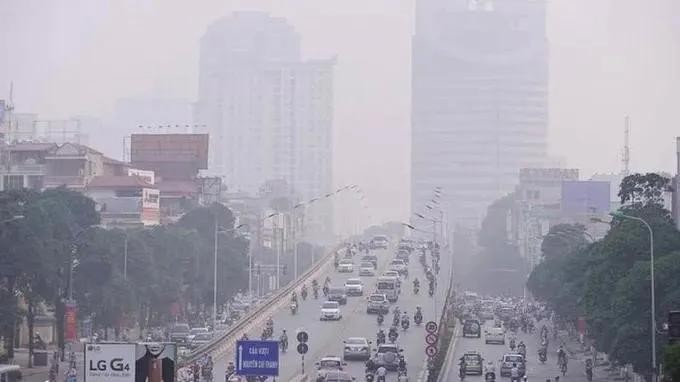
On the morning of December 3, despite slight improvement due to a cold front and stronger northeast monsoon winds, air pollution and fine dust levels in Hanoi remained dangerously high, posing significant health risks to residents.
At 7:00 a.m., Hanoi’s Air Quality Index (AQI) reached 167, a red category level considered unhealthy, while the concentration of fine particulate matter (PM2.5) measured 65 micrograms per cubic square which is nearly five times higher than the World Health Organization’s recommended limit. In some areas such as Thach That and Ha Bang, the AQI exceeded 200 (purple category), signaling very unhealthy conditions.
With these readings, Hanoi ranked 9th among the world’s 10 most polluted cities, following Delhi and Kolkata in India, Dhaka in Bangladesh, and Tehran in Iran.
In response to the prolonged air pollution, the Hanoi People’s Committee has directed relevant departments and local governments to implement urgent measures to control air quality. The city’s Department of Health is preparing public guidance materials to help residents recognize periods of poor air quality and minimize outdoor exposure especially in the early morning and at night. Hospitals in communes have been asked to enhance capacity in anticipation of a potential rise in respiratory cases.
The Department of Education and Training has instructed schools to monitor daily air quality levels and adjust activities accordingly. When air quality deteriorates to unhealthy levels, schools will limit outdoor activities and, if necessary, modify class schedules for safety. Construction sites are required to strengthen dust control through vehicle washing, mist spraying, and the use of AI powered monitoring cameras at major projects.
Some residential areas, parks, and main roads will pilot fine mist spraying to reduce dust concentration. Factories with high emission potential are encouraged to reschedule operations to periods of more favorable weather conditions.