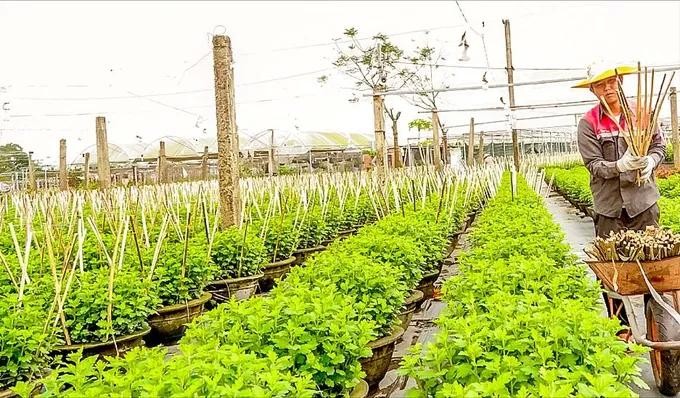
As the year draws to a close, flower-growing areas along April 30 Street in the Central city of Da Nang’s Hoa Cuong Ward have entered the crucial stage of the Lunar New Year (Tet holiday) flower production. Yet, farmers continue to worry about unpredictable weather and rising input costs.
Cultivating around 600 pots of chrysanthemums, Nguyen Quang Son in An Khe Ward said fertilizer and pesticide prices have increased by about 20 percent compared to last year, forcing growers to carefully manage every stage of cultivation. With rainfall easing, farmers are now adjusting techniques to ensure even growth in time for Tet.
Most flowers are sold to traders for distribution across North-Central provinces, with some kept for local markets.
In Duong Son flower village in Da Nang City’s Hoa Xuan Ward, higher ground helped minimize flood damage in late October. Doan Van Trinh, a 62 year old farmer, is growing about 4,000 flower pots of various types. Flower prices this year are expected to rise slightly due to increased input costs and the impact of natural disasters on other production regions. The Duong Son flower area covers about 4.5 hectares, with 21 households producing an estimated 80,000 flower and ornamental plant pots for the Tet holidays.
According to Ly Phuoc Dang, head of Duong Son Flower Cooperative Group, this year’s Tet crop required heavier investment due to higher fertilizer, pesticide, and seed prices. Although agricultural input costs show no signs of decreasing, growers remain hopeful for favorable weather and high-quality blooms to offset earlier losses caused by floods.
In downstream areas of the Huong River in Hue City, since early December, flower growers have been working hard to nurture surviving ornamental plants in higher plots. Others are preparing new beds, using lime to treat soil acidity and prevent disease before replanting short-term flower varieties.
Nguyen Son, a flower grower from Duong No Ward standing in his lush 500-square-meter flower garden just two weeks after replanting, shared that this season has been particularly challenging, but farmers are determined to ensure their flowers bloom in time for Tet.
According to Nguyen Van Trai, Vice Chairman of Duong No Ward People’s Committee, about 54 hectares of crops were affected, including more than 3,000 pots of chrysanthemums and 6.2 hectares of field flowers severely damaged. Local authorities and agricultural agencies are helping provide suitable seedlings and technical support for plant care and pest control to help short-term flowers bloom in time for the holiday season.
Farmers are holding on to their fields
In vegetable-growing regions, farmers are also racing to recover after severe floods. In Thanh Trung vegetable village in Hoa Chau Ward, the largest vegetable-growing area in Hue City with over 100 hectares, flood traces from November still remain. Instead of leaving fields fallow, farmers have cleared flooded crops, cleaned the soil, and replanted short-term vegetables.
Farmer Nguyen Hoi from Thanh Trung shared that the current weather is favorable, and he hopes the Tet vegetable crop will yield well to make up for flood losses and stabilize incomes.
Le Minh Tri, Head of the Plant Protection Division of Hue City’s Crop Production and Plant Protection Sub-Department, said that nearly 700 hectares of vegetable fields have now been restored and replanted, nearly 100 percent of the targeted area, with over half following safe and VietGAP-certified practices.
In La Huong vegetable village in Da Nang City’s Cam Le Ward, continuous rains in October and November caused severe crop losses and soggy soil conditions, raising recovery costs. Low-lying areas had to replant late, while higher plots already have their first harvests.
Farmer Mai Van Phu from Cam Le Ward stated that even with the associated risks, local residents are implementing the "short-term to sustain long-term" strategy by initially planting fast-growing leafy greens to secure quick income, while simultaneously preparing for the harvest of longer-term crops like cabbage and broccoli during Tet. He explained that long-term crops require approximately two and a half months to mature, whereas short-term greens provide early returns.
According to Tran Van Hoang, Director of the La Huong Safe Vegetable Cooperative, recent floods caused an estimated VND100 million in damage. Despite higher seed prices, farmers continue to invest to maintain production. The cooperative is coordinating with partners to secure market outlets, helping farmers stay committed to their fields and recover production after a turbulent rainy season.