These acts are widely considered a monumental breakthrough in order to remove deeply entrenched bottlenecks, ultimately sanitizing the management database while simultaneously injecting fresh momentum into the broader business environment.
As of October, the entire system recorded approximately 2.5 million taxpayers in a state of suspended business operations without having terminated their TIN validity (status 03), or no longer operating at their registered address (status 06). Strikingly, over 529,000 of these taxpayers have ceased operations for more than a decade.
On the side of citizens and businesses, even though they’ve shuttered or dissolved, they simply can’t finalize the TIN termination procedures due to complex procedural hurdles, a sheer lack of legal comprehension, or lost paperwork and ledgers. The total debt of this demographic sits at over VND27.8 trillion (US$1.08 billion), wherein late tax payment penalties account for roughly VND9.7 trillion ($388 million), making up nearly 35 percent of the total tax debt.
For regulatory agencies, total financial obligations severely exceeding repayment capacities prompt taxpayers to simply abandon their suspended TINs. This forces tax authorities to squander valuable resources and administrative costs on tracking, urging, and enforcing coercive measures against phantom debts that are virtually unrecoverable.
The official decision to abolish the business license fee starting January 1, 2026, under Resolution 198/2025/QH15, has unequivocally demonstrated the Party and State’s consistent stance on wholeheartedly supporting the private economic sector. Therefore, decisively wiping out old, backlogged business license fee debts serves as a synchronized maneuver. It profoundly helps taxpayers shed unnecessary financial burdens to either start from scratch or officially exit the market in full compliance with the law.
Handling these tax debts and closing backlogged TINs tangibly helps sanitize and elevate the precision of the national database regarding tax management. A data system harboring millions of ghost or inactive TINs will inevitably distort the macroeconomic picture, drastically reducing the efficacy of risk supervision while scattering the regulatory body’s overarching resources.
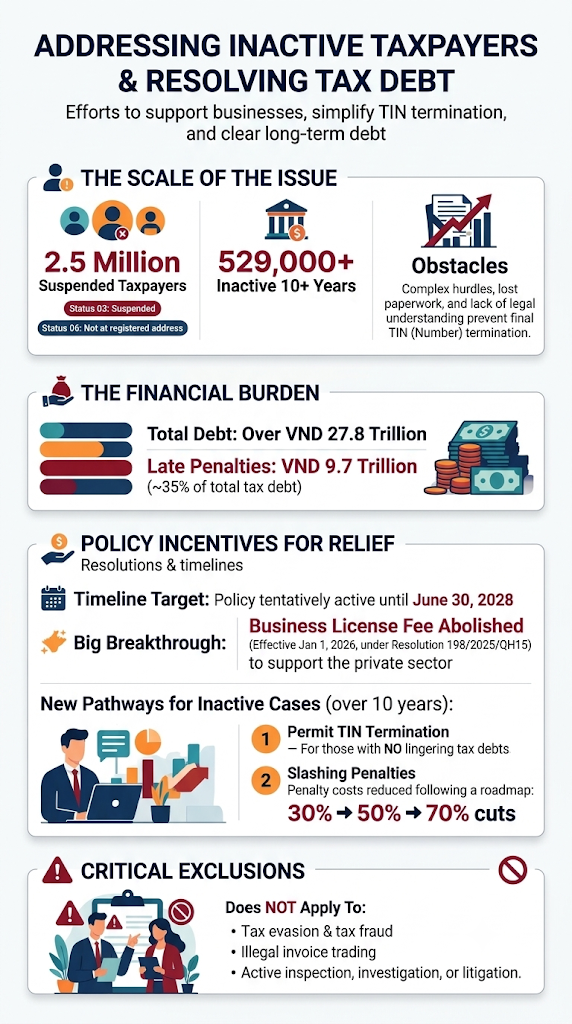
Permitting the termination of TIN validity for cases inactive for over 10 years without lingering tax debts, or slashing administrative penalty costs following a specific roadmap (30 percent, 50 percent, 70 percent), will forge a robust incentive. This actively encourages taxpayers to proactively return and finalize procedures.
According to the Ministry of Finance, the policy of erasing late payment penalties isn’t applied indiscriminately or across the board. Instead, it strictly adheres to a core principle that late payment penalties are only wiped clean when the taxpayer has successfully settled 100 percent of the original tax debt principal. This dual-pronged approach protects the core revenue stream for the state budget while seamlessly guaranteeing fairness among disparate business entities.
The draft also establishes a protective guardrail. Preferential policies aren’t applied to instances of tax evasion, tax fraud, illegal invoice trading, or cases currently undergoing inspection, investigation, or litigation. This specialized policy is tentatively slated for implementation until the end of June 30, 2028.
Alongside the profoundly positive impacts on institutional and economic fronts, rolling out a specialized preferential policy with such a massive footprint also harbors hidden risks if it isn’t strictly controlled and carefully supervised. Among these, the most glaring risk is that certain taxpayers might deliberately exploit this bespoke mechanism to delay their obligations. They could dishonestly report their temporary suspension periods merely to secure reduced fines and erased late payment penalties.
Soliciting feedback and promptly promulgating a resolution on this specialized policy to handle tax debts and sanitize TINs stands as a breakthrough and remarkably timely institutional decision. Once the paralyzing bottlenecks regarding procedural backlogs have been successfully alleviated and management data are rigorously standardized, the state budget can recover substantive principal debts. Concurrently, it robustly solidifies the business community’s profound faith in the State’s constructive companionship.