The Ministry of Education and Training has published a draft amendment to Decree 238/2025/ND-CP on tuition policies, exemptions, reductions, financial support, and service fees in education and training. The draft is open for public comment.
The draft adds new groups eligible for tuition exemptions, reductions, and support, including students in agriculture, forestry, fisheries, construction, arts, sports, and vocational secondary education programs. It also clarifies responsibilities for covering the difference between state-supported tuition and the actual tuition charged when fees exceed state support, while refining technical regulations to ensure consistent application of exemptions and reductions.
Importantly, the draft does not alter the tuition roadmap or annual tuition caps, which remain aligned with student affordability and local realities.
To comply with the 2025 Law on Vocational Education and the 2025 Law on Higher Education, the draft introduces adjustments such as unifying tuition caps for self-financed institutions, setting tuition for vocational secondary education programs based on a 40 percent general education and 60 percent vocational training ratio, and aligning tuition caps for accredited college and intermediate programs with university-level standards. Fully self-financed institutions may charge up to 2.5 times the tuition of partially self-financed institutions.
Funding will come from both central and local government budgets. The draft also specifies tuition caps for college and intermediate programs at public institutions that are not fully self-financed, starting from the 2026–2027 academic year.
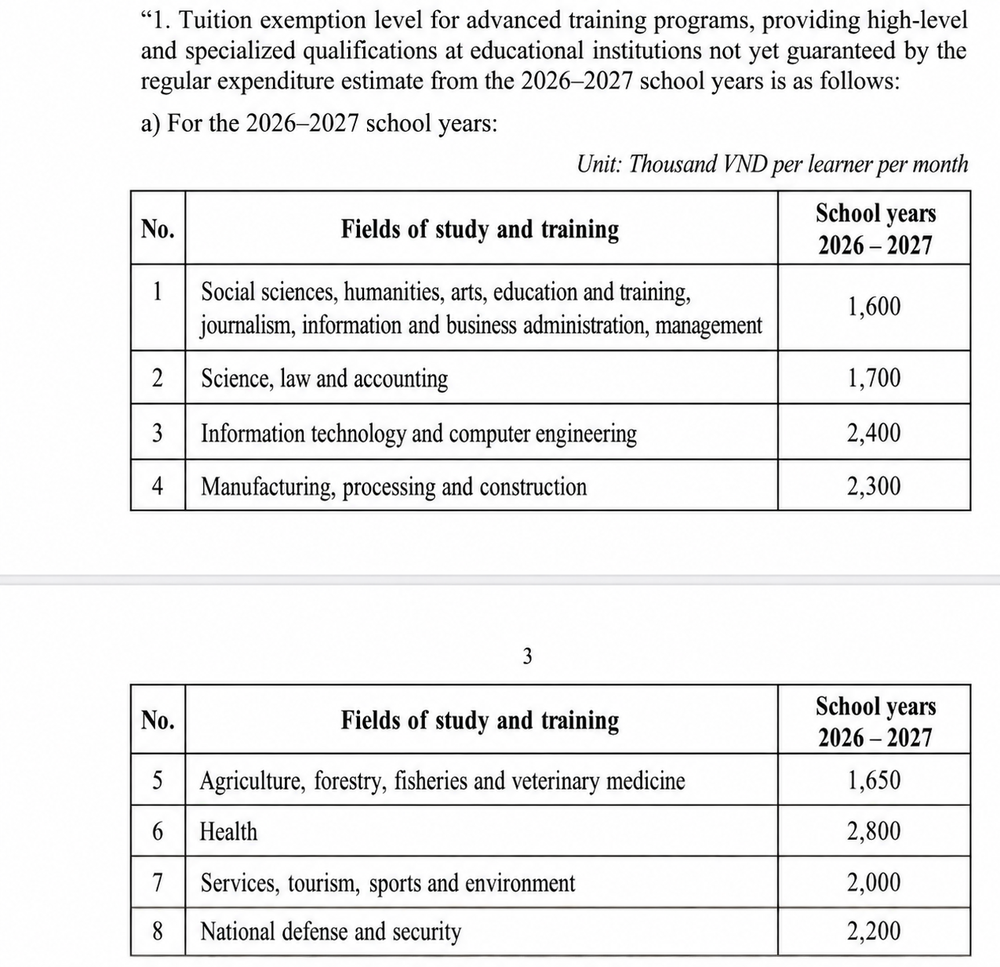
The tuition fee ceilings for vocational secondary education programs at public educational institutions from the 2026–2027 academic year onwards are set as follows:
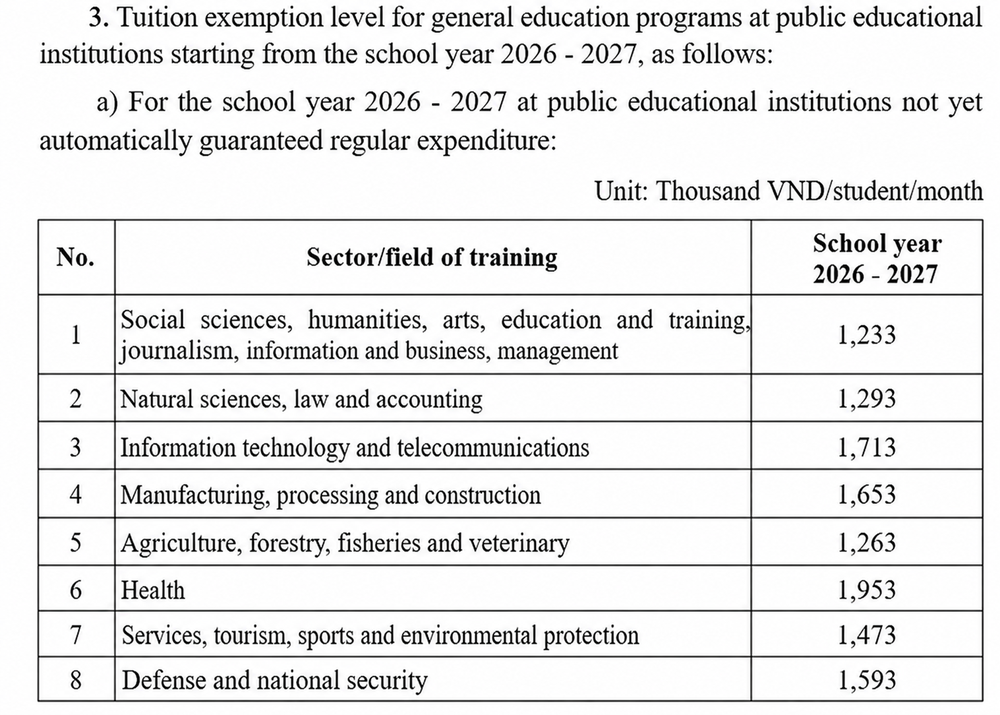
The draft also stipulates the tuition fee ceilings for public higher education institutions that do not yet cover their own recurrent expenditures, applicable from the 2026–2027 academic year onwards, as follows:
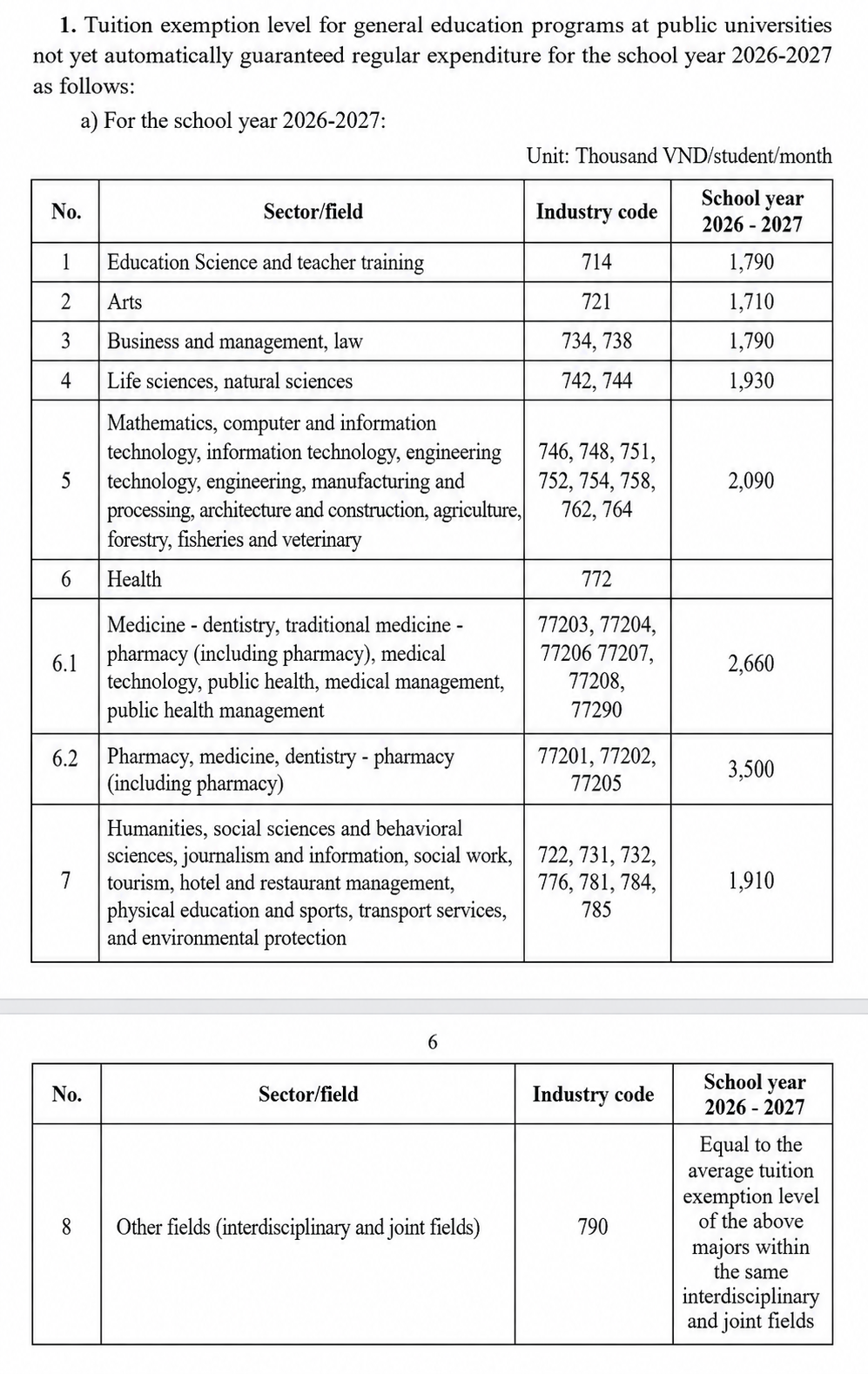
Tuition fee ceilings for master's and doctoral programs at public higher education institutions are determined by multiplying the undergraduate tuition fee ceiling by a factor of 1.5 for master's programs and 2.5 for doctoral programs, corresponding to specific fields of study and levels of institutional autonomy for each academic year.
From the 2027–2028 academic year onwards, tuition fee ceilings shall be adjusted in accordance with the public's ability to pay and socio-economic conditions; however, the adjustment must not exceed the rate of increase in the Consumer Price Index (CPI) as announced by competent state authorities at the time the tuition fee is determined compared to the same period of the previous year.
Based on the prescribed tuition framework, provincial and municipal people’s committees will submit proposals to their respective people’s councils to set tuition rates at public educational institutions, compensation levels for tuition exemptions and reductions, and tuition support for children and students attending people-founded institutions and private educational institutions. Such support must not exceed the tuition fees charged by the respective people-founded institutions or private institutions.