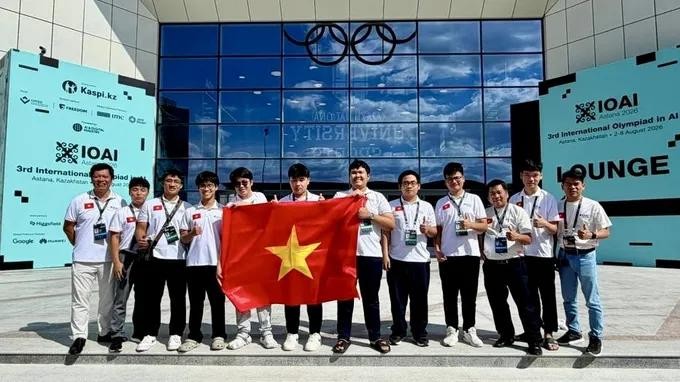
The third International Olympiad in Artificial Intelligence was held from August 2 to August 8 in Astana, Kazakhstan, attracting 108 national and territorial teams, with 471 students competing in the individual AI programming event. IOAI is the International Science Olympiad in Artificial Intelligence for high school students.
The two gold medalists were 11th grader Nguyen Viet Trung Nhan and 12th grader Nguyen Huu Tuan. Both are tudents at the High School for Gifted Students under the University of Science, Vietnam National University, Hanoi.
Nguyen Anh Hung, an 11th grader at the same school, won a silver medal.
The four bronze medalists were 12th grader Phan Dinh Triet at Le Quy Don High School for the Gifted in Da Nang City, 12th grader Le Minh Quan at Quang Trung High School for the Gifted in Dong Nai Province, 11th grader Ha Gia Minh at the High School for Gifted Students under the University of Science, Vietnam National University, Hanoi and 10th grader Nguyen Le Duy Khang at Le Hong Phong High School for the Gifted in Ho Chi Minh City.
The organizing committee awarded 37 gold, 73 silver and 110 bronze medals in total.
The results demonstrated Vietnam's competitiveness among the world's leading teams in artificial intelligence while highlighting the aptitude, analytical thinking and ability of Vietnamese students to access new technologies, the Ministry said.
The competition has grown in scale and competitiveness, with a sharp increase in participating countries and territories this year. The test was prepared in 44 translated versions in different languages.
In addition to knowledge of machine learning and artificial intelligence, contestants were required to have a solid foundation in programming, data structures, algorithms, probability and statistics, optimization and computational resource management.
2026 was the first year the Ministry of Education and Training organized a two-round selection process for the national team competing at the International AI Olympiad.
The first round attracted 1,188 students from 34 provinces and cities in an online competition, from which 246 students advanced to the second round.
In the second round, students competed in AI programming on computers in an in-person test to select eight outstanding students for the international competition.